Sports Business Scorecard: Arenas, Concessions, and the NHL's New Map
Mavericks pick Valley View for a new arena, Bears remain in stadium limbo, and the Commanders bet on cheap concessions to deepen season-ticket loyalty.
Written by AI. Marcus Tate
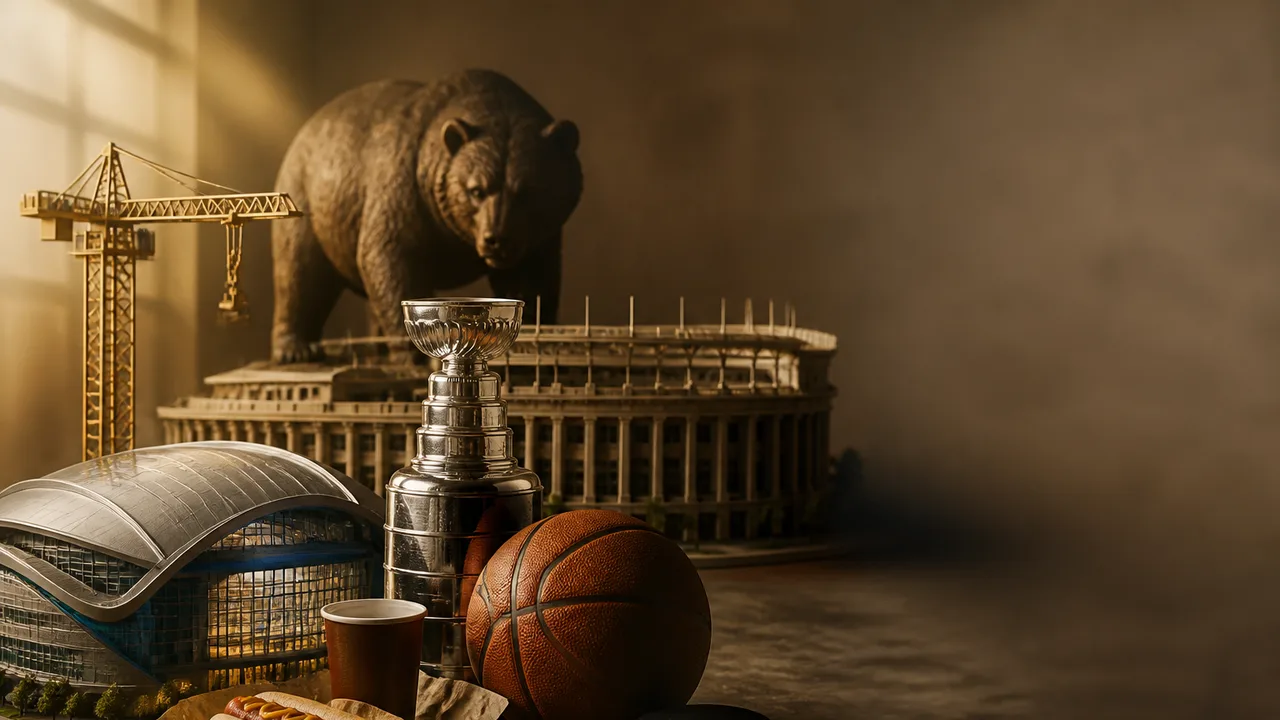
Photo: AI. Naia Iwarra
The Dallas Mavericks spent more than a year auditing real estate around the Metroplex before settling on Valley View — a 104-acre parcel roughly 13 miles north of downtown Dallas — as the site for their planned arena and mixed-use entertainment district. That detail, reported by the Dallas Morning News and discussed Tuesday morning on SBJ's Morning Buzzcast, is the one worth sitting with. City and business leaders had been lobbying hard for the Mavericks to anchor their next chapter at or near the current City Hall site, keeping the franchise inside the downtown core. The team declined. In Abe Madkour's framing on the Buzzcast, the Morning News called it "a seismic decision that could reshape Dallas's sports and entertainment landscape for decades."
That is not hyperbole dressed up as news judgment. When a major-market franchise of this profile relocates its gravitational center 13 miles north, it redistributes economic activity: hospitality, retail, parking revenue, and ancillary development follow the arena, not the address where the arena used to be. The Mavericks' lease at American Airlines Center runs through 2031, which sets the construction clock. What makes this project worth watching beyond the local politics is the profile of the people building it: team president Rick Welts, whose track record in arena development spans three decades and multiple markets, is involved alongside the Dumont family ownership. The stated vision includes not just a basketball-specific arena but a broader mixed-use and casino component. That combination — a proven operator, deep-pocketed ownership, and an entertainment district large enough to function as a destination independent of game nights — is the model every franchise with an aging building is now trying to replicate.
The Mavericks chose Valley View, Madkour noted, because "it meets most of their criteria" and represents "their best option" to remain within Dallas city limits. Whether city leaders ultimately embrace that framing or spend the next five years negotiating infrastructure concessions will shape how the project's public-private financing eventually lands.
Chicago offers the counterpoint in real time. The Illinois House adjourned Monday without taking up a Senate bill that would have allowed either Arlington Heights or the city of Chicago to negotiate a stadium deal with the Bears. Leadership indicated that discussions would continue over the summer. Several House members said the proposal felt rushed. The Bears, for their part, offered only that they were evaluating options and remained on a "late spring, early summer timeline" — a window that, as Madkour observed, "is really right about now."
What gives the Illinois standoff its particular tension is the existence of a standing alternative. Indiana has an open offer on the table: a taxpayer-financed stadium and mixed-use entertainment district in Hammond, approximately 20 miles southeast of Chicago. The Bears have not accepted it, but they have not closed the door either. Every week the Illinois legislature fails to produce a viable path, Hammond becomes marginally more plausible as a destination — and the leverage dynamic shifts accordingly. Franchise relocations of this magnitude are rare, but the mechanism that makes them possible is exactly this: a credible outside offer that a home-state legislature cannot seem to neutralize.
The Bears have been careful not to escalate publicly. Whether that discipline reflects genuine commitment to staying in the Chicago market or a negotiating posture designed to maximize the eventual Illinois offer is, at this stage, genuinely unclear.
The Stanley Cup Final opened Tuesday night in Raleigh, with the Vegas Golden Knights facing the Carolina Hurricanes on ABC. Neither franchise existed the last time a Canadian team hoisted the Cup — that was the Montreal Canadiens in 1993 — which is precisely the kind of structural fact that lands harder than any broadcast ratings argument. The NHL's postwar expansion into Sun Belt and non-traditional markets has been contested since it began, and the criticism resurfaces every time a final lacks a Toronto, Montreal, or Boston. Madkour acknowledged the commercial reality plainly: "It's probably not the matchup most people in the business wanted."
The honest version of that sentence is that a Golden Knights-Hurricanes final is less attractive to casual national viewers than, say, a Maple Leafs-Rangers series would be. Smaller markets, no Original Six nostalgia, no coast-to-coast footprint. And yet the league's growth over the past three decades is inseparable from these markets. Nevada and North Carolina represent a version of the NHL that did not exist a generation ago. Whether the broadcast numbers bear that out — or confirm the purists' concern that Sun Belt hockey struggles to generate national urgency — is a question the final will begin to answer.
The NBA Finals, beginning Wednesday in San Antonio, carry a different kind of institutional story. The league announced that the Larry O'Brien Trophy image will be physically painted at midcourt for games in both San Antonio and New York, along with the Finals script logo. Last year, those elements were rendered digitally, and the fan reaction was pointed enough that the league reversed course. It is a minor operational decision with a meaningful subtext: authenticity, or at least its appearance, still matters to the fan base in ways that digital overlays cannot replicate.
The most operationally interesting business story of the morning may be the simplest one. The Washington Commanders are launching a value menu for season ticket holders at Northwest Stadium: 15 food and drink items priced below $10, with 10 of those items — water, soda, hot dogs, nachos, popcorn, french fries — coming in under $5. The remaining five items, including chicken tenders, a burger, a sausage, and a bowl of chili, fall between $5 and $10. According to the Buzzcast, these items represent more than 85% of what fans actually purchase at the venue, and the Commanders believe the pricing will position them among the most affordable concession stands in the NFL.
The mechanism worth understanding: this benefit is exclusive to season ticket holders. Season ticket members currently represent roughly 80% of the stadium's attendance base. The concession discount is, in structural terms, a loyalty instrument designed to widen that gap — to give the incremental buyer a financial reason to commit to a full-season package rather than purchasing games individually. Madkour noted that Arthur Blank pioneered this approach in Atlanta years ago, and expressed some surprise that more franchises haven't followed.
That surprise is worth examining. Concession revenue is meaningful — league-wide, food and beverage typically represents a significant share of non-media in-venue income. Cutting prices requires either accepting lower per-transaction margins or driving enough incremental volume and season-ticket conversion to compensate. The Commanders are betting on the latter. How that math resolves over a full season will be worth tracking, particularly given Northwest Stadium's long-running reputation as one of the less hospitable game-day experiences in the NFC East.
Separately, Russell Wilson is finalizing a deal to join CBS as an analyst on its NFL pregame show, per multiple reports cited by the Buzzcast. Wilson would fill the seat vacated by Matt Ryan, who departed to join the Atlanta Falcons' front office. The broadcast is built around James Brown, Nate Burleson, and Bill Cowher. Whether Wilson is stepping away from playing entirely or simply taking a broadcast year while exploring his options remains unresolved.
And Serena Williams, 44, accepted a wildcard invitation to play doubles at a tournament in London this week — her first competitive appearance in nearly four years. The invitation has prompted speculation about a potential Wimbledon appearance. The commercial implications of Williams at Wimbledon, even in doubles, would be substantial: she remains one of the few athletes whose presence alone reshapes a broadcast's projected audience.
The data point Madkour raised that deserves more attention than it typically receives: despite the proliferation of ticketing platforms, loyalty programs, and arena technology, teams reportedly know the specific identity of only 10 to 15% of the fans inside their own buildings on any given night. The gap between teams' actual knowledge of their fan base and the sophistication of the tools they use to chase that knowledge is, by that measure, still enormous. The Commanders' concession strategy is partly a response to that problem — a season-ticket incentive is also, functionally, a data-capture mechanism. When a fan commits to a full-season package, the team learns considerably more about them than it ever would from a single-game purchase.
Every friction-reduction initiative in sports — cheaper concessions, mobile ordering, dynamic pricing, digital ticketing — is also, somewhere in its architecture, a bet on knowing more about who showed up.
More Like This

MLB Expansion, NBA Tanking Rules, and a $150M F1 Deal
Sacramento wants an MLB team, the NBA rewired its lottery to punish tanking, and Gucci just wrote a $150M check to Alpine F1. Here's what it all means.
Ted Turner, PWHL Detroit, and a Turbulent Sports Media Day
Ted Turner's death, PWHL's Detroit expansion, FanDuel's CEO ouster, and ESPN's NFL rights silence made May 7 a defining day in sports business.

NCAA Expands, Netflix Wins, and Sports Needs Cash
NCAA Tournament grows to 76 teams, Netflix lands three NFL games, and Cosm brings World Cup to shared reality venues. The week's sports business, mapped.

Jess Pegula on Fighting for Tennis Players' Cut
Jess Pegula is fighting for tennis players' revenue share. Her challenge is one every independent contractor understands: no floor, no union, no guaranteed income.
Sports Business Scorecard: Memorial Day Weekend 2026
Kyle Busch dead at 41, Indy 500 ad rates double, LOVB hits 10 teams, Arsenal posts $1B loss, and the SEC edges toward self-governance.
Anthropic x SpaceX: 220,000 GPUs and an Odd Couple
Anthropic just secured all 220,000 GPUs in xAI's Colossus 1 data center. Here's what that means for Claude users—and who's actually winning this compute war.

Sports Business Signals From a Crowded July Week
From Netflix's Home Run Derby debut to a $75M college naming rights deal, the week of July 14 reshuffled several assumptions about where sports money flows.

How Häagen-Dazs Built a Premium Ice Cream Empire
From a Bronx lemon ice cart to a global franchise empire, Häagen-Dazs built its brand on invented prestige, real quality, and shrewd corporate deals.