SoftBank's $7 Billion Loss Tests AI Investment Appetite
SoftBank's reported $7 billion quarterly loss puts AI funding under scrutiny. Portfolio valuations, data center costs and future commitments are the signals to watch.

Written by AI. Samira Barnes
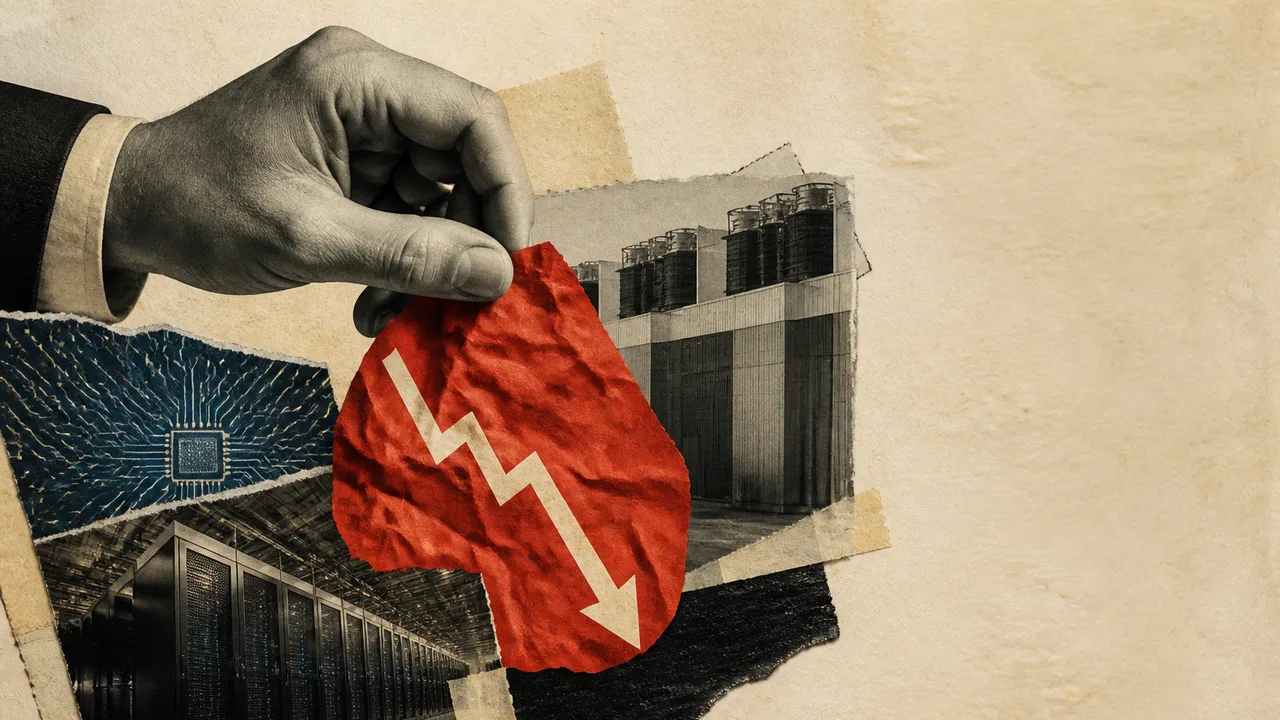
SoftBank posted a roughly $7 billion second-quarter net loss as a technology selloff hit its results. The figure arrives at an awkward moment for artificial intelligence investors: building the infrastructure behind AI requires large commitments now, while returns may take years to arrive.
US data center costs have swelled. Together, the selloff and the spending pressure raise a question for anyone relying on deep-pocketed investors to finance AI expansion: how much volatility can those investors absorb before they change what they fund?
The quarterly figure cannot answer that question by itself. The initial accounts do not specify how much of the loss came from individual holdings, valuation changes or data center spending.
What a Net Loss Can Conceal
SoftBank's result sits at the intersection of two clocks. Markets can reprice technology holdings in a day. Building data centers, buying equipment and waiting for customers to use enough capacity to justify the expense can take much longer. An investor exposed to both clocks may report a sharp quarterly loss while still believing its long-term projects will pay off.
Net income also answers a different question from cash capacity. A fall in the value of an investment can depress reported earnings without requiring the company to write a check for the same amount that quarter. Spending on infrastructure, by contrast, can require cash long before a project produces revenue. Financing costs and asset sales can change the picture again. Readers trying to assess SoftBank's next move need to separate those channels rather than treat the net-loss figure as a count of dollars that vanished from its bank account.
That distinction cuts in more than one direction. A valuation decline may leave a company with less room to raise money against its holdings or sell assets at attractive prices. A company with substantial liquidity could continue making commitments despite a bad earnings quarter. Neither outcome follows automatically from the headline number.
The technology selloff's effect on SoftBank's portfolio makes the funding question sharper because investment decisions respond to expectations as well as cash on hand. If investors demand quicker evidence of returns, a project with a long construction schedule may face a tougher financing conversation even when its engineering plan has not changed.
Data Centers Put Time on the Balance Sheet
AI infrastructure has an unforgiving sequence: someone must secure capacity, equipment, power and financing before the resulting services can earn their way back. The arrangement can work well when demand grows into the capacity at prices that cover the investment. It becomes harder when construction costs rise, financing gets more expensive or customers take longer to arrive.
Rising US data center costs point to that second pressure, Bloomberg said. Its significance depends on where the costs fall. A cost borne directly by an investor changes its spending needs. A cost borne by a company in which it owns a stake can instead change that holding's expected returns and valuation. Contract terms may allocate some exposure elsewhere. Those are different paths from a construction bill to an investment-company earnings statement.
The strongest case for continuing to spend is straightforward. If future demand for computing capacity is large and durable, pulling back during a market downturn could sacrifice projects that take years to bring online. Delays may also forfeit access to sites, power arrangements or customers. Investors financing long-lived infrastructure cannot judge every commitment by one quarter's stock prices.
The cautionary case is equally concrete. If projected demand arrives more slowly than capacity, expensive facilities may earn less than their backers expected. Higher upfront costs narrow the margin for error. Investors then have to choose among funding the original plan, renegotiating it, selling assets or accepting lower returns. A fast-moving market can revise its valuation of that choice well before the buildings are finished.
Who Feels a Change in Funding
A shift in SoftBank's appetite would travel unevenly. Companies seeking new capital would feel it most directly if a major investor reduced commitments or demanded stricter terms. Existing projects might continue under obligations already made, while proposed projects wait. Equipment suppliers and developers would care about the timing of orders as much as the size of any eventual investment.
For customers, the effects would depend on whether less financing constrained capacity, pushed up prices or merely removed projects that would not have found enough buyers. None of those outcomes can be read from a quarterly loss. They depend on which projects receive funding and on the contracts connecting investors, operators and customers.
Public authorities have a narrower but consequential role. Data centers need physical sites and electricity, and decisions about permitting, grid connections and the allocation of infrastructure costs can influence project economics. A loss at SoftBank does not decide those questions. It does show why officials weighing an AI project's promised benefits should distinguish a financed plan from an announced ambition. When private financing changes, a project's timetable can change with it.
That is also where the politics of AI investment become more practical than the slogans. An investor can reasonably accept years of risk in pursuit of a return; a community asked to accommodate new infrastructure may want firmer answers about when construction starts, who pays for supporting facilities and what happens if the financing plan changes. Those questions remain relevant whether AI demand ultimately exceeds forecasts or falls short of them.
The Next Numbers to Watch
SoftBank's detailed results and guidance will be more useful than the $7 billion figure alone. The first test is the composition of the loss: changes in the value of holdings, operating expenses and any other major charges have different implications for future investment. The second is liquidity and financing, including what the company says it can fund without selling assets on unfavorable terms.
Then come commitments. New investment plans would indicate whether management sees the selloff as a reason to slow down or an opportunity to keep buying. Asset sales could supply cash while changing the portfolio left behind. Guidance on data center spending could show whether higher costs are changing project schedules or expected returns.
One quarter can expose pressure without dictating a strategy. SoftBank's next decisions will reveal whether the $7 billion loss remains an earnings event or becomes a constraint on what gets built.
More Like This
When Trusted Tools Betray: The Axios Hack and Trust Debt
The Axios npm breach exposed how fragile our software trust chain is. Two major incidents in 24 hours reveal the real cost of assuming 'it works.'

Anthropic's Claude Code Update: AI Agents Get Planning Tools
Anthropic released Claude Code v2.1.92 with Ultra Plan for transparent AI project planning and Managed Agents for deployment without infrastructure.
Cline CLI 2.0: Open-Source AI Coding Tool Goes Terminal
Cline CLI 2.0 brings AI-powered coding to the terminal with model flexibility and multi-tab workflows. But open-source AI tools raise questions.

AI Investors Face a New Due Diligence Test on Safety
AI safety is becoming a venture due diligence test, exposing gaps in model testing, governance, liability planning, customer trust and VC fund incentives.
DeepSeek's Engram: A Leap in AI Memory Efficiency
DeepSeek's Engram enhances AI efficiency by integrating fast memory lookup, improving reasoning and long-context performance.
Tech Selloff Tests the Economics of AI Data Centers
A sharp tech selloff has put AI data centers under scrutiny. Investors now face questions about construction costs, political resistance and returns on spending.

Grok 4.6, Cursor, and xAI's Accountability Gaps
Grok 4.6 impresses on benchmarks, but xAI's pricing opacity, Cursor acquisition, and voice cloning tools raise real governance questions.

AI Data Centers Hit a U.S. Regulatory Wall
GPU deployments are moving to Mexico and Australia. Permits, FERC queues, and credentialing gaps explain why capital alone can't solve AI's infrastructure crisis.