Samsung Brings Private 5G Into Hana Financial's Office
Samsung's private 5G network at Hana Financial promises secure, low-latency connectivity, but its edge AI role and performance remain undefined so far.

Written by AI. Marcus Chen-Ramirez
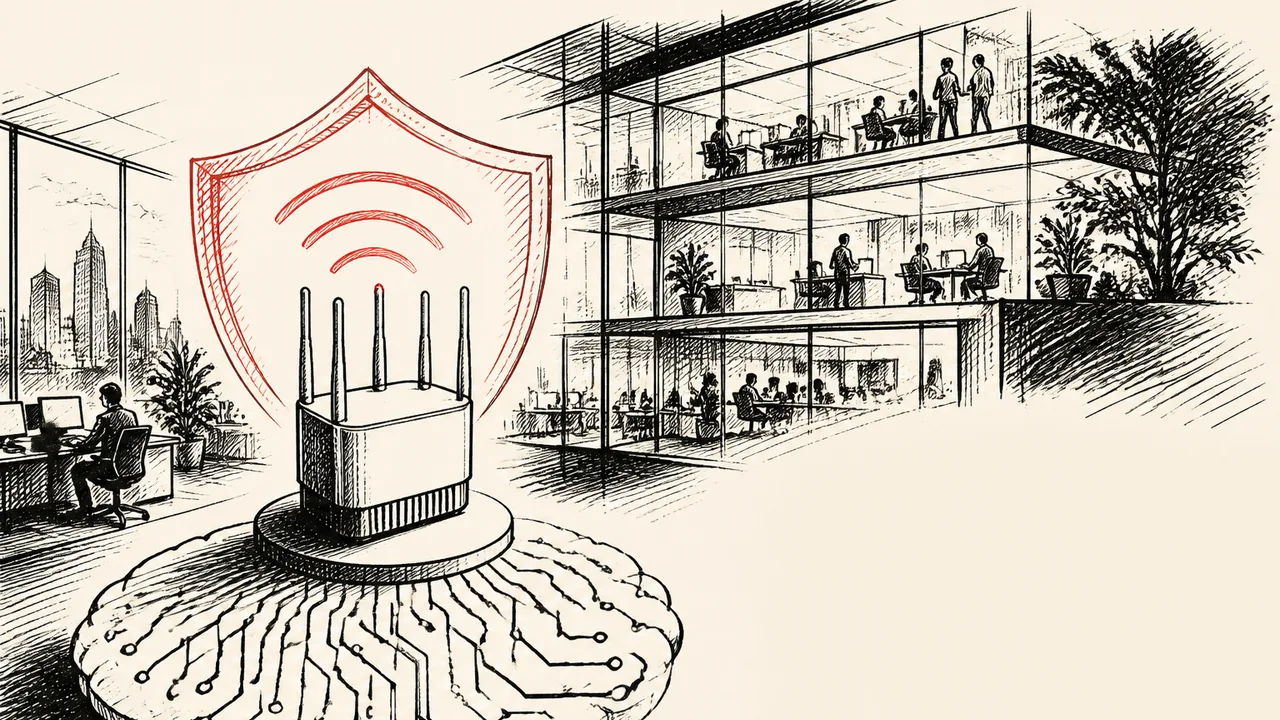
Samsung, SK Telecom and Hana Financial Group have built a private 5G network at Hana Financial's new headquarters in Incheon, South Korea. The companies describe it as the country's first private 5G smart office in the financial sector, a narrow but potentially instructive milestone for enterprises deciding how much of their digital infrastructure should remain under local control.
The deployment covers 16 floors and serves thousands of employees across the financial group, according to Sammy Fans' account of the project. Samsung supplied the end-to-end private 5G technology, while SK Telecom participated in building the service. Private LTE and 5G reports that Samsung was the sole private-network equipment vendor.
Those details establish the deployment's scale in floors and employees. They leave several engineering questions unanswered. The published material provides no bandwidth figures, latency targets, device count, traffic volume or service-level guarantees. It also names no artificial intelligence model running inside the building.
That gap puts the AI claim in its proper box. Hana Financial now has connectivity that could support local AI systems, but the public record does not show an operational edge-AI deployment.
What Private 5G Changes Inside an Office
A private 5G network gives an organization a cellular system intended for its own users, devices and sites. Depending on the design, the enterprise can control authentication, traffic policies, network segmentation and parts of the cellular core. Data can travel between devices and local computing resources without every interaction crossing the public internet or a distant cloud region.
For a financial institution, speed may rank alongside less glamorous requirements: predictable coverage, device identity, traffic isolation and administrative control. Banking offices handle customer information, employee credentials and communications among systems with sharply different risk profiles. A visitor's phone, an employee tablet and a building sensor should not receive the same access simply because all three can find an antenna.
Private cellular technology can assign devices to separate policies and use SIM-based credentials to identify them. It can also preserve connections as employees move between coverage zones, an advantage for mobile devices in a large headquarters. Wi-Fi can provide strong performance and sophisticated security too, often with lower device and operating costs. The practical comparison depends on building layout, device support, spectrum arrangements and the expertise available to run each network.
Private 5G therefore enters an office as another managed infrastructure layer, rather than an automatic replacement for Wi-Fi. Enterprises may use cellular service for devices that need consistent mobility or controlled access while keeping conventional office traffic on wireless LANs. The resulting architecture can be more capable and more complicated, two qualities enterprise technology regularly ships in the same box.
The AI Foundation Has yet to Acquire an AI Workload
In Samsung's announcement, the company says the network provides a foundation for enterprise AI transformation while satisfying the financial industry's security requirements. That wording describes future capacity. It does not identify an inference server, workplace assistant, computer-vision application or automated decision system operating on the network.
The potential connection to AI is straightforward. Many workplace AI applications depend on moving data from sensors, cameras, computers or mobile devices to processors that can analyze it. A local network with controlled access and low latency can send those inputs to servers inside the office, receive an inference result and avoid routing every request through a public cloud.
Possible uses include document processing, building management, security monitoring and employee tools that retrieve internal information. Each example brings its own governance questions. A model analyzing occupancy sensors presents a different privacy profile from one processing customer records or employee communications. Network locality can reduce data exposure in transit, but it does not establish whether a model has appropriate access, retains inputs or produces reliable results.
As techbuzz.ai observed in framing the deployment, low-latency controlled networks are increasingly positioned as infrastructure for connected workplaces and edge inference. The positioning is credible at an architectural level. The Hana project offers too little performance or workload data to demonstrate the claim at an operational level.
The missing figures include the ones that would allow comparison. What round-trip latency does the network achieve under load? How much traffic remains within the building? What happens during a component failure? How many devices can connect concurrently, and what portion of them require 5G rather than Wi-Fi? Without those answers, the deployment can be assessed as a substantial office network, while its AI impact remains prospective.
Local Control Does Not Settle Security
Private infrastructure can give Hana Financial more authority over where traffic flows and how devices connect. It can also reduce dependence on public connectivity for local operations. Neither feature makes the system secure by default.
A private 5G environment still contains radios, network software, management consoles, credentials, connected devices and administrators. Each component creates maintenance duties and potential failure points. Software needs patches. Credentials need lifecycle management. Devices can be misconfigured. Administrators can grant excessive access. Local processing keeps some data closer to its source, yet a compromised local server remains compromised at a shorter distance.
Vendor concentration adds another consideration. Samsung's end-to-end role may simplify integration and accountability because fewer suppliers must coordinate the cellular stack. It may also increase switching costs if Hana later wants to replace equipment, management software or support services. The available reports disclose neither contract terms nor interoperability provisions, so any judgment about lock-in would be premature.
Cloud services involve a parallel trade-off. Major providers can offer extensive security tooling, global redundancy and teams dedicated to maintaining infrastructure. They also place sensitive operations within an external provider's technical and contractual domain. A hybrid design can divide workloads according to risk, performance and cost, keeping some processing on-site while sending other jobs to cloud systems.
Private 5G gives an institution another place to draw that boundary. It does not draw the boundary on the institution's behalf.
The Business Case Will Need More than Coverage
The strongest case for Hana's deployment rests on control and operational consistency. A financial group occupying 16 floors may value continuous mobile connectivity, centralized device policies and the ability to separate traffic among employees, equipment and future smart-office services. If the network later supports local inference, the same infrastructure could carry data between workplace devices and on-site computing systems.
Costs sit on the other side of the ledger. Private cellular networks require equipment, spectrum access, integration, monitoring and staff or contractors who understand telecom systems. Compatible devices may cost more or offer fewer choices than their Wi-Fi counterparts. An enterprise also has to decide whether the applications justify a dedicated network or merely look impressive in a headquarters tour.
Hana, Samsung and SK Telecom can clarify that business case through operational disclosures. Useful evidence would include uptime, handoff performance, application response times, device totals, security architecture and the share of traffic processed locally. An identified AI workload would allow readers to examine what data it consumes, where inference occurs and whether private 5G improves the result.
Until then, Hana Financial's network marks a credible expansion of private cellular service into a tightly regulated workplace. Its clearest achievement is bringing a controlled 5G layer across 16 floors. Whether that layer becomes AI infrastructure will depend on what eventually runs over it, not the acronym printed on the access point.
More Like This

Google's Open Knowledge Format for AI Agents
Google's Open Knowledge Format promises to fix how AI agents navigate knowledge bases. Here's what it actually does, what it doesn't, and why the structure matters more than the tool.

Claude Marketing Skills Ranked by GitHub Stars (2026)
Which Claude Code marketing skill repos actually earn their stars? We map the top packages—from CRO to paid media—and ask what GitHub popularity really measures.
Karpathy's Obsidian Setup Challenges RAG Orthodoxy
Andrej Karpathy's markdown-based knowledge system questions whether most developers actually need traditional RAG systems at all.
Tech Career Decisions: What to Know Before 2026
Marina Wyss breaks down seven tech roles—from software engineering to applied science—through a decision tree based on personality, not just skills.

Needle 2 Is a 45M Parameter Model Built for Edge Devices
Needle 2 runs on 28MB of RAM as a 14MB binary. Here's what it actually does, what it can't do, and why that distinction matters.
Nvidia Cosmos 3 Edge Brings AI Inference to Robots
Nvidia's Cosmos 3 Edge runs AI directly inside robots and cameras—no cloud required. Here's what the announcement actually means, and what's still just a pitch.

Gemini Nano Gets Faster on Pixel Without Retraining
Google's frozen Multi-Token Prediction retrofits speed gains onto existing Gemini Nano models—no retraining needed. Here's what that means for on-device AI.

AI Detects Hidden Seismic Patterns Before Earthquakes
A new study from GFZ Helmholtz used unsupervised AI to find behavioral patterns in small earthquakes before major ones—a step toward smarter forecasting.