Sam Altman Says AI Is Moving Slower Than He Thought
Sam Altman admits AI adoption is slower than expected. The Moonshots panel breaks down what that means for Anthropic, Nvidia, Grokbot, and China's AI surge.

Written by AI. Yuki Okonkwo
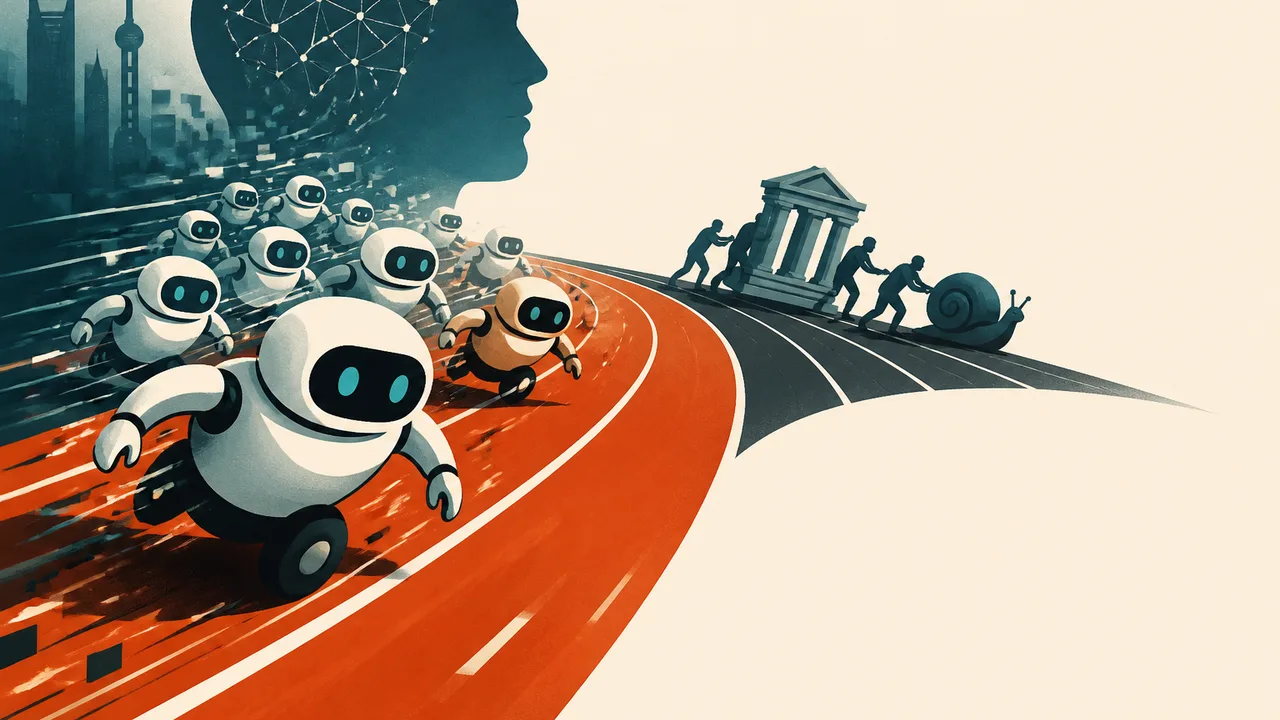
Photo: AI. Mika Sørensen
Sam Altman went on video recently to say something that takes a particular kind of confidence to admit out loud: he was wrong.
Not about the technology. About the timeline. About how fast the world would actually use the technology once it existed. "The economy just has so much inertia," Altman said. "People keep doing the same things they're doing... I think it means we've all been too ambitious on timelines even with this incredible technology."
This landed as the central provocation in the latest Moonshots with Peter Diamandis episode, a sprawling two-plus hour session with Emad Mostaque (founder of Intelligent Internet), Alexander Wissner-Gross, Dave Blundin, and Salim Ismail. The conversation covered AI agent swarms, Nvidia's open-source bet, Anthropic's IPO dilemma, and why Chinese models are quietly eating everyone's lunch. What emerged wasn't a unified take — it was five smart people disagreeing productively about the shape of the thing we're all inside.
The slowdown that isn't really a slowdown
Altman's mea culpa got the sharpest response from Wissner-Gross, who pushed back on the diagnosis even while agreeing with the symptom. His argument: societal inertia isn't the villain here — abstraction layers are. When you swap an internal combustion engine for an electric one, the driver still sees a steering wheel and pedals. "One abstraction layer down, there's total step function in the technology," he said, "but you go up a layer, it's still a car with a recognizable steering wheel."
The implication is actually more optimistic — or more actionable — than Altman's framing. If the slowdown is a structural artifact of how technology gets layered into existing interfaces, then the fix isn't waiting for society to catch up. It's vertical integration: own more of the stack, erase the gaps between layers, and you can move faster. Wissner-Gross was fairly explicit that if OpenAI wants to see transformative progress, leasing data centers instead of owning them is exactly the wrong direction.
Mostaque offered a third reading. His position: the models genuinely weren't good enough until recently, so the slow diffusion isn't mysterious. "Here's the reality," he said. "The models weren't good enough until a few months ago. The code they were writing was garbage a year ago." The implication being that what looks like societal resistance is partly just the market rationally waiting for something worth adopting.
Blundin's take was less charitable to the messaging. He noted that Altman's house has been firebombed, that OpenAI's offices now require armed security, and that the AI-is-disrupting-everything narrative has frightened far more people than it's galvanized. "Now they're going to start picking and choosing their words a lot more carefully," he said, suggesting the slowdown talk is partly strategic — pre-IPO, pre-regulatory-battle optics management.
All four readings are plausible. None of them fully cancel the others out.
Grokbot and the agent moment
The episode's most practically interesting segment was on Grokbot, xAI's entry into the agentic AI space, which launched in early beta in August. The idea: each bot gets its own dedicated cloud computer with a browser and terminal, and you message it like a colleague rather than a chatbot. A "chief of staff" agent coordinates specialists beneath it. Multiple bots run in parallel, message each other, and only surface to you when they need a judgment call.
Mostaque arrived with receipts — he's running 18 Grokbots in a swarm, with some controlling physical machines including a MacBook M4 Max and a range of subscriptions. One bot, he said, is an art collective called Atelier that generates daily work. "Every day it goes through its pieces and comes up with its main one," he said. "I just don't know if I understand art."
Wissner-Gross threw cold water on the interface design specifically, not the concept. His argument: if agent fleets are going to scale to millions, the WhatsApp-style management pane — where a human scrolls through bot conversations — is "vaudeville." The only scalable manager for agents at that scale is other agents. "We'll look at this like the vaudeville era of agents," he said, "and say this was a naive attempt to graft human organizational structures onto humans managing agents."
Ismail agreed on the interface point but made the counterargument that matters for adoption: this is what humans are actually ready for right now. Familiar interfaces lower the barrier to entry. The architecture can evolve once people have internalized what agents even are.
Both positions are coherent. The tension between "this is the on-ramp" and "this on-ramp leads the wrong way" is real, and worth sitting with.
Nvidia's open-source move and the vertical integration thesis
According to Yahoo Finance, Nvidia agreed to pay Poolside $6 billion in a licensing deal and tapped the startup's staff — a move the panel read as Nvidia's play to dominate the open-source model layer the way it already dominates chips. Poolside, founded by the former CTO of GitHub, had originally tried to raise $2 billion for a Blackwell cluster, couldn't, and ended up in Nvidia's orbit instead. The panel noted that Wissner-Gross flagged a wrinkle: the remaining Poolside entity — the part that didn't transfer to Nvidia — is, according to Wissner-Gross, building a 1.2-gigawatt data center, a claim corroborated by a Forbes report on the West Texas data center project.
Mostaque's read on the Nvidia deal: this is the beginning of a full open-source stack play. Companies like Mistral and Cohere, he suggested, will stop building independent open-source models and start building to the Nvidia reference design. Wissner-Gross flagged that the "hackquire" structure — licensing IP rather than formally acquiring — is partly about navigating the FTC's statutory review timelines, which in AI time represent a competitive eternity.
The underlying dynamic: every major AI company is trying to own more of the stack simultaneously. OpenAI is designing chips. Anthropic wants enterprise infra. Nvidia is now in the model business. The race isn't just between models anymore. It's between integrated platforms.
The Anthropic squeeze
Possibly the most complicated story in this episode involves Anthropic — pulled in several directions at once in a way that's hard to resolve cleanly.
The Financial Times reported that Claude 5 (referred to on the panel as "Fable 5") has plateaued in enterprise uptake. The panel's consensus diagnosis: it's not a quality problem. It's a price problem and a data sovereignty problem. Anthropic's previous policy required enterprise data to route back to Anthropic's servers for a 30-day review window, even when deployed on third-party infrastructure like Amazon Bedrock. Corporations with sensitive IP found that unacceptable. The week of the episode's recording, Anthropic reversed this policy — enterprises can now keep data on their own cloud infrastructure.
The timing wasn't subtle. An IPO is reportedly weeks away.
Mostaque argued Anthropic shouldn't IPO at all. His position: if you're genuinely in the late stages of building AGI, the right move is a massive private raise — he cited OpenAI's $120 billion round as the model — and a straight shot at the objective. IPO mechanics, quarterly reporting, and public market optics are structurally at odds with that mission. "I can see no reason for that [IPO] unless they can't raise it privately," he said, "which I think they can."
Blundin offered the counterargument: Palantir's Alex Karp had publicly shredded Dario Amodei's credibility as an operator. Backing down from the IPO now would validate Karp's critique in the worst possible way, and Anthropic's venture backers — who've marked up their positions to enormous valuations — aren't sitting quietly while Dario rethinks his timeline.
Wissner-Gross added a structural angle: the IPO race between xAI, OpenAI, and Anthropic has a competitive element independent of capital needs. The window for a favorable IPO market might not stay open. If you're going to go, the argument for going now isn't irrational.
Artificial Analysis confirmed that Gemini 3.7 Flash has been notably strong on the intelligence-versus-time-per-task Pareto frontier — a finding the panel used to kick off their Google discussion. Wissner-Gross's read: the result reflects overoptimization for the specific benchmark's reward function (reliability across five attempts, no time penalty for stochasticity), not a sign that Google has caught the capability frontier. Mostaque's take was blunter — institutional malaise, talent attrition, and an inability to do the rational thing (copy what the Chinese labs have already proven works at a fraction of Google's resource cost) has left the company underperforming its own advantages.
The China question nobody wants to answer directly
Running underneath all of this is the Chinese model story, which the panel treated less as a geopolitical abstraction and more as a live business reality. The panel discussed Moonshot AI's Kimi Linear architecture — which reportedly cuts context memory usage by 75% while delivering substantially faster decoding — as one example of Chinese labs continuing to solve the problems Western labs are also trying to solve, often faster and cheaper. The GLM Flash model dropped during the week of recording and was described as delivering comparable benchmark performance to Claude at roughly 100 times lower cost per token.
Blundin put it plainly: "It's not about trying to use something inferior at a lower cost. It's about — they're just as good."
The cost differential at that scale doesn't just mean savings. It means a company that can afford one Claude instance can afford thousands of Chinese model instances running simultaneously. In an agentic world where parallelism is the point, that's not a marginal advantage.
Whether that calculus holds as data sovereignty, regulatory, and national security pressures mount on the other side is a genuinely open question. The panel gestured at it without resolving it — which is probably the honest answer for now.
The singularity, it turns out, is less a moment than a negotiation — between what's technically possible, what institutions can absorb, what markets will pay for, and what governments will allow. Sam Altman said he was wrong about the timeline. The more interesting question is whether the friction is a bug or, as Altman himself suggested, something closer to a feature.
More Like This
Opus 4.7 Drops Amid Molotov Cocktails and AI Fear
Anthropic's Opus 4.7 launches as a 20-year-old throws a Molotov cocktail at Sam Altman's house. The AI world is splitting in two—and it's getting violent.

Anthropic Wants a Pause. Argentina Wants AI Companies.
Anthropic published a landmark paper calling for a pause mechanism on frontier AI—the same week Argentina unveiled legal personhood for AI agents. Two signals, one reckoning.

AI's Crowded August: Leaks, Checkpoints, and Open-Weight Politics
Fable 5.1 enters red-team testing, OpenAI fields mystery checkpoints, Kimi K3 goes open-weight, and Anthropic picks a fight over China AI policy.

OpenAI's RL Pause, AI Monoculture Risk, and Anthropic's IPO
OpenAI paused frontier RL training. Anthropic eyes a massive IPO. AI models may be converging. What do regulators actually have tools to address?
ChatGPT Ads Are Here—and the Playbook Looks Familiar
OpenAI is testing ads in ChatGPT. The current version looks fine. But if you've seen how Google and Facebook evolved, you know where this could go.
India Just Became AI's Next Battlefield (And Why It Matters)
88 nations signed the New Delhi AI declaration, but the real story is who's training the models versus who's running them—and what that means for power.
Tencent HY3 Reviewed: Free, Open Source, and Uneven
Tencent's HY3 is a free, 295B open-source model with real agentic strengths—but benchmark scores and real-world output quality tell different stories.

GPT 5.6 Sol vs Fable 5: Early Numbers, Real Tradeoffs
GPT 5.6 Sol is half the price of Fable 5 — but is it half as good? Early benchmark comparisons, alignment regressions, and the politics reshaping who gets access.