Ryan Clark’s Pivot Shows the Power of Owning the Show
Ryan Clark kept The Pivot through his ESPN exit. Its Netflix, NFL Films and Howard Schultz deals show how creator ownership changes media leverage.
Written by AI. Jai Trivedi
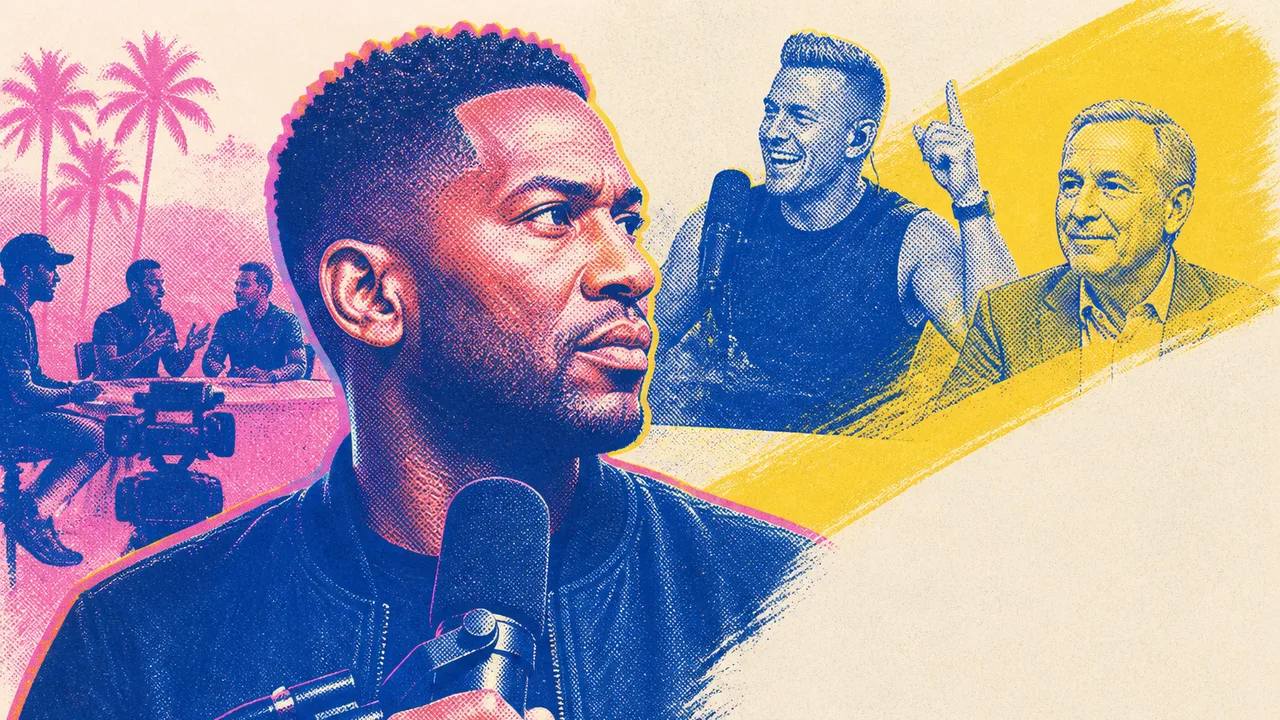
Ryan Clark says ESPN opened recent contract talks by telling him he could no longer host The Pivot, the show that now anchors his post-ESPN business.
Clark made the claim on The Daniel Cormier Show, saying the proposed term arrived around November. He recalled telling ESPN in January that if the network would not move from that position, “that’s not even a place of a conversation to have.”
ESPN’s reasoning remains unknown. No response from the network is included in the available reporting, and the contract language has not been published. Clark’s account establishes his view of the negotiation, rather than an independently verified version shared by both parties.
Still, the sequence is a useful little economics lesson wearing shoulder pads. ESPN reportedly wanted Clark separated from his independently built show. ESPN then laid him off in July. Since then, The Pivot has landed Netflix distribution, launched a weekly program with NFL Films and attracted former Starbucks CEO Howard Schultz as an investor and strategic partner.
Clark lost a job. He kept the asset that could hire him.
The Layoff Came During ESPN’s NFL Reset
Clark’s departure belonged to a broader restructuring. ESPN cut several prominent employees in July, including Cam Newton, Karl Ravech, David Lloyd and Stephania Bell.
The layoffs followed ESPN’s deal to absorb NFL Network and other league media assets while giving the NFL a 10% stake in ESPN. In a memo described in a running account of the cuts, ESPN President Jimmy Pitaro said the company had examined its business model after the transaction and faced “difficult decisions.”
That background offers a plausible business explanation for reducing overlapping NFL personnel. It does not explain why Clark says ESPN sought to remove him from The Pivot months earlier, or whether that request affected the eventual layoff. Connecting those decisions causally would require internal records or an ESPN account that has not surfaced.
The timeline shows why outside ownership can function as career insurance for on-air talent. A network salary pays while the contract survives. An owned feed, production operation and audience can survive the network contract itself. One disappears from the direct deposit. The other can become inventory.
Clark already had that inventory. Before leaving ESPN, he hosted The Pivot while appearing across NFL Live, First Take, Get Up and Monday Night Countdown. After the layoff, his company could redirect his time into programming it controlled.
In September, Pivot25 launched The Pivot Sports with Ryan Clark, a live studio show produced with NFL Films and distributed initially through the podcast’s YouTube channel. The same report described The Pivot’s Netflix arrangement as a non-exclusive licensing deal, allowing the company to retain access to its existing digital audience instead of locking the whole operation behind one platform’s front door.
That is a strong distribution setup on paper: YouTube supplies reach and audience data, Netflix supplies another storefront, and NFL Films adds production credibility and football access. It also leaves Pivot25 responsible for production costs, sales and enough revenue to keep the lights, cameras and group chat running. Owning the kitchen is great until every invoice has your company’s name on it.
ESPN Already Has a Creator-Owned Template
Pat McAfee provides the obvious comparison because ESPN chose a different structure with him.
In 2023, ESPN licensed The Pat McAfee Show, including its existing hosts, producers and Indianapolis studio. McAfee also holds a separate talent deal for College GameDay. Stephen A. Smith described the arrangement to Front Office Sports with admirable bluntness: “He owns his own platforms. He leases that to ESPN.”
Smith occupies the middle lane. ESPN owns First Take and employs him, but his five-year deal worth more than $100 million reportedly gives him flexibility for non-sports work. Smith said those freedoms came through negotiated contractual rights, while McAfee operates in “an entirely different world.”
Those arrangements create three models of star power inside the same media company:
- McAfee owns the show and licenses it to ESPN. The network buys access to a finished operation and its audience.
- Smith fronts an ESPN-owned franchise while negotiating outside freedoms. His leverage creates carve-outs, but ESPN retains the flagship program.
- Clark says ESPN asked him to stop hosting his independently owned show. He rejected that starting point and kept producing the show while employed, before ESPN later eliminated his position.
The contracts are unavailable, so the comparison cannot establish whether Clark received a standard exclusivity proposal, an opening bargaining position or an unusually restrictive demand. The shows also arrived with different audience sizes, production costs and strategic value. ESPN could reasonably decide that licensing McAfee made financial sense while licensing The Pivot did not.
Clark’s own description complicates a simple conflict-of-interest explanation. He said The Pivot was a carve-out and that he could not take competing jobs with CBS or NBC. If his account accurately reflects the proposed restrictions, ESPN could have explored a license, distribution partnership or revised carve-out without giving Clark permission to moonlight for a direct television rival.
A license would have required ESPN to pay for an asset it did not own and accept some limits on control. Asking Clark to leave the show would have concentrated his output inside ESPN’s system. From the network’s side, that can protect programming, sponsors and talent availability. From Clark’s side, it would have removed the business that could keep operating after ESPN stopped calling.
The negotiation appears to have broken on that allocation of risk. ESPN offered the institutional platform and salary. Clark wanted to preserve the independent property. Each side protected the thing it controlled.
Schultz is Investing in the Property, Not Just the Host
Pivot25’s next phase stretches beyond putting Clark behind another desk. Schultz has joined the company as an investor and strategic partner, while The Pivot has secured a multiyear Netflix agreement. Barrett Media’s account of the partnership put the YouTube audience above 1.4 million subscribers; Sports Business Journal, summarizing New York Times reporting, put it above 1.5 million. The figures were published a day apart, so the safest reading is that the channel had cleared at least 1.4 million.
Financial terms and the size of Schultz’s stake were not disclosed. Neither were the economics of the Netflix deal. Those omissions block any clean verdict that independence now pays Clark more than ESPN did. Subscriber counts demonstrate reach, not profit, and famous investors can bring impressive contact lists without turning every content line into a healthy business.
The intended expansion is broader than one podcast. Sports Business Journal said Schultz plans to help Pivot25 pursue live experiences, corporate partnerships, brand licensing and multiplatform entertainment. The strategy follows paths associated with Peyton Manning’s Omaha Productions and LeBron James’s SpringHill Company.
Those companies offer useful precedents and lofty expectations. Both were built around famous athletes turning personal access and recognition into production businesses. Pivot25 shares that ambition, but its current scale, capital and revenue are undisclosed. A recognizable blueprint does not cover payroll, production or customer acquisition. Pivot25 still has to prove that its audience can support an expanding slate.
Talent evaluating the same trade-off can start with five questions: Who owns the show? Who controls distribution? Can the audience move with the host? Does the contract permit outside work? Is the guaranteed salary worth surrendering future rights?
Clark’s case cannot prove that every analyst should reject a network deal and launch a podcast. Most independent shows will never secure Netflix, NFL Films or Howard Schultz. It does show what ownership changes when the network relationship ends. ESPN could remove Clark from its lineup, but it could not cancel the company he had already built around himself.
The next sports-media power broker may still sit behind an ESPN desk. The leverage starts with whether the name on the show also appears on the ownership documents.
More Like This
Troy Aikman's ESPN Talks Test an NFL Repair Premium
Troy Aikman's unresolved ESPN deal shows how NFL rights, a 10% league stake and Monday Night Football talent shape the price of stability for viewers and ESPN.

How NASCAR Went From Moonshine Runs to TV Gold
NASCAR's rise from backroad bootlegger races to 16 million CBS viewers is a masterclass in sports media timing, chaos, and unlikely opportunity.
Stephen A. Smith Tests Sports Media's Political Reach
Stephen A. Smith's 2028 speculation shows how sports media can convert recurring attention into political capital, while creating new risks for ESPN and its audience.
Clay Travis Launches Sport & State After OutKick Exit
Clay Travis is building a new sports-and-politics media outlet called Sport & State after departing OutKick. Here's what we know about the venture and what it reveals about independent sports media.
Kenny Beecham's Bold Bet on Media Ownership
Kenny Beecham turned down $1M to build his own sports media empire. Here's how ownership transformed his journey.