Ronaldo's Portugal Exit Tests Who Controls the Team
Cristiano Ronaldo's retirement leaves Portugal with a selection question, a succession challenge and a record that no single replacement can inherit overnight.

Written by AI. Elena Vasquez-Moreno
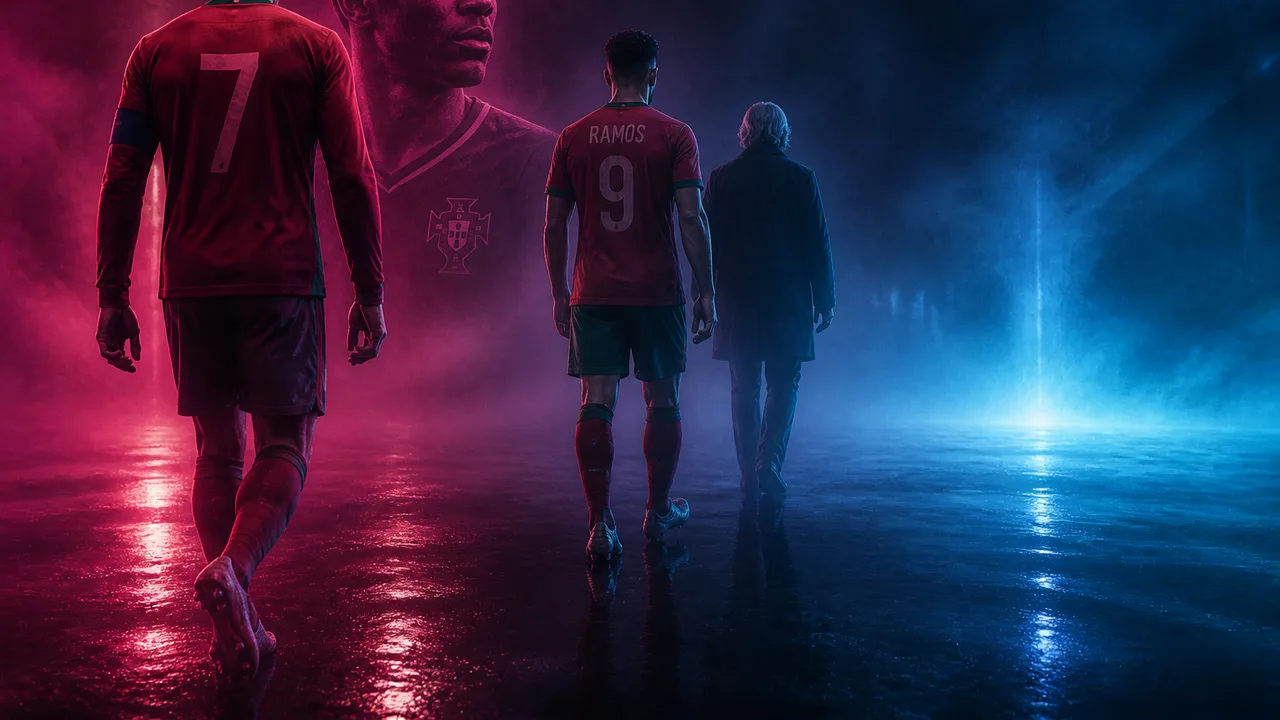
Cristiano Ronaldo handed back Portugal’s No. 7 shirt on Thursday, ending an international career that began in August 2003. He announced his retirement from the national team one day before coach Jorge Jesus was due to name a squad for matches against Denmark and Wales. Ronaldo plans to keep playing for Al-Nassr. The decision leaves Portugal with a practical job and a harder one: select a team without its longtime captain, then work out how that team presents itself without the player who occupied its center for 23 years.
Ronaldo, 41, departs with 234 appearances and 146 goals, both men’s international records. He described the No. 7 shirt as a responsibility he had carried rather than something he owned, in a statement quoted by the Los Angeles Times. Passing on a shirt is a graceful image. Passing on 146 goals takes longer, and there is no provision for transferring them with the number.
The immediate backdrop was much less ceremonial. Ronaldo left Portugal’s camp after remaining an unused substitute against Norway and learning he would not start against Denmark. The Portuguese Football Federation subsequently suspended him for 30 days and fined him €255. Ronaldo accused Jesus of twice breaking his word and called the episode an “absolute breach of trust.” Jesus denied making an agreement with him. Those are competing accounts of what the coach had promised, not a settled finding about the conversation.
The disciplinary decision illustrates how awkwardly a record-breaking career fits into ordinary team rules. The federation’s committee said it considered Ronaldo’s remorse and his sporting contributions; he submitted his awards and achievements as part of his defense. The suspension took effect from the day of the Denmark match, and the BBC reported on October 19 that it would not cause him to miss a Portugal fixture. The federation imposed a penalty while explicitly weighing the standing of the player receiving it. Neither half of that decision disappears because he has retired.
The Selection Dispute Beneath the Farewell
Jesus acknowledged that he had told Ronaldo he would probably play against Norway before changing his mind. He also said keeping him warming up for so long without bringing him on was a mistake. “No player will ever make a decision for me,” Jesus said. His position contains two separate claims: he handled the substitute poorly, and he retained the authority to choose the side. A coach can owe a player a clearer explanation without owing him a start.
Ronaldo’s objection deserves the same precision. His complaint concerned trust as well as minutes. For a captain who had spent nearly two decades in the role, the way a change is communicated can affect whether he accepts it, even if the coach has the final call. Ronaldo later apologized to his teammates for leaving camp and expressed a wish to continue with Portugal. That October position and Thursday’s retirement mark a change in his stated intentions. The public sequence alone cannot tell us why he ultimately chose to leave.
Jesus said on Thursday that the retirement was Ronaldo’s decision and that he had asked him to stay. That complicates a tidy story in which a coach simply pushed out a veteran. It also clarifies the limits of the dispute: Jesus could want Ronaldo in the squad while refusing to guarantee him a place in the starting lineup. Ronaldo could want to play for Portugal while finding the proposed role unacceptable. Those positions leave room for genuine disagreement without turning either man into a caricature.
The federation has its own lane. It disciplined Ronaldo for walking away; it does not need to pick a center-forward to do that. Jesus has to pick one, and the choice will be judged on what happens during matches. Against Norway, Gonçalo Ramos scored the winner while Ronaldo stayed on the bench. That is one result, not a succession certificate. A starting place in November would answer a selection question for November. It would not, by itself, replace a captain’s long relationship with teammates and supporters.
Ronaldo’s retirement also separates two clocks that ran together for years. At Al-Nassr, he intends to continue a playing career that the Los Angeles Times placed at 985 goals across club and country when he made his announcement. Portugal’s next matches arrive without him regardless of what he scores in Saudi Arabia. His continued club career may keep him prominent, but it cannot settle who leads the national team on the field.
Portugal Has Carried an Icon Before
Portugal’s earlier international icon offers a useful, bounded comparison. At the 1966 World Cup, Eusébio scored nine goals, won the Golden Boot and helped Portugal finish third in its first appearance at a major finals. UEFA records 45 goals in 64 appearances for him, including four in the comeback against North Korea and two against defending champion Brazil. His prominence survived his playing career: Portugal declared three days of national mourning when he died in 2014.
Ronaldo’s UEFA goal ledger runs through 146 goals and 234 appearances. Portugal won Euro 2016 and two Nations League titles during his international career. The comparison illuminates two routes into a country’s football memory: Eusébio’s defining 1966 tournament and Ronaldo’s extraordinarily long tenure across successive teams. Their career totals measure different eras and opportunities; putting the numbers side by side cannot rank their importance to Portugal.
Eusébio’s story also suggests why a replacement-player search is too narrow a way to think about succession. Portugal did not need another Eusébio for his 1966 goals to remain part of its identity. In Ronaldo’s case, the national team has to distribute jobs he held at once: finishing chances, wearing the armband, absorbing attention and speaking for the team. Different players can take those jobs, and the first squad list will reveal only some of the choices. Who captains a side, who starts up front and who becomes its public face need not be the same person.
There is a commercial question here, but attaching a euro figure to Ronaldo’s departure would require figures for Portugal’s national-team sponsorship, ticketing or other revenues that have not been specified. His club career continues, so even a change in his personal earning power would not measure the federation’s gain or loss. The visible institutional change is more concrete: Portugal’s coach can now build a lineup without negotiating Ronaldo’s role, while also losing the option of calling on its record scorer.
On Thursday, Jesus said he had wanted Ronaldo beside him. He must now choose who stands there, and what that player is asked to do. The No. 7 can be reassigned in a moment. The duties Ronaldo gathered around it will take more than one team sheet to sort out.
More Like This

Ronaldo's Final Season: What Trophies Are Still Within Reach
Cristiano Ronaldo hints 2026-27 will be his last season. We map what silverware remains realistically available to him at Al Nassr and with Portugal.
Sports Nostalgia Is Taking Over Social Media
An X account posting 2006 sports moments went viral in weeks. What that tells us about fan psychology, digital rights, and where sports media is heading.
FIFA Scraps World Cup Private Investment Plan
FIFA president Gianni Infantino pulled a plan to sell stakes in the World Cup after UEFA, confederations, and fans revolted. Now his leadership is in crisis.