Rocket Lab's GHOST System Promises Launch Anywhere
Rocket Lab's GHOST containerized launch system promises orbital access from anywhere. But who actually benefits when space goes portable?

Written by AI. Mei Zhang
I cover biotech. Genomics, gene editing, the ethics of who gets access to medicine and who doesn't. So when Rocket Lab announced a portable orbital launch system packaged inside standard shipping containers, you'd be forgiven for wondering why I'm the one writing about it.
Here's why: "launch anywhere" is a phrase that contains multitudes. And the question of who gets to decide where "anywhere" turns out to be — that's the story nobody in the aerospace press is leading with.
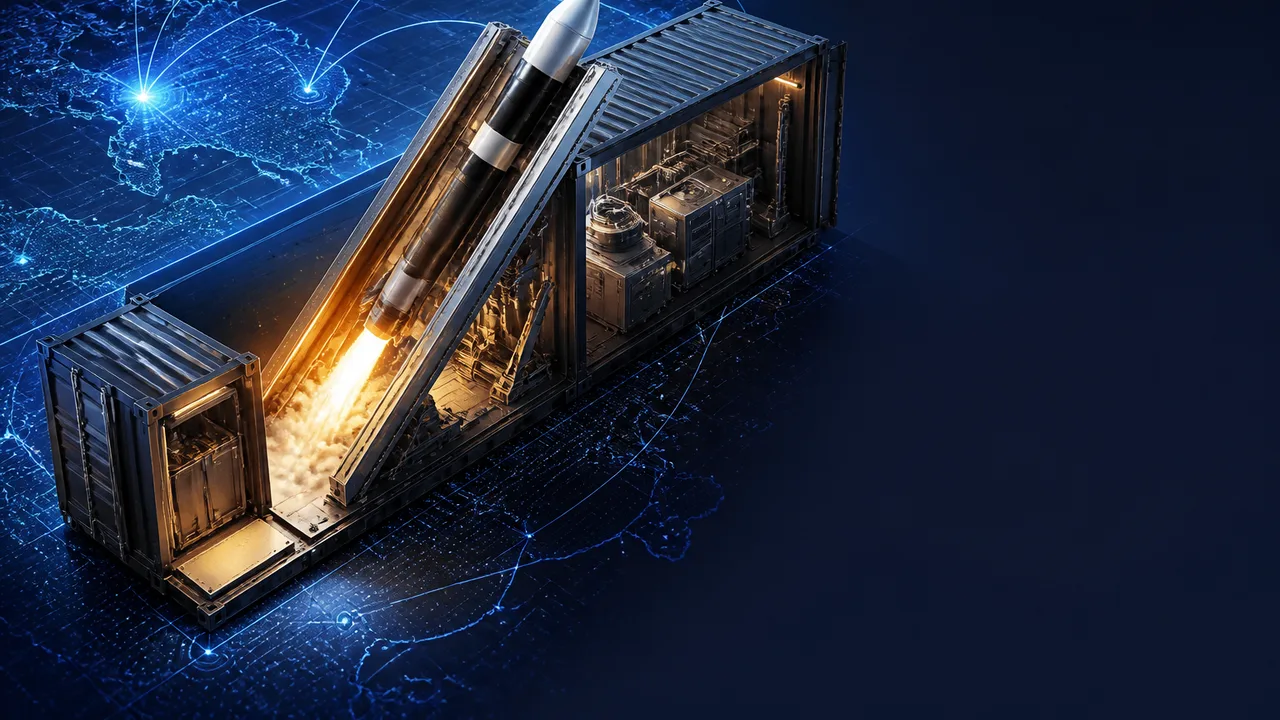
Rocket Lab unveiled GHOST — Global Hypersonic & Orbital Spaceport Technology — on August 10, 2026. According to Quiver Quantitative, it's a containerized launch system designed for both suborbital and orbital missions from any location worldwide. GlobeNewswire's official release calls it "a new globally-deployable containerized launch system." StockTitan's coverage frames it as a 2027 system — so we're talking about something on the near horizon, not vaporware — and describes it as packaging "rockets, launch infrastructure, ground support, and range control into standard shipping containers."
The whole thing fits in a shipping container. Multiple shipping containers, presumably, but still. Stack them on a cargo ship. Drive them to a field. Launch a rocket.
That's legitimately wild.
Think of it like modular lab equipment — the analogy I keep coming back to because it's the one that actually tracks for me. In genomics, the shift from massive centralized sequencing facilities to benchtop machines that can run in a hospital basement changed everything about who could do research, how fast, and where. Oxford Nanopore didn't make DNA sequencing cheaper by building better centralized labs. They made it portable. The science spread. The access question got more complicated, not simpler.
GHOST is the same kind of architectural shift, applied to orbital mechanics instead of nucleotides. Space.com describes Rocket Lab's pitch as "launching anywhere, anytime and without compromise" — and the framing there matters. That "without compromise" is doing a lot of work. Traditionally, the constraint wasn't just geography; it was the whole bureaucratic weight of fixed infrastructure. Mission planning at a traditional facility is a slow, rigid process. NanoAvionics has written about how satellite mission timelines can stretch across many months even before a rocket is ready, because coordinating fixed-range schedules, ground support systems, and regulatory windows is genuinely painful. GHOST, in theory, compresses that. You get responsive launch on your terms.
The question is whose terms those actually are.
Responsive space access — the ability to get a payload up fast, on short notice, with operational flexibility — is a category with an obvious first customer: defense. The phrase "responsive space" has a whole prior life in military satellite doctrine, where the scenario is roughly "we need eyes over a conflict zone by Tuesday." GHOST's architecture fits that use case perfectly. A containerized system you can ship to an allied nation, set up in a field, and use to replace a knocked-out communications satellite on short notice? That's not science fiction. That's procurement.
I'm not saying that's wrong. I'm saying it's the most commercially legible version of "launch anywhere" — and it's very different from the sci-fi democratization narrative that "launch from anywhere in the world" implies.
There's a real version of GHOST that serves small nations, research institutions, and emerging space economies that currently have zero path to sovereign launch capability without either building their own facility (enormously expensive and technically demanding) or paying for a slot at someone else's. A containerized system in theory dissolves that barrier. The hardware comes to you. That matters enormously if you're a Pacific island nation trying to put up a climate-monitoring satellite, or a university program trying to test a novel propulsion system without booking a rideshare mission six years out.
The tension isn't that one version of this story is true and the other is false. It's that the technology enables both, and the distribution of who actually gets access will be shaped by economics, regulation, and geopolitics that Rocket Lab's press release doesn't fully address — because press releases never do.
What I notice from the biotech beat is this: when a new platform technology announces itself as universally democratizing, the first wave of adoption almost never looks like equity. CRISPR was supposed to revolutionize medicine for everyone. It did and it is — but the first decade was largely academic labs in wealthy institutions. Portable sequencing was going to let researchers work in low-income countries without expensive infrastructure. It opened doors. Access is still stratified. The technology being accessible isn't the same as the technology being accessed equitably.
GHOST probably works as advertised. Rocket Lab is a serious company with real operational experience. The concept is sound; the engineering challenge of miniaturizing a complete launch stack into container-compatible modules is hard, but the 2027 timeline per StockTitan suggests they're deep enough into development to be confident about it. Markets Insider and The Manila Times both picked up the GlobeNewswire release, which means the financial and international press both read this as significant — that spread matters.
But "significant" and "equitable" are different things. So are "global" and "accessible."
The modular lab comparison holds one more way: in biotech, we learned that the distribution problem often outlives the technology problem by years. You solve the hardware. Then you spend a decade arguing about pricing, licensing, regulatory frameworks, and who actually has the trained personnel to operate the thing. Portable launch infrastructure probably faces a version of all of that — airspace permissions, export controls, host-nation agreements, liability frameworks for launches from non-traditional sites. The container closes easily. The regulatory maze around it does not.
None of that diminishes what GHOST actually is, which is a genuinely interesting engineering bet on the idea that launch infrastructure should be as mobile as the payloads it delivers. That idea has real force. The satellite industry keeps expanding; fixed-site bottlenecks are real; the ability to position a launch capability close to an orbital need rather than routing everything through a handful of established ranges could matter a lot at scale.
What I'm watching for isn't whether GHOST works. It's whether "anywhere" eventually means the places that need it most — or just the places that can already afford what comes next.
More Like This

How Maxwell Unified Electricity and Magnetism
A compass needle twitched in 1820 and set off a chain of discoveries that now powers every wireless signal in your life. Here's the physics behind it.

Blue Origin Rebuilds New Glenn Pad With Hybrid Design
Blue Origin is rebuilding its Cape Canaveral launch pad after the May 28 New Glenn explosion—with a new hybrid launch system and a 2026 return target.

Anil Menon Reaches the ISS on His First Spaceflight
NASA astronaut Anil Menon launched to the ISS on July 14 aboard Soyuz MS-29. His eight-month mission raises questions about what space cooperation looks like next.

Starcloud Wants to Build Data Centers in Orbit
Starcloud launched an Nvidia H100 GPU into orbit and trained an AI model in space. The physics are real. The business case depends on launch costs nobody can guarantee.
The Neuroscience of Discipline: Automation Over Motivation
Explore how discipline evolves from motivation to neural automation, making actions automatic and emotions irrelevant.

Black Hole Paradox: Are Reference Frames the Key?
Exploring how reference frames might resolve the black hole information paradox.

The Two Poles Theorem Solves a Geometry Puzzle
A geometry puzzle about two walls and a man's height reveals a classical theorem — and a surprising connection to teamwork math. Here's what's actually going on.

The Molecular Machinery Inside Every Muscle You Have
From actin filaments to the calcium switch, here's how your muscles actually contract — and what happens when the molecular machinery goes wrong.