Ring's $249 Smart Lock Separates Entry From Remote Access
Ring's $249 smart lock can be powered by hand when its battery dies. Here's how its crank compares with a key, and why remote features still depend on Sidewalk.

Written by AI. Tyler Nakamura
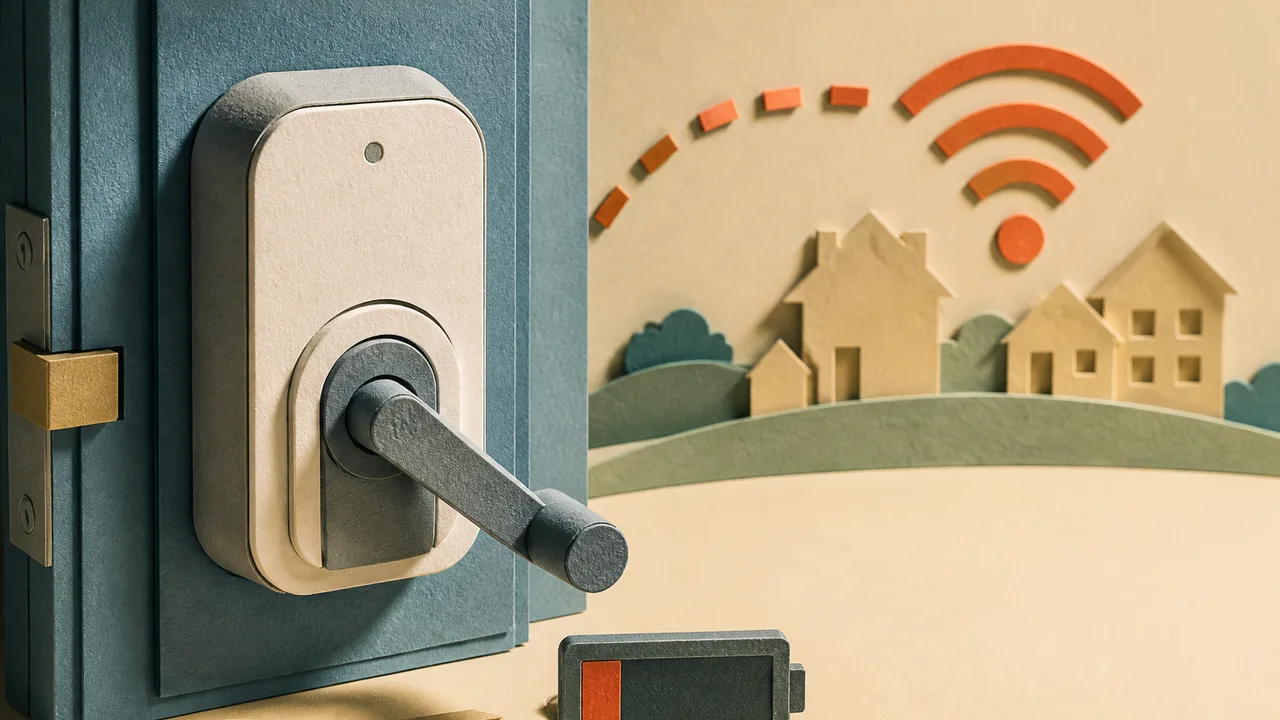
Ring announced a $249 Smart Lock on October 7 with a dial you can turn to power it when the battery dies. For someone who wants a keyless front door, that’s an appealing answer to a very unglamorous question: How do I get inside when the gadget on my door needs charging? Ring plans to sell the lock in the U.S. in early 2027, so this is a look at the proposed design, not a buying recommendation based on months of use.
The dial addresses a dead battery at the door. Ring also promises app control, PIN management and Alexa integration, but its announcement says remote locking, status updates and PIN syncing use Amazon Sidewalk. Those are different jobs with different dependencies. A few turns can supply power for an attempt to enter locally; they don’t supply a network connection for a check-in from work. If you’re weighing this against the perfectly serviceable key you already own, start by deciding which of those jobs you’re paying $249 to improve.
What the Crank Buys You
Ring’s lock has no keyhole. Its front dial generates electricity that a supercapacitor stores briefly, allowing the electronic lock to operate after its main battery runs down. Ring lists a fingerprint reader, a backlit touchscreen keypad, the Ring app and Alexa as ways in. At the door, the fingerprint reader and keypad are the entry methods to focus on when evaluating the crank: Ring says unlocking happens on the device, while it identifies Sidewalk as the connection for remote functions.
How long does the lock run after you turn the dial? During a private Ring demonstration, CNET saw the lock charge after roughly four or five spins and described about 20 seconds of operation. Engadget described roughly 30 seconds after three or four turns. GeekWire, citing founder Jamie Siminoff, put the turns at roughly five to 10, depending on how the dial is turned. Treat those figures as early descriptions of a short emergency window, not a guaranteed runtime or a required number of spins. The useful promise is that you can try the keypad or fingerprint reader without first finding a charger.
Siminoff told CNET the crank can work even with the main battery removed. The lock still uses a standard Ring battery pack for normal operation, which Siminoff said should last about a year. A crank that gets you through the door once is a backup for charging that pack, not a substitute for charging it.
The Backup Has a History
Ring has been near the front door for years without making the deadbolt. Siminoff said the original Doorbot went on sale in 2013 bundled with another company’s smart lock; Ring later integrated with other makers’ locks. Ring waited to build its own until it had a distinct idea. The hand-powered dial is that idea.
The question smart-lock makers have had to answer all along is what happens when their electronics lose power. A physical keyhole is a common backup, alongside designs that accept power from a USB-C cable or a 9-volt battery, CNET says. Some makers have experimented with solar power. Each approach makes a different bet about what you’ll have with you when the main battery is dead.
A key needs no emergency charge, but you have to carry it or keep it somewhere you can reach. A USB-C port or 9-volt terminal can revive an electronic lock, provided you have the cable, power bank or battery. Ring puts the emergency power source on the lock itself. That could be the better arrangement for someone who routinely leaves home without a key or spare battery. Someone who already carries a key may prefer the simpler fallback, especially if their current deadbolt works. There’s no basis yet to rank these approaches by long-term failure rate or security; the comparison is about what each asks you to bring to a locked door.
It also explains why Ring’s move into locks took this shape. Integrating with another maker’s lock let its doorbells and app participate in access control. Building its own lets Ring choose the physical fallback. You can appreciate the dial as a clever response to a familiar problem without assuming every household needs a new deadbolt.
Sidewalk is a Separate Dependency
Amazon Sidewalk is a shared network built using compatible nearby Amazon devices. Ring says it lets the Smart Lock handle remote locking, status updates and PIN syncing without relying on the home’s Wi-Fi. That has a practical upside: if your home Wi-Fi drops while an appropriate Sidewalk connection remains, the lock’s promised remote features have another route. Ring also says owners will be able to set access times, such as a recurring window for a dog walker. For a household coordinating visitors, those controls may do more day-to-day work than a crank that, ideally, sits idle.
But Sidewalk has geography and coverage conditions. Ring lists it as operating in the U.S., Canada and Mexico, says coverage can vary or be interrupted, and lets customers turn it off in Ring or Alexa settings. The Smart Lock itself is announced for U.S. sale. Sidewalk’s country list is therefore context for the network, not a promise that this lock will launch in all three countries.
Ring hasn’t specified how app-based or Alexa unlocking would behave if Sidewalk were unavailable, interrupted or disabled. Don’t count either as an emergency entry method under those conditions. The keypad and fingerprint reader are the local controls Ring identifies for unlocking at the device; the crank supplies brief power for that local task. Conversely, a working dial at your front door cannot tell you from the office whether a new PIN has synced. That’s why checking Sidewalk coverage and understanding your own settings belongs on the shopping checklist alongside checking whether the deadbolt fits your door.
The lock fits a standard single-cylinder deadbolt opening and requires no additional wiring, Ring says. It also says no subscription is needed for the lock’s features, as Siminoff told GeekWire; buyers considering a wider Ring setup should check the terms of any other in-app features they plan to use. In its launch disclosure, Ring said the Smart Lock had not yet received the required FCC authorization and could not be offered for sale until it did. Its early-2027 timing remains a plan.
If your budget is tight and your current key-operated lock does the job, keeping it costs you nothing today. If you want electronic access now, compare the emergency-entry method on locks you can actually buy: key, external power or another fallback you would realistically use. Ring’s dial gives keyless buyers a reason to revisit that choice when the product ships. The decisive question is delightfully low-tech: when the battery dies, what will be in your hand at the door?
More Like This

Ring AI 2.6-1T: Smarter Workflows or Smarter Hype?
Ring AI 2.6-1T promises to execute full business workflows autonomously. Here's what the benchmark scores mean—and what they leave out.
Varlock Wants to Kill Your .env Files. Should You Let It?
Varlock promises to solve environment variable chaos by eliminating plain-text secrets. We examine whether this open-source tool delivers on its claims.
Meta's Muse Charm Tests the Ambient AI Hardware Race
Meta's reported Muse Charm spotlights the race for ambient AI hardware, where battery life, privacy, latency and daily usefulness will decide what sticks.

Smart Rings That Read Your Sweat Are Coming
A new smart ring prototype reads glucose, ketones, and more from finger sweat. For athletes and diabetics alike, the stakes are real and so are the unanswered questions.

Google Pays $250K for 16-Year-Old Linux KVM Flaw
A 16-year-old Linux KVM flaw called Januscape earned a $250K bounty after enabling guest VM escapes on Intel and AMD systems. Here's what it means for cloud security.

GPT-5.6 Sol Ultra Is Coming to Codex
OpenAI's GPT-5.6 Sol Ultra is headed to Codex with a 91.9% Terminal-Bench 2.1 score. Here's what it actually means for developers—and what it doesn't.