Ring AI 2.6-1T: Smarter Workflows or Smarter Hype?
Ring AI 2.6-1T promises to execute full business workflows autonomously. Here's what the benchmark scores mean—and what they leave out.

Written by AI. Marcus Chen-Ramirez

Photo: AI. Dexter Bloomfield
Every few weeks, a new model drops with claims that make the previous one sound like a pocket calculator. Ring AI 2.6-1T is the latest contender—a trillion-parameter reasoning model from Ang Group that's generating real buzz in the small-business and creator space, partly because of a recent walkthrough by Julian Goldie, an SEO consultant who uses it to demonstrate end-to-end business workflow automation.
The core pitch is worth taking seriously, even if the surrounding marketing context requires a raised eyebrow or two.
The Argument Ring AI Is Making
The distinction Goldie's video draws is one that practitioners in this space will recognize immediately: the difference between an AI that responds and an AI that executes.
"Most AI tools give you an answer. Ring AI executes a job," the video states. It's a clean line. And it points at something real.
Anyone who's spent time with current-generation LLMs knows the workflow: you get output, you do something with it, you paste it somewhere, you prompt again, you lose context halfway through a long task, you start over. The human is still the connective tissue between every AI-generated piece. What Ring AI (and a broader class of "agentic" models) claims to change is that architecture—replacing human hand-holding with the model's own capacity to plan, execute, and self-check across a sequence of steps.
The spec sheet supports the ambition. Ring 2.6-1T carries a 262,000-token context window with up to 66,000 output tokens. In practical terms, that means you can feed it your entire content archive, your business strategy doc, your customer feedback inbox, and ask for a deliverable—and it won't forget what you told it three paragraphs ago. That's not nothing. Context window size has been one of the genuinely meaningful differentiators among models in the last 18 months.
What the Benchmark Actually Shows
The video cites a score of 87.60 on Pinch Bench, a benchmark designed specifically to test task completion rather than knowledge retrieval. That score, the video claims, puts Ring 2.6-1T ahead of GPT-4 variants and Gemini 3.1 Pro on actual task execution.
Here's where I'd pump the brakes, not to dismiss the claim, but to contextualize it properly.
Benchmarks measure what they're designed to measure. Pinch Bench focuses on whether an AI agent completes assigned tasks—a more practical lens than the standard knowledge-trivia benchmarks, yes. But "completing a task" and "completing a task well enough to deploy" are different thresholds. A model can technically finish a 30-day content calendar and still produce 30 days of undifferentiated marketing mush that no human audience would engage with.
The more interesting question isn't whether Ring AI finishes the job faster than a human. It's whether the output requires meaningful human revision before it's actually useful—and that's something a benchmark score can't tell you.
The Workflows: Genuinely Interesting, Heavily Contextualized
The specific workflows Goldie demonstrates are the most concrete part of the video, and they deserve examination on their own terms.
The market research workflow is illustrative: feed Ring AI context about your community, ask it to identify where your target audience congregates online, surface their core frustrations, write hooks for each frustration, and produce a platform-specific distribution plan—all in a single prompt run. Goldie notes the outputs included frustrations like "I've tried five AI tools and none of them actually saved me time"—which is, ironically, exactly the frustration a skeptic might apply to this very demo.
The 30-day content calendar workflow is arguably the most practical for solo operators and small teams. The prompt specifies not just topics but formats—short-form video, LinkedIn post, email subject line—for each of 30 days, with instructions to avoid repeating what's already been covered. "Human building this manually takes three to five hours," the video claims. "Ring AI produces it in under two minutes."
That math is plausible. Whether the output is any good—whether day nine's "AI workflow that handles your entire lead follow-up process without you" is a genuinely compelling angle or a forgettable entry in the ocean of AI automation content—is a question the demo doesn't answer.
The onboarding email sequence and landing page workflows follow similar logic: give the model specific context, get structured, deployable-ish output, skip the days of back-and-forth with a contractor. "You'd normally brief a copywriter, wait days, do multiple revision rounds," the video observes. "Ring AI does it in one shot."
This is the strongest version of the argument. Not that AI replaces skilled copywriters for high-stakes creative work, but that it eliminates the painful middle tier—the contractor briefs, the first drafts, the revision loops—for functional business assets that need to be good enough, not brilliant.
What the Video Doesn't Address
There are a few things worth noting that the demo sidesteps.
The entire workflow demonstration is built around a single use case: growing Goldie's own paid community, the AI Profit Boardroom. That's not a criticism of the demos themselves, but it's worth flagging that the outputs are being evaluated by the same person who wrote the prompts, for a product they're selling. That's a very controlled loop.
The model is described as coming from "Ang Group"—which at the time of writing isn't a household name in AI research circles the way Anthropic, OpenAI, or Google DeepMind are. That's not disqualifying; meaningful AI research is happening across a broader ecosystem than the big three. But it does mean the independent scrutiny that models like GPT and Claude receive hasn't fully landed on Ring AI yet. The Pinch Bench scores are real data points; they're not the whole picture.
There's also the question of what "agentic" actually means in practice right now. The video describes Ring AI as running steps, checking its own work, and continuing until the job is done. That's a compelling framing. It's also a description that could apply to a model that's very good at staying on-task within a long prompt—which is less dramatic than it sounds, and meaningfully different from a model that's autonomously planning and executing across external tools or systems. The distinction matters, and the video doesn't draw it clearly.
The Honest Tension Here
The interesting thing about Ring AI's pitch isn't whether any specific benchmark number is accurate. It's the underlying claim about what kind of labor AI is replacing and for whom.
For a solo operator or small team trying to keep content consistent, nurture an email list, and build a conversion funnel without hiring five contractors, a model that produces functional first drafts of all of those things in an hour is genuinely valuable—even if every output needs human refinement. The time savings are real even when the outputs are imperfect.
For someone who's already paying skilled writers and strategists to do this work, the value proposition is different. Ring AI at its current capability level probably isn't replacing your senior copywriter. It might be replacing your junior one, or your freelance brief-writer, or your 3 a.m. content panic session.
The video is selling a vision—and also, fairly transparently, a community membership. Those two things don't cancel each other out. The workflows are demonstrably real. The question of whether Ring AI's outputs are as polished as the demo implies is one that anyone curious about this model should answer for themselves, since Goldie's explicit recommendation is to "go try Ring 2.6-1T on Open Router" and run the prompts against your own business.
That's actually reasonable advice. Just run it against something you know well enough to evaluate honestly.
More Like This
Ernie 5.0: Baidu's Bold AI Leap Forward
Explore Baidu's Ernie 5.0, a new AI model challenging GPT-4 with its multimodal capabilities and cost-effectiveness.
OpenAI's GPT-5.5: When the Benchmarks Don't Tell the Whole Story
GPT-5.5 arrives with impressive real-world benchmarks and doubled pricing. But the coding results reveal tensions in how we measure AI capability.
Google's Gro Wants to Change How Developers Think About AI
Google's upcoming Gro coding agent shifts from task-based prompts to goal-oriented AI. What happens when you stop telling AI what to do and start telling it what to achieve?
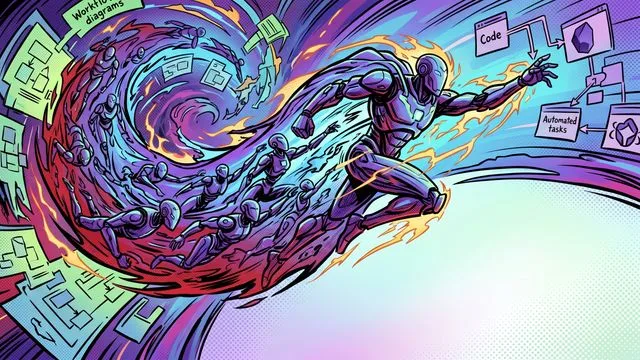
Ruflo Turns Claude Into an Agent Swarm. Here's the Reality
Ruflo promises to turn Claude into a 100-agent autonomous swarm. We break down what the demo actually shows—and what it quietly skips over.

What a VC's AI Playbook Means for Main Street
YC's Tom Blomfield says AI can replace middle management and self-improve companies overnight. Here's what that actually means if you run a real business.
DeepSeek V4: Build Apps and AI Agents for Free
DeepSeek V4 lets non-coders build apps and run AI agents for free. Here's what actually works, what breaks, and what the hype leaves out.

Hugging Face ML Intern Automates AI Development
Hugging Face's ml-intern is an open-source agent that automates the full ML research loop. Here's what it does, what it can't, and what it signals.

Small Language Models Are Reshaping Agentic AI
Small language models are outperforming larger rivals on key AI agent benchmarks. Here's what the efficiency shift means for how AI gets built and deployed.