What a VC's AI Playbook Means for Main Street
YC's Tom Blomfield says AI can replace middle management and self-improve companies overnight. Here's what that actually means if you run a real business.

Written by AI. Dorothy "Dot" Williams

Photo: AI. Roxanne Vex
I ran a bookstore for thirty years. I had a manager named Carol who handled the floor on weekends, remembered every regular customer's reading habits, knew which sales rep was reliable and which one would oversell you on a display you'd regret, and kept three part-time employees from killing each other during the holiday rush. She was, by any technical definition, middle management. She was also irreplaceable in about forty ways that never showed up on an org chart.
I keep thinking about Carol when I watch tech executives declare that middle management is over.
The latest version of this argument comes from Tom Blomfield, a YC partner who founded the UK neobank Monzo before joining the accelerator. In a talk published this week on YC's channel, Blomfield lays out what he calls the "self-improving company" — an organization structured not as a hierarchy of people passing information up and down, but as a set of recursive AI loops that diagnose problems, write fixes, deploy them, and improve overnight while everyone's asleep. It's a genuinely interesting framework, and I think the people it's most likely to unsettle aren't the software founders sitting in Blomfield's audience. They're the people who read me.
So let me translate.
The actual idea, stripped of the jargon
Blomfield's core argument is that the "AI as productivity tool" framing — the 20% efficiency boost, the copilot that helps your engineers ship faster — is too small. He wants you to think about AI not as a better engine bolted onto the same machine, but as the machine itself.
He describes a loop with five parts: a sensor layer (customer emails, cancellations, support tickets — signals from the outside world), a policy layer (rules about what the system can do autonomously versus what needs a human), a tool layer (the actual software and APIs the AI calls), a quality gate (safety checks, human review for high-stakes decisions), and a learning mechanism that feeds failures back into the top of the loop.
The YC example he uses to illustrate the "holy shit moment," as he puts it: they built an agent that answered questions about their portfolio companies. Then they put a monitoring agent on top of it that watched every query, identified failures, figured out why they failed, wrote code to fix the problem, put in a pull request, had another agent review and merge it, and deployed — overnight, without a human involved. "When a human comes the next day to ask the same query, it will now succeed."
I believe that happened. I also note it happened at Y Combinator, which has a software engineering team, a technical infrastructure, and a financial runway that most business owners reading this do not have. Blomfield is describing a proof of concept at a well-resourced tech organization and suggesting the pattern is broadly applicable. Maybe it is. But the gap between the pattern and the implementation is where most businesses actually live.
"Record everything" lands differently outside Silicon Valley
The section of Blomfield's talk that most demands translation for my readers is the one about making your organization "legible to AI." His prescription: record everything. Every email, every Slack message, every meeting. "If it did not get recorded, it did not happen to your intelligence."
For YC, this means logging partner emails and office hours transcripts. For a business with 35 employees and one HR person who's also the bookkeeper, this means something more complicated.
It means recorded calls with customers who didn't know they were being recorded — which is a legal question in two-party consent states, not a technical one. It means documented conversations with employees about performance, which creates paper trails with real legal weight. It means your disciplinary discussions, your vendor negotiations, your difficult moments with a supplier you've worked with for fifteen years — all of it ingested into a system whose outputs you may not fully understand.
I'm not saying don't do it. I'm saying the question of what to record, what to protect, and who owns what you've captured is not a detail. It's the whole thing. Blomfield mentions, in passing, that you have to "diorize" (he means diarize — synthesize and categorize) your recordings before feeding them to the AI, because you can't pump 100,000 hours of audio into a context window. That's true. It's also doing a lot of work. The synthesis step is where your institutional knowledge either gets preserved or gets flattened into something unrecognizable.
Blomfield reports that YC fed roughly 2,000 hours of recorded office hours into an AI and produced a 150-page updated user manual "by the end of the weekend." That's YC's own account of YC's own experiment — worth noting as a data point, not treating as an established benchmark. What it took to set up the recording infrastructure, what was lost in the synthesis, whether the manual is actually better or just more comprehensive — none of that is in the talk.
The middle management question I can't wave away
"I think middle management is done," Blomfield says flatly. "I just don't think you need middle management for this coordination problem."
He's talking about coordination — the passing of information and decisions through organizational layers. And he's right that AI can handle a version of that. What he's not accounting for is what else middle managers do, which is the part that kept Carol employed for twelve years.
Carol handled the coordination, yes. She also de-escalated the Saturday afternoon when two employees had a genuine interpersonal conflict on the floor in front of customers. She caught the shoplifting pattern we'd missed for six weeks. She told me, plainly, when a vendor relationship had gone sour and I was the last to know because everyone was being polite to my face. She was the business's immune system for a category of problems that don't show up in dashboards.
The companies that have tried management elimination experiments have generally discovered that what they lost wasn't coordination. It was judgment about the things that hadn't been categorized yet.
Blomfield does acknowledge this, to his credit. He carves out a space for humans at the edges of his "company brain" model — "novel situations, ethical considerations, high-stakes moments." He specifically mentions the example of a founder considering breaking up with a co-founder: "those real high stakes, high emotion moments where you really want a human being." He also holds on to sales conversations as human territory for "the next 20 years."
That's not nothing. But notice that his examples of irreducibly human work are almost entirely relational and emotional — not operational. For a business where operations are relational (a restaurant, a physical therapy practice, a boutique retail shop), the distinction between the "edge" where humans live and the "brain" where AI runs may be harder to draw than his framework suggests.
The number that needs a asterisk
Blomfield claims YC is seeing portfolio companies reach demo day with "about 5x more revenue per employee than they did 18 months ago." He offers this as evidence that the AI-native company structure is already producing results.
That is a striking figure from a single promotional talk by someone whose job includes recruiting founders to YC. It may be accurate. It almost certainly reflects a selection effect — the companies making it to demo day with AI-native structures are probably not representative of the full distribution. It should not be treated as a reliable data point about what's possible for your business. I mention this not to dismiss the claim but because figures like that have a way of becoming received wisdom before anyone checks them.
What's actually useful here, for your business
Strip away the YC scaffolding and a few things remain that are worth taking seriously regardless of your industry or headcount.
The sensor-policy-tool-quality-learning loop is a genuinely useful way to think about any repeatable process in your business. Not because you're going to automate it tonight, but because it forces you to ask: what information are we actually receiving about this process? What decisions do we make with it? What do we do when something fails? Most businesses have answers to none of those questions in written form. That's not an AI problem — it's a basic operational hygiene problem that predates AI and that AI makes more visible.
Blomfield's point about software being ephemeral and context being valuable is also real. The thing worth preserving is your understanding of how your business works — the institutional knowledge that currently lives in people's heads and should probably live somewhere else, not because AI needs it but because you're going to lose people eventually and that knowledge will walk out with them.
And his framing of "burn tokens, not headcount" — meaning, measure AI engagement rather than headcount additions — is directionally right even if the metric is crude. The question for any business owner right now is not whether to hire or not to hire. It's whether you actually know which parts of your operation are candidates for AI handling and which parts aren't. Most business owners I talk to haven't done that audit. Blomfield's framework, whatever its limits, is a decent structure for starting it.
The part I'd push back on is the certainty. This is a 13-minute talk describing a direction of travel, built on examples from a single well-resourced tech organization, delivered to an audience of founders who want to believe it. Blomfield himself admits: "I'm not sure anyone has a truly self-improving company in every function." That's the honest sentence in the talk, and it's the one that should probably lead.
Carol retired in 2019. I never did find a clean replacement for what she actually did — not because I didn't look, but because I kept looking for someone who could do the coordination part and kept underestimating how much of her value was everything else. AI might eventually handle the coordination. The question Blomfield doesn't quite ask is what happens to the everything else.
More Like This

ElevenLabs and the Voice AI Bet Nobody Wanted
ElevenLabs CEO Mati Staniszewski explains how a two-person team from Warsaw suburbs built a $400M voice AI business by betting on the domain nobody wanted.
Why Most Companies Are Using AI Wrong (And How Winners Do It)
75% of AI's economic gains go to just 20% of companies. Here's what the winners understand that everyone else is missing about organizational AI.
What AI Is Really Competing Against in Knowledge Work
After 25 years consulting for Fortune 500 companies, one technologist argues most knowledge work isn't the high bar we imagine. Here's what he found.

Vibe Coding Grew Up. Karpathy Explains What's Next
Andrej Karpathy says vibe coding raised the floor. Agentic engineering is the harder discipline forming on top of it—and the gap between who gets it is widening fast.
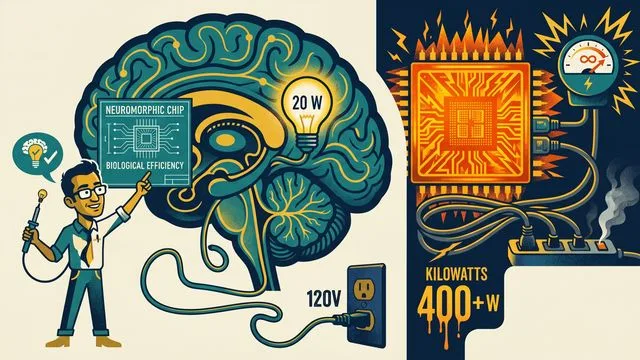
AI's Energy Problem Is a Main Street Problem Too
Naveen Rao says AI will hit an energy wall in years, not decades. Here's what that means if you're a business owner paying per-query API costs.

Why Vertical AI Is an Org Problem, Not a Model Problem
Chris Lovejoy's oracle-evaluator-architect framework reframes vertical AI failure as an organizational design problem. Here's what that means in practice.

Texas Is Becoming the Hub of Commercial Space
From SpaceX's Starbase to Firefly's moon landing, Texas has become the center of commercial space. Here's what's driving the shift—and what it costs.

Spain's Immigration Boom: Real Gains, Real Costs
Spain's mass immigration wave is propping up its pension system — but stagnant wages and a housing crisis reveal what the government isn't building alongside it.