AI's Energy Problem Is a Main Street Problem Too
Naveen Rao says AI will hit an energy wall in years, not decades. Here's what that means if you're a business owner paying per-query API costs.

Written by AI. Dorothy "Dot" Williams
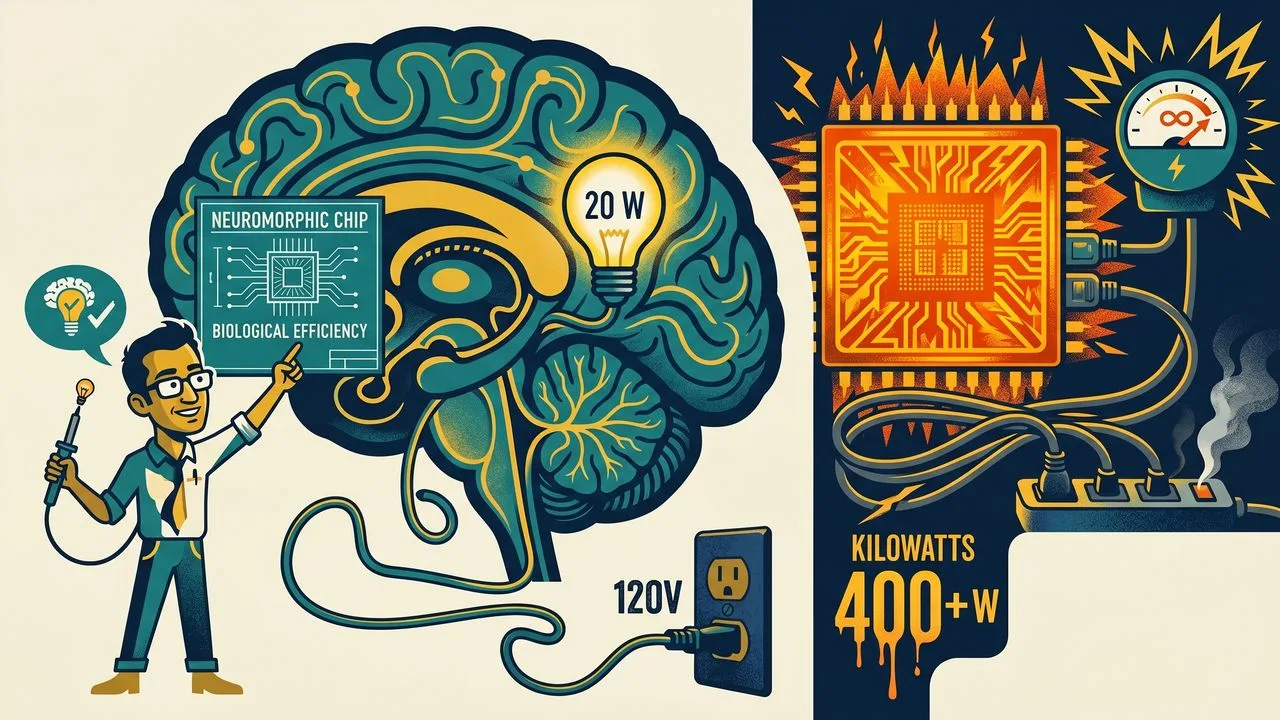
Photo: AI. Mika Sørensen
The electric bill was always the quiet enemy. When I ran my bookstore in Asheville, I knew to the dollar what the lights cost, what the heat cost, what the credit card reader cost. Those numbers were load-bearing. They were the difference between a good month and a call to the landlord. I say this because when a chip company founder at a Sequoia event starts talking about global electricity capacity, I don't hear an abstraction. I hear margins.
Naveen Rao — neuroscientist, former computer architect, founder of Nervana Systems (acquired by Intel in 2016), and most recently the architect of Databricks' AI platform — walked into AI Ascent 2026 and made an argument that the AI industry's dirty problem isn't regulation or alignment. It's the electric bill. He's now CEO of Unconventional AI, a startup that thinks it has a better physics model for how computers should work. His pitch is, broadly: the 80-year-old digital computer was built for different reasons, on different assumptions, for different purposes, and we're using it wrong.
The math he lays out is stark. Eight billion human brains, running at roughly 20 watts each, consume about 160 gigawatts total. The entire human species, thinking and navigating and building and creating, runs on 160 gigawatts. Rao cites global electricity generation capacity at around 9,000 gigawatts — a figure worth treating carefully, since the IEA puts total installed global capacity higher than this, and there's a real difference between installed capacity and what's actually available on the grid at any moment. But even with that caveat, his point holds directional shape: AI infrastructure is already consuming gigawatts for training and inference, and Rao asserts it will hit an effective energy ceiling within two to four years.
That two-to-four-year window is his projection, not a published forecast from an independent study. He's a founder making this case at a fundraising-adjacent event, which is worth naming plainly. But even if you discount it by half, the trajectory is real enough that the energy constraint has become a genuine topic in infrastructure circles, not just futurist hand-wringing.
Here's where it lands for a business owner, and I don't think this gets said enough: you are probably already paying into this energy problem. If your business uses AI tools — customer service bots, inventory forecasting, marketing copy, any of it — you're paying API costs to someone running those queries on data center hardware that is burning electricity at a rate your brain does not. If the energy math gets harder, those API costs are one of the places that math shows up. Not necessarily soon, not necessarily dramatically, but the pipeline from "data centers are energy-constrained" to "your per-query rate just went up" is shorter than it looks. Nobody's talking about this on the small business side of the fence. They probably should be.
Rao's argument for why we're in this situation comes down to a design choice made in the 1940s. Digital computers — floating point math, binary logic, the whole architecture we've built the modern world on — were built for a specific purpose on specific assumptions about what computing was for. They weren't built for intelligence. And the way they handle memory, specifically the constant back-and-forth between processor and memory to read state, operate on it, and write it back, turns out to be where most of the energy goes. We've gotten better at manufacturing chips, and that's made them cheaper. But as Rao notes, "actual energy per flop with memory access has not gotten better. It's very very incremental now."
The alternative he's proposing comes from neuroscience, and I'll try to translate it the way I'd explain it to someone who just walked through my door asking whether they should care.
Think about how you actually solve problems. You don't process information in neat sequential steps, retrieving a fact, operating on it, filing it back, then fetching the next one. Your brain is more like a room full of instruments that have learned to play together — when you give it a situation, things start resonating, patterns emerge, the answer kind of arrives rather than being calculated. The computation happens in the interaction itself, not in a series of discrete operations.
Rao describes this using a concept called Kuramoto synchronization — a phenomenon where oscillators that start in random states will naturally synchronize over time, based purely on how they're coupled to each other. He's generalizing that idea: build a circuit of oscillators with trainable connections between them, give it a starting condition, and let the physics run. "Here's the initial state, kick it and let it run," he says. The physics do the computation. You don't write state out, retrieve it, operate, write it back. The state is implicit in the behavior of the system itself.
What this means in practical terms: if it works at scale, you get computation that doesn't burn most of its energy shuffling data in and out of memory. The system processes the way biology processes — dynamically, in time, without a hard separation between storage and computation. Whether that can be trained reliably to do the kinds of tasks AI actually needs to do is a genuinely open question, and Rao is honest about this: "We don't really know" exactly how the brain does what it does, "but there are some ideas that we can harvest from neuroscience."
There's a thermodynamic ceiling on all of this — something called the Landauer principle, which sets the absolute physical limit of how much computation can happen within a given amount of energy. Current GPUs are roughly three orders of magnitude below that ceiling. Biology is closer, though still not at the limit. Rao thinks focused effort can close a significant portion of that gap. That's the claim his company is organized around.
The prototype part. Unconventional AI claims — and this is the company's own account, unverified — that it went from essentially no team in January to a chip prototype taped out in six months. Rao credits AI-assisted chip design for making that timeline possible. I've covered enough "this changes everything" moments in business to know that the gap between prototype and product is where most of the story actually happens. A chip that demonstrates interesting dynamics in a lab is genuinely promising. A chip that ships at cost, performs reliably, integrates with existing software infrastructure, and doesn't require every developer to relearn how to build for it — that's a different and much harder thing. The people who've tried to sell novel computing architectures before mostly learned this the hard way.
That said, I'm also old enough to remember when people said independent bookstores would never survive ebooks, and when they said there was no point competing against Barnes and Noble on inventory. Sometimes the conventional architecture really is the wrong one for the moment. The question is whether the moment is actually now.
Rao ends with a line he says has guided his whole career. He doesn't repeat it in the transcript, but the argument builds toward one idea: we can now start to understand how brains work because we can build them. Thirty years of thinking about this problem, and he's here with a chip in his hand.
I genuinely don't know whether Unconventional AI's approach will work at scale, or on what timeline, or what the unit economics look like on the other side of it. Neither does anyone else yet. But the energy argument underneath it — that you cannot keep scaling intelligence on hardware this inefficient forever — that part is not a pitch. That part is physics. And if you're a business owner whose tools run on someone else's infrastructure, the moment that physics becomes someone's pricing problem, some of it becomes yours too.
More Like This

ElevenLabs and the Voice AI Bet Nobody Wanted
ElevenLabs CEO Mati Staniszewski explains how a two-person team from Warsaw suburbs built a $400M voice AI business by betting on the domain nobody wanted.

AI Companies Are Running Out of Compute—and Money
As AI agents consume tokens at unprecedented rates, companies like Anthropic and GitHub are abandoning flat-fee pricing. The subsidy era is over.

Vibe Coding Grew Up. Karpathy Explains What's Next
Andrej Karpathy says vibe coding raised the floor. Agentic engineering is the harder discipline forming on top of it—and the gap between who gets it is widening fast.

How Andrew Wilkinson Runs Businesses With AI Agents
Andrew Wilkinson replaced headcount with a $40K/month Claude bill. Here's the real stack—and the honest limits—behind his AI-run businesses.
This Developer Spent $20K Building an AI Company That Never Sleeps
Alex Finn invested $20,000 in local AI models to create a 24/7 autonomous digital workforce. Here's what happened when the API costs disappeared.

Harnessing Claude Skills for Business Success
Explore how Claude Skills can enhance business operations by merging AI with human expertise.

Texas Is Becoming the Hub of Commercial Space
From SpaceX's Starbase to Firefly's moon landing, Texas has become the center of commercial space. Here's what's driving the shift—and what it costs.

Spain's Immigration Boom: Real Gains, Real Costs
Spain's mass immigration wave is propping up its pension system — but stagnant wages and a housing crisis reveal what the government isn't building alongside it.