Resident Evil Requiem Wins a Close Golden Joystick Race
Resident Evil Requiem won the Golden Joysticks' top prize with 17% of the vote. Meccha Chameleon's four wins show how the 2026 honors spread across games.

Written by AI. Lily Tsai
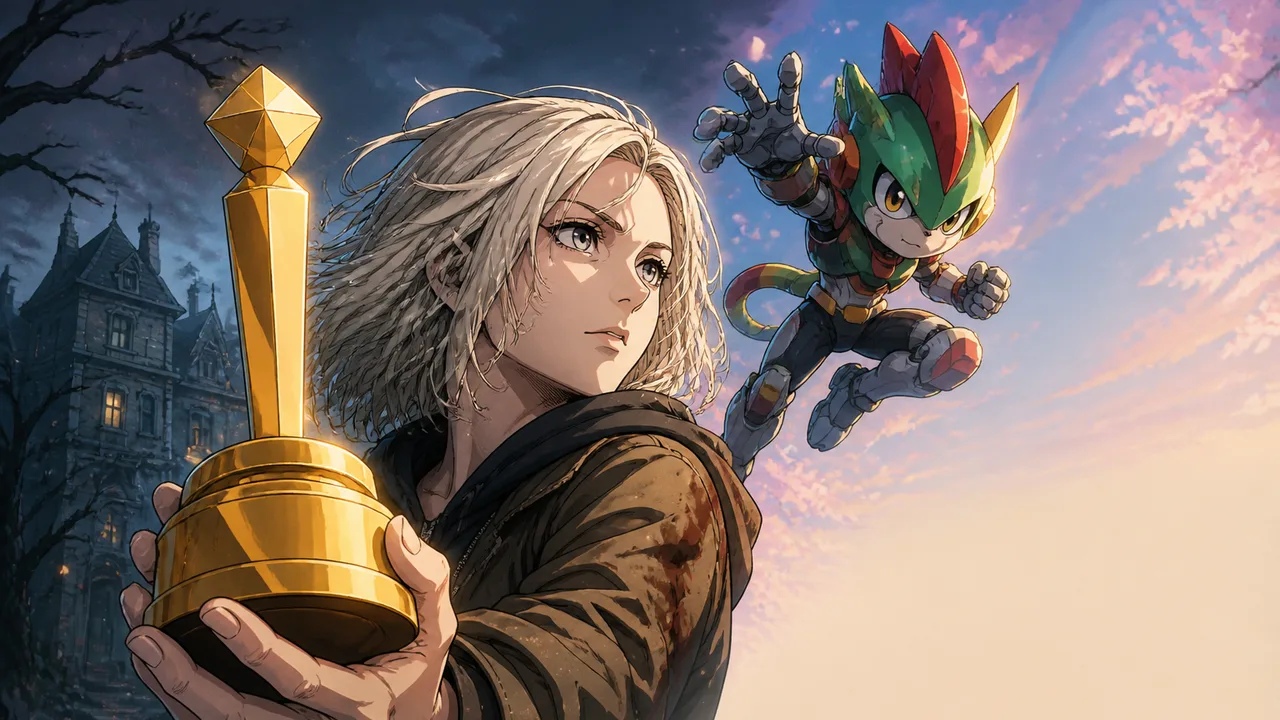
Resident Evil Requiem won Ultimate Game of the Year at the 2026 Golden Joystick Awards on November 11. Capcom’s game also took Console Game of the Year and Best Game Trailer, while Angela Sant’Albano won Best Lead Performer for playing Grace Ashcroft. Four awards give Requiem a substantial night, topped by the ceremony’s biggest prize. They also open a better question than “Who won?”: What, precisely, did voters reward?
The Ultimate Game of the Year vote gives the headline some useful scale. Requiem received 17%, followed by Phantom Blade Zero at 16% and Crimson Desert at 15%. That is a close finish among the three leaders, with substantial support going elsewhere. The percentages describe this award’s vote; without a turnout figure or a breakdown of the other nominees’ shares, they cannot tell us how many people backed each game or how representative those voters are of players generally.
A close result does not diminish the win. Coming first in a crowded vote is an achievement, and Requiem also won a platform-specific game award, a trailer award and a performance award. Those categories recognize different parts of the work. Reading them together offers a fuller account of its night than either the top-prize headline or the vote percentage alone. A trailer can make a case for a game before someone plays it; a performance award singles out an actor’s contribution. Ultimate Game of the Year asks for a broader choice.
Two Games, Four Awards Each
Meccha Chameleon also collected four Golden Joysticks: Best Multiplayer Game, Best Indie Game (Self-published), Streamers’ Choice and Developers’ Choice. Its hide-and-seek premise has players paint themselves into their surroundings to avoid being spotted. Two developers made it in a couple of months, GamesRadar+ reported. That small team and short development period give its results an unusually sharp context, though neither tells us its budget or the conditions under which the developers worked.
The two sets of four make an appealing scoreboard. They are also four different awards apiece, with different eligibility and different questions behind them. Requiem won the overall prize and Console Game of the Year; Meccha Chameleon won categories centered on multiplayer, self-publishing and recognition from streamers and developers. The latter two were jury-voted awards. The indie’s haul therefore reaches beyond one measure of public popularity, while Requiem holds the top public-vote result. Treating the totals as interchangeable would flatten both stories.
For a two-person project, Best Multiplayer Game is especially striking alongside Best Indie Game (Self-published). The pairing says that Meccha Chameleon was recognized for an aspect of play as well as for its route to market. It does not give us a development diary: the awards cannot explain how the team tested its hiding mechanic, found an audience or sustained the work. Those are the questions a small-studio success makes interesting, rather than details to fill in from the size of its trophy shelf.
Capcom’s tally has a similar counting trap. The company received seven awards overall, including Studio of the Year, Best Audio Design for Onimusha: Way of the Sword and Best Supporting Performer for Grace Saif’s role in Pragmata. The winners list assigns four awards to Requiem. Capcom’s studio prize belongs to the company and its work across games; adding it to Requiem’s count would turn recognition for a developer into another award for one title.
The rest of the list makes the range visible. Dispatch won Best Storytelling and Best Soundtrack. Crimson Desert, which finished close behind Requiem in the Ultimate vote, won PC Game of the Year. Big Walk received Critics’ Choice, while Valheim won Best Indie Game, a separate category from Meccha Chameleon’s self-published indie award. Anyone looking for a game through an interest in story, multiplayer or a particular platform gets more from those distinctions than from a single overall ranking.
A Different Shape from 2025
Last year offered a useful contrast. Clair Obscur: Expedition 33 won nearly every Golden Joystick category for which it was nominated in 2025, then went on to a wider run of major gaming awards. Its Golden Joystick showing gave one game a much more concentrated place in that ceremony’s results. In 2026, Requiem has the top prize, but Meccha Chameleon matches its four game-level wins and other titles appear across the category list.
That comparison helps explain why the same Ultimate Game of the Year label can sit atop different-looking ceremonies. In a sweep, the top winner may also occupy much of the surrounding list. This year, the surrounding list keeps pointing readers toward other work. Award categories, nominees and voters shape each year’s picture.
The strongest case for Requiem is straightforward. It won the broadest named game prize in this ceremony, took Console Game of the Year and earned recognition for its trailer and lead performance. The 17% figure adds precision, rather than an asterisk: it tells us the top vote was competitive. Meanwhile, Meccha Chameleon’s four wins show that a tiny team’s work can earn recognition through several distinct routes, including judgments from developers and streamers.
For players choosing what to try next, the categories are better prompts than an imagined league table. Requiem has the overall and console honors; Crimson Desert has the PC prize; Dispatch has story and soundtrack; Meccha Chameleon has multiplayer and self-published indie. Each award answers a narrower question than whether a game will suit an individual player. November 11 produced one Ultimate Game of the Year winner, and a winners list with room for more than one kind of achievement.
More Like This
Mixtape Wins Australian Game Developer Awards' Top Prize
Mixtape won Game of the Year, visual art and sound design honors at the 2026 Australian Game Developer Awards. Here's what the three-award sweep means for its reach.
Quake Turns 30: New Expansion and NIN Merch Drop
id Software marks Quake's 30th anniversary with a 19-map expansion and a NIN merchandise collection that sold out almost immediately. Here's what that tells us.
Control Resonant’s 84 Hides a Fierce Critical Split
Control Resonant scored 84 on Metacritic, but critics split hard on its melee combat, open Manhattan and Dylan. Here’s what players should weigh.

EA's 25 Classic Games Reveal the Work of Preservation
EA's 25-game release brings back Wing Commander and Road Rash. Their restorations show how archive work, fan patches and music rights shape access to old games.
Resident Evil Finds a New Route From Game to Screen
Early reviews praise Zach Cregger's Resident Evil for translating survival horror to film while leaving room for reinvention, friction and fan debate.

Capcom, Jira, and the Question of Who Gets to Make Games
A former Capcom employee's critique of Jira-heavy Western studios has reopened an old argument about process, creative ownership, and who actually authors games.

Double Fine Offers Brütal Legend Free for 666 Minutes
Double Fine made Brütal Legend free for exactly 666 minutes as a tribute to Tim Curry—and the number is the whole point. Here's what that gesture actually means.
Xbox and PlayStation Retreat from Multiplatform Marketing
Xbox is scrubbing PS5 logos from trailers while Sony revives "Only on PS5" language. Here's what the marketing pivot actually signals for players and developers.