Plasma Laundry Gun Could Keep Astronauts Clean in Space
A pen-sized plasma gun developed at UAH with NASA could sanitize astronaut clothing without water—a potential breakthrough for long-duration space missions to the Moon and Mars.

Written by AI. Nadia Marchetti
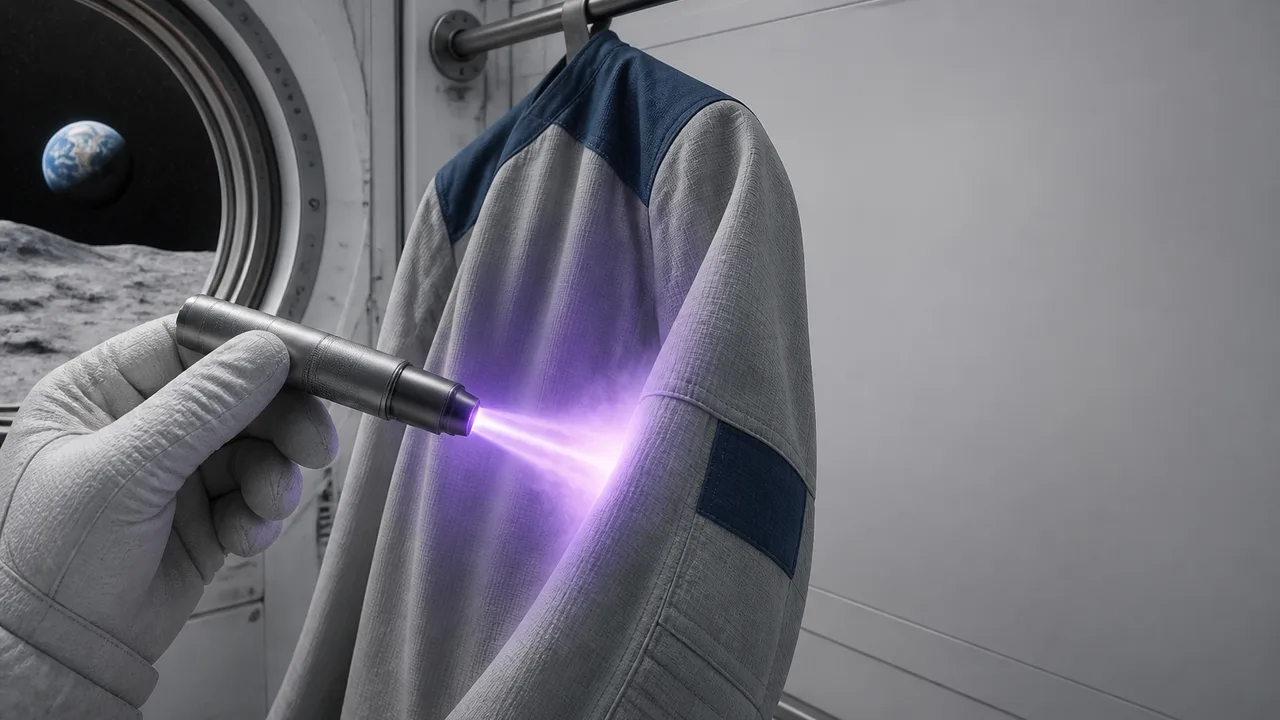
Nobody talks about the laundry problem when they talk about going to Mars. They talk about radiation shielding, propulsion systems, psychological isolation, food supply. Fair enough—those are the headline killers. But somewhere around month four of a seven-month transit to the red planet, the astronaut who can't change their socks becomes a genuine medical variable, not a punchline.
Bacteria don't care about mission objectives. Left unchecked in a sealed habitat with limited airflow and no washing machine, they accumulate on fabric, on skin, on surfaces. The ISS has documented elevated microbial loads in its crew quarters. Studies have tracked how certain opportunistic pathogens—not usually dangerous on Earth, where you can just shower—become persistent problems in microgravity environments where water is too precious to waste on laundry. This is the unglamorous, biologically serious constraint that a team at the University of Alabama in Huntsville is now trying to solve with something that looks, at least for now, like a fancy pen.
What the Device Actually Does
The UAH team, working in collaboration with NASA's Marshall Space Flight Center, has built a prototype plasma gun roughly the size of a pen, according to Space.com. It fires cold plasma—ionized gas generated at or near room temperature—directly into fabric, disrupting the cellular membranes of bacteria and neutralizing the compounds responsible for odor.
The "cold" distinction matters more than it might seem. When most people hear plasma, they picture the fourth state of matter at tens of thousands of degrees—the stuff of fusion reactors and lightning bolts. Cold atmospheric plasma is a different animal: ionized enough to be chemically reactive, but not hot enough to char the shirt you're trying to clean. It's already in medical use for wound sterilization and surface decontamination in surgical settings. The UAH team is applying the same underlying physics to a different problem.
Gabe Xu, an aerospace engineer at UAH, told Gizmodo that the current prototype is a proof-of-concept, with a plasma stream about the size of a pencil that can sanitize roughly one square centimeter at a time. That's slow going if you're trying to clean a full flight suit—but the device's value isn't in competing with a washing machine on throughput. It's in doing something a washing machine flatly cannot do in microgravity: clean fabric with no water at all.
The Water Equation
Water recycling aboard the ISS is already a marvel of engineering—the station's Environmental Control and Life Support System recovers roughly 90-plus percent of crew water from humidity, urine, and other sources. But that recovered water is load-bearing. It's drinking water, experiment coolant, electrolysis feedstock for oxygen generation. Using meaningful quantities of it to run laundry is, in the current calculus, a non-starter.
The practical consequence is that ISS crews wear clothing for extended periods before it's simply discarded—resupply missions bring fresh garments, and used ones are packed into departing cargo vehicles that burn up in reentry. It's not the most elegant system. And for missions beyond low Earth orbit—to the lunar Gateway, to a Mars surface base—resupply isn't a quarterly event. The mass and logistics cost of shipping clean clothing to Mars would be punishing.
A device that sanitizes clothing, bedding, and other fabrics without water or traditional cleaning chemicals, as 256Today reports the UAH team is developing, isn't just a quality-of-life upgrade. It's a mass-budget intervention. Every kilogram you don't have to launch in replacement clothing is a kilogram available for something else, or a cost reduction that makes the mission more viable in the first place.
Universe Magazine notes that the device is explicitly designed to function in microgravity—which is a non-trivial engineering consideration. Plasma behavior in the absence of convection currents is not identical to its behavior at 1g, and designing a handheld device that works predictably while floating in a pressurized habitat requires testing and iteration that ground-based prototypes only partially address.
The Gap Between Proof-of-Concept and Flight Hardware
Here's where I want to be honest about the distance between what exists and what's being described. The current device sanitizes about a square centimeter at a time. A full set of astronaut clothing—undergarments, mid-layers, flight suits—represents many square meters of fabric. Doing the math on that coverage rate, even generously, reveals that the prototype in its current form is more scientific demonstration than practical tool.
Xu's comment to Gizmodo that the device could, if scaled up, help astronauts sterilize spacesuits and tools as well is genuinely interesting—spacesuit sterilization before planetary surface exploration has real scientific stakes, since Earth microbes hitching a ride on a suit could contaminate sample sites and confound life-detection experiments. But "if scaled up" is doing a lot of work in that sentence, and the sources are appropriately careful not to promise a timeline.
Newswise's coverage of the research frames this as a technology advancing toward that potential, not a product ready for a launch manifest. Phys.org similarly positions it as research that could transform future missions—with the emphasis on "future." The NASA Marshall Space Flight Center collaboration is a meaningful signal that this isn't purely academic; NASA doesn't typically co-develop proof-of-concept hardware it has zero intention of eventually flying. But early-stage aerospace research has a long road between a promising prototype and certified flight hardware.
The honest read is that this is a real technical advance on a real problem, at a stage where the most important next steps are ones we don't have detailed reporting on yet: durability testing, microgravity performance validation, power consumption analysis, and integration with habitat life support systems.
Why This Particular Problem Deserves More Attention
Space medicine researchers have been documenting the immune and microbiome effects of long-duration spaceflight for years. Astronauts return from extended ISS stays with measurable changes to their immune function—some suppression, some dysregulation. The microbial environment they live in during those months is a contributing variable that's not fully characterized. A technology that meaningfully reduces bacterial load on the surfaces closest to the crew—their clothing and bedding—has implications that go beyond comfort.
There's also the psychological dimension, which doesn't get enough credit in engineering conversations. The social friction of living in close quarters with people who cannot adequately clean themselves for months is not a trivial stressor. Astronaut psychological health on long-duration missions is a documented area of concern for agencies planning crewed deep-space exploration. The ablity to maintain something resembling basic hygiene norms is part of the habitability equation.
None of this is to oversell a pen-sized plasma emitter. But it is to say that the problem this device addresses has been hiding in plain sight, treated as a background condition of spaceflight rather than a solvable engineering challenge. The UAH team appears to be among the first to take it seriously as the latter.
The question worth watching isn't whether cold plasma can kill bacteria on fabric—it can, and the physics isn't controversial. The question is whether a version of this device can be made reliable, safe, energy-efficient, and operationally simple enough that a crew already managing extraordinary cognitive demands can incorporate it into a daily routine, in a pressurized tin can, somewhere between here and Mars.
That's a different kind of problem than the science. And it's the one that will actually determine whether astronauts ever get clean clothes.
More Like This
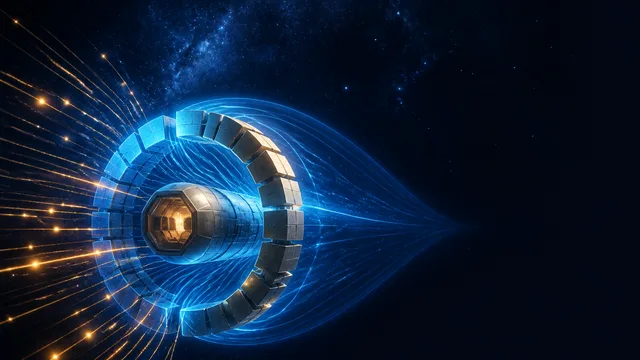
Magnetic Shielding for Space Radiation: What's Possible
A new study assesses neodymium permanent magnets as radiation shields for spacecraft. Here's what the physics allows, what it doesn't, and why this problem won't go away.

Water as Rocket Fuel: The Case for Electrolysis
Water electrolysis propulsion could reshape space travel. Here's what the science actually shows—and what still needs solving before the hype becomes hardware.
The Most Sensitive Dark Matter Detector Might Find Nothing
LUX-ZEPLIN sits a kilometer underground, waiting for dark matter. But success might look like silence—and that would tell us something huge.

Heavy Spoilers Builds an Office, Ditches the Algorithm
YouTube creator Paul from Heavy Spoilers explains why he built a garden office, changed his logo, and chose depth over views in content strategy.
Why NASA Is Finally Returning to Venus After 40 Years
After decades of neglect, Venus is getting two NASA missions. Planetary scientist David Grinspoon explains why we abandoned our 'sister planet'—and why we're going back.
How Nanoparticles Are Already Changing Everyday Life
From self-cleaning glass to cancer detection, UCL's Professor Ivan Parkin maps what nanoparticle science can actually do right now — and where it still falls short.
Brian Keating on What Came Before the Big Bang
Cosmologist Brian Keating explains the multiverse, dark energy, string theory's fatal flaw, and why finding extraterrestrial wisdom matters more than finding aliens.

Seven Proofs That the Harmonic Series Diverges
Michael Penn's 31-minute video walks through seven distinct proofs that the harmonic series diverges—from a 1350 grouping trick to a prime-number infinite product.