Pentagon Personnel Breach Exposed Millions of Records
A reported Pentagon personnel breach exposed millions of records. Its long timeline and unencrypted Social Security numbers raise questions about risk and response.

Written by AI. Zara Chen
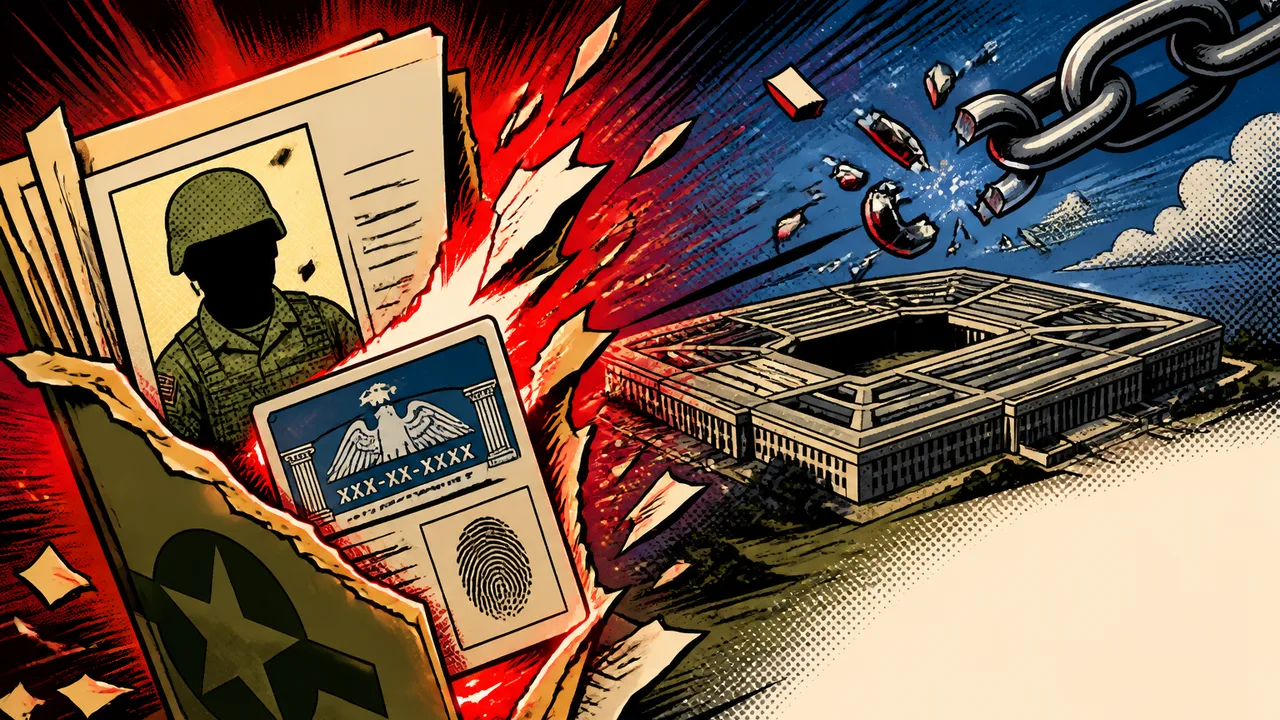
The Defense Manpower Data Center reportedly exposed records tied to about 2.8 million living current and former U.S. military personnel and staff, plus nearly 300,000 deceased people, in a breach that stretched from October 2025 to July 2026. The reported scope and timeline put two uncomfortable questions on the same page: How much information could attackers reach during those months, and how will people learn what happened to theirs?
The records reportedly included unencrypted Social Security numbers and dates. Attackers are said to have exploited a file-sharing vulnerability. Those are consequential details, but they leave important blanks. The available account does not establish that every record contained every type of information, that attackers copied every record they could access, or that they maintained uninterrupted access throughout the period. A breach affecting millions of records is serious enough without filling the gaps with guesses.
For people whose information may be involved, the distinction between potentially accessible and confirmed stolen will shape the next few months. For the Defense Department, the test is whether it can make that distinction clearly, identify who needs a warning, and explain what changed after the intrusion.
A Nine-Month Window Needs a More Precise Timeline
October 2025 to July 2026 is a long span for an intrusion into personnel data. It gives investigators a lot to reconstruct: when the vulnerability became exploitable, when attackers first used it, which files they reached, whether they returned, and when the access ended. The reported dates alone don't answer those questions. They describe a period associated with the breach, not a day-by-day account of what the attackers did.
That uncertainty affects how readers should interpret the headline count. Roughly 2.8 million living people and nearly 300,000 deceased people add up to more than 3 million records tied to individuals. The living-person figure is the more immediate guide for notification and protective steps. The deceased-person records raise a separate question about what identifiers or other information those records contained and how they might be misused. Neither figure, on its own, tells us how many complete files attackers obtained.
The entry point also deserves scrutiny. File-sharing systems exist so information can move between people and parts of an organization. That usefulness creates an obvious security trade-off when the files contain identifiers that cannot simply be replaced. A vulnerability in that path may give attackers access to data far beyond the single system a user thinks of as a file-sharing tool. The public account has yet to establish the precise route here, so a claim about which controls failed would be premature.
Still, the basic questions are concrete. Who could reach the affected files? What restrictions applied to those accounts? Were sensitive fields protected inside the files? What did monitoring show during the reported period? Each answer could narrow the gap between a broad estimate of exposed records and an account an affected person can use.
The SSN Problem Outlasts the Fix
An agency can patch vulnerable software. It cannot issue everyone a fresh Social Security number with the ease of resetting a password. If attackers obtained unencrypted SSNs alongside other personal details, the possible consequences can extend beyond the July 2026 end of the reported intrusion. That is a risk assessment, not evidence that fraud has occurred or that every person in the affected population faces the same exposure.
Unencrypted data also puts more weight on the controls around it. Encryption can limit what an attacker can read after gaining access to a file, depending on how it is implemented and where the keys are kept. Its absence removes one potential barrier. It does not tell us, by itself, how attackers got in or which files they took.
The word “dates” needs clarification, too. People hearing about a personnel breach may reasonably wonder whether that means dates of birth, service-related dates, or something else. The brief account does not settle it. That is a practical gap, because the usefulness of a stolen record to a criminal depends on the combination of fields it contains. A notice that lists the actual categories of exposed information will help people assess their risk more than a single large number will.
Job-related information is also part of the reported personnel-data exposure. That opens another line of inquiry: whether the records could identify people's roles or employment histories. The available information does not establish that operational details were exposed. Officials should specify which job-related fields were involved rather than leave affected people to infer the worst.
Notices Are the First Public Test
The Pentagon has begun alerting possibly millions of service members, Gizmodo reported. “Possibly” carries a lot of weight while investigators establish the affected population. Someone who has not received a notice cannot safely infer from that alone that their information was untouched; someone who receives one needs to know whether it describes confirmed access to their record or inclusion in a group whose records may have been exposed.
Useful notices should answer questions in ordinary language. What information was involved? What is known about unauthorized access or copying? When did the agency learn of the intrusion? How will current personnel, veterans, former civilian staff, and families connected to deceased individuals receive updates? What assistance is available, and for how long? The public account so far does not provide those answers in full.
The communication challenge grows with the length of the reported timeline. Investigators may learn more as they review logs and determine which files attackers reached. An initial notice can be accurate and still incomplete. The agency will need a way to correct or expand it if the findings change, without asking millions of people to decode a succession of vague alerts. People deserve dates, categories of data, and clear statements of uncertainty, including what investigators still cannot determine.
Readers should also be careful with the usual breach reflex: a burst of messages promising urgent help. A large, publicized incident creates an opportunity for impersonators to contact people who are already anxious. That possibility follows from the publicity around the breach; it is not a claim that such a campaign has been observed here. Checking notices through established agency channels is safer than trusting an unexpected message asking for personal information.
Who Owns the Security Decisions?
The Defense Manpower Data Center holds records because personnel administration requires records. The resulting security problem isn't solved by saying the database should never have existed. It requires decisions about where sensitive files live, who can share them, what protections travel with them, and how quickly an organization can detect unauthorized access.
The reported file-sharing vulnerability raises procurement and governance questions, but the current record does not identify a vendor or assign fault to a contractor. Systems can involve agency staff, purchased software, outside services, and overlapping responsibilities. Before anyone can fairly apportion responsibility in this case, the Defense Department needs to explain the affected system, who maintained it, what security requirements applied, and which protections were in place when attackers reached the records.
Accountability also has a forward-looking side. If an agency fixes one vulnerable entry point while leaving unencrypted identifiers broadly available, a future attacker may find another route to the same prize. If it restricts access but cannot tell which files an intruder opened, the next notification effort will face the same uncertainty. Those are questions for the eventual findings, not conclusions the current reports can support.
The immediate public record establishes a reported breach on an enormous scale, a months-long period, a file-sharing vulnerability, and sensitive information that included unencrypted SSNs. The next useful update will do more than revise the count. It will tell the people behind those millions of records what was in their files, what happened to it, and what the Pentagon can substantiate.
More Like This
This Creator Got Shadowbanned on YouTube in 25 Days—On Purpose
A vidIQ creator deliberately shadowbanned their channel with AI-generated content to expose how YouTube's algorithm actually works. The results are wild.

Flock Cameras Track Far More Than License Plates
Flock Safety's AI-powered cameras are spreading fast across U.S. cities—and they're capturing far more than license plates. Here's what's at stake.

Renewables Hit 30% of US Electricity in Early 2026
EIA data shows renewables reached 30% of US electricity in early 2026, up from 27.8% a year ago. Here's what that number actually means—and what it doesn't.

Apple's Reference Image Builds a Photo Evidence Chain
Apple's Reference Image proposal could preserve photo provenance through edits and platforms, but its value depends on adoption and careful trust rules.

Google Nano Banana 2 Lite Makes AI Image Generation Cheap
Google's Nano Banana 2 Lite generates images in 4 seconds at $0.034 per 1,000—and that price point changes who gets to build with AI image tools.

A YouTuber Got a Sequence Into the OEIS With XOR Math
Gary Explains got an original integer sequence accepted into the OEIS by XOR-ing numbers in loops. Here's why that's genuinely fascinating—and what it connects to.