What Nintendo's $4.5M Switch Piracy Judgment Proves
Nintendo won $4.5 million by default against alleged Switch pirate James Williams. Here is what the ruling establishes, and what remains untested in court.

Written by AI. Mike Wierzbicki
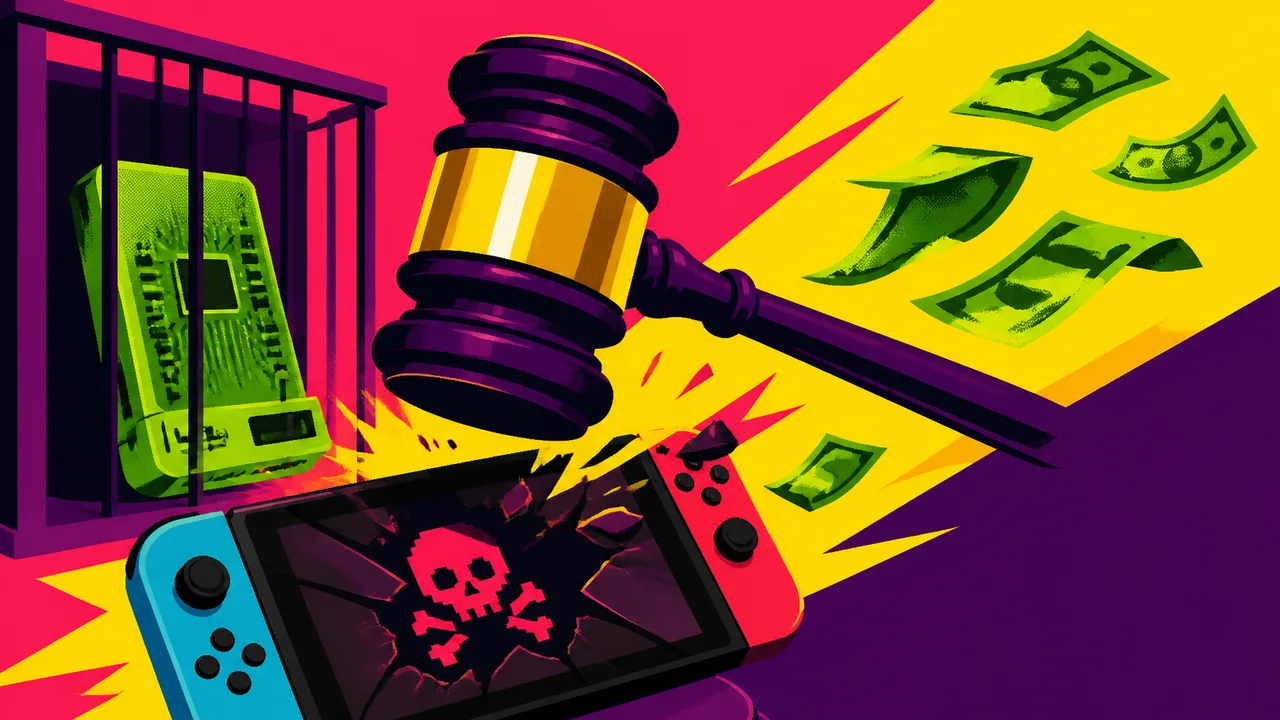
Nintendo won a $4.5 million default judgment against James Williams, the Reddit user known as Archbox, after he failed to respond to the company's Switch piracy lawsuit.
That result gives Nintendo an enforceable award and a broad injunction. It does not give readers a contested accounting of how Williams allegedly caused $4.5 million in damage. Nintendo selected that figure, Williams offered no courtroom opposition, and the court awarded what the company requested.
That sequence is more informative than another headline about Nintendo's lawyers collecting a pirate's skull for the lobby cabinet. It separates the legal result from the damages narrative surrounding it.
Nintendo Got the Amount It Requested
Nintendo sued Williams in a Washington district court on June 28, 2024, alleging copyright violations. The company described him as a moderator of r/SwitchPirates and the “operator, overseer, and driving force behind several Pirate Shops” distributing Switch games.
Williams did not respond to the lawsuit in court. Nintendo subsequently requested $4.5 million in an October 2025 motion, and the court granted that amount through a default judgment, according to Aftermath's account of the filing.
The resulting injunction orders Williams to disable access to online shops he operates or controls that offered libraries of pirated Switch games. He must also close piracy-linked social media accounts and stop distributing, advertising, selling, uploading or downloading Nintendo software or hardware, GamesIndustry.biz reported.
Those are concrete legal consequences. The damages figure requires more careful reading.
Nintendo said its injury was difficult to quantify and argued that $4.5 million was “nowhere near” enough to compensate it for the seriousness of the alleged conduct. The company also said it could have pursued several million dollars in additional statutory damages under the Digital Millennium Copyright Act, but characterized its narrower request as reasonable, according to Polygon's account.
The available reporting establishes three steps: Nintendo proposed the number, Williams did not challenge it, and the court entered it as an award. That supports describing $4.5 million as the judgment. It does not support treating the number as a precise, adversarially tested measurement of lost game sales.
The absence of a defense also does not show that Nintendo's allegations were false or that its request was arbitrary. Williams left the company's account unanswered, and the reporting contains no defense filing, competing damages model or financial records from his alleged shops. Readers are left with a binding judgment and an incomplete picture of the economics behind it.
One Repair Created the Identification Trail
The most useful lesson for piracy communities sits outside the damages total.
Game File previously reported, as relayed by Aftermath, that Nintendo connected Archbox's Reddit activity to a Nintendo account used for a hardware repair. Archbox had posted information indicating that he lived near Phoenix. A shipping address in Nintendo's customer-service system reportedly helped the company identify and serve Williams shortly after repaired hardware was returned.
That trail illustrates how enforcement works when an online alias touches an ordinary commercial system. A platform holder does not need to break an alias through exotic forensics if posts, account records and a repair address can be linked. The reporting does not disclose every evidentiary step, so it cannot establish how broadly Nintendo uses this method. In Williams' case, however, the mundane service record appears to have connected the public persona to a deliverable legal identity.
Reddit moderation alone also did not produce the $4.5 million award. Nintendo alleged that Williams operated and promoted shops offering extensive game libraries. Collapsing those allegations into “Reddit moderator sued for posting” would erase the commercial distribution activity at the center of Nintendo's case.
Switch Piracy Produced an Enforcement Pipeline
Nintendo's action against Williams belongs to a longer response to vulnerabilities around the original Switch, released in 2017. Major games appeared online before their planned release dates, while Nintendo pursued piracy sites, hardware hackers, software sellers and people livestreaming pirated games. The company has said it suffered an estimated $170 million in lost sales and, at one point, worked with the FBI.
That $170 million remains Nintendo's estimate, rather than a neutral industry-wide measurement. Still, the range of targets shows how its strategy expanded across the piracy supply chain: devices that circumvent protections, shops that distribute files, public promotion and identifiable operators.
A September 2026 ruling from the District Court of The Hague extended the device side of that strategy. The court made it illegal to sell MIG Switch and similar modding kits in Europe when those devices enable downloaded pirated games. Nintendo framed the action as protection for developers who depend on legitimate sales.
The developer-livelihood argument has a straightforward foundation. Game sales fund publishers, studios and the workers building those products, and unauthorized commercial distribution can divert sales. The public record summarized here does not quantify how Williams' alleged activity affected individual developers, royalties or staffing. Nintendo's broad labor claim therefore explains its enforcement rationale more clearly than it measures the harm in this case.
Taken together, the European device ruling and the Williams judgment suggest a two-track strategy: restrict circumvention products upstream, then pursue identifiable distributors and promoters downstream. The cases involve different jurisdictions and facts, so they do not create one global rule. They do show Nintendo applying pressure at more than one point in the distribution system.
The Comparisons Reveal Different Objectives
Nintendo's case against Ryan Daly and Modded Hardware offers the closest contemporary comparison. Daly's business sold modified original Switch systems, mod kits and flash carts. Nintendo and Daly initially reached an arrangement under which he would stop, but that deal broke down. Daly was eventually ordered to pay $2 million and relinquish equipment used to modify consoles, according to Kotaku's summary of the case.
Daly and Williams occupied different alleged positions. Modded Hardware sold tools and altered hardware; Nintendo accused Williams of operating shops with downloadable games and promoting piracy. Both outcomes combined money with operational shutdowns. That pairing suggests Nintendo values disabling infrastructure alongside obtaining a large judgment. Collection may take years or yield far less than the face value, while surrendered hardware and closed shops can interrupt activity immediately.
The reporting provides no information about Williams' assets or Nintendo's collection prospects, so any prediction about what Nintendo will recover would be guesswork.
Gary Bowser supplies a more severe precedent, but published totals require caution. GamesRadar reports that Bowser was ordered to pay $4.5 million in 2021 and that the amount was later increased to $10 million, with repayment expected to continue through his working life. TheGamer instead describes Bowser as receiving a $14.5 million fine. Without the underlying judgments in this record, those figures cannot be cleanly reconciled, so $14.5 million should not be dropped into the Williams comparison as if every outlet were describing the same obligation.
Bowser's long repayment horizon exposes the gap between a judgment's headline value and its collectability. Williams now faces a $4.5 million obligation, but the available reporting establishes neither his capacity to pay nor how aggressively Nintendo will pursue collection.
The injunction operates without waiting for that answer. Nintendo received an order aimed at shops, accounts, promotion and distribution, while the unchallenged damages request became a $4.5 million judgment. For anyone trying to understand the enforcement strategy, the shutdown powers and the repair-record trail explain more than the large number does.
More Like This
Xbox Is Closing Studios While Promising More Exclusives
Microsoft is moving to shutter Double Fine, Ninja Theory, and Compulsion Games while doubling down on exclusives. The math does not work out.
WoW Gold-Making in Patch 12.0.7: Strategies and Trade-offs
ElonCS breaks down cross-realm flipping, crafting, and burnout management in WoW Midnight's Patch 12.0.7. Here's what actually works and what it costs you.