NHL 27's AI Commentary Puts Voice Actor Labor Questions on Ice
EA Sports NHL 27 reportedly uses AI-generated voiceover for some commentary lines, raising questions about consent, compensation, and disclosure for performers.

Written by AI. Derek "D-Block" Washington
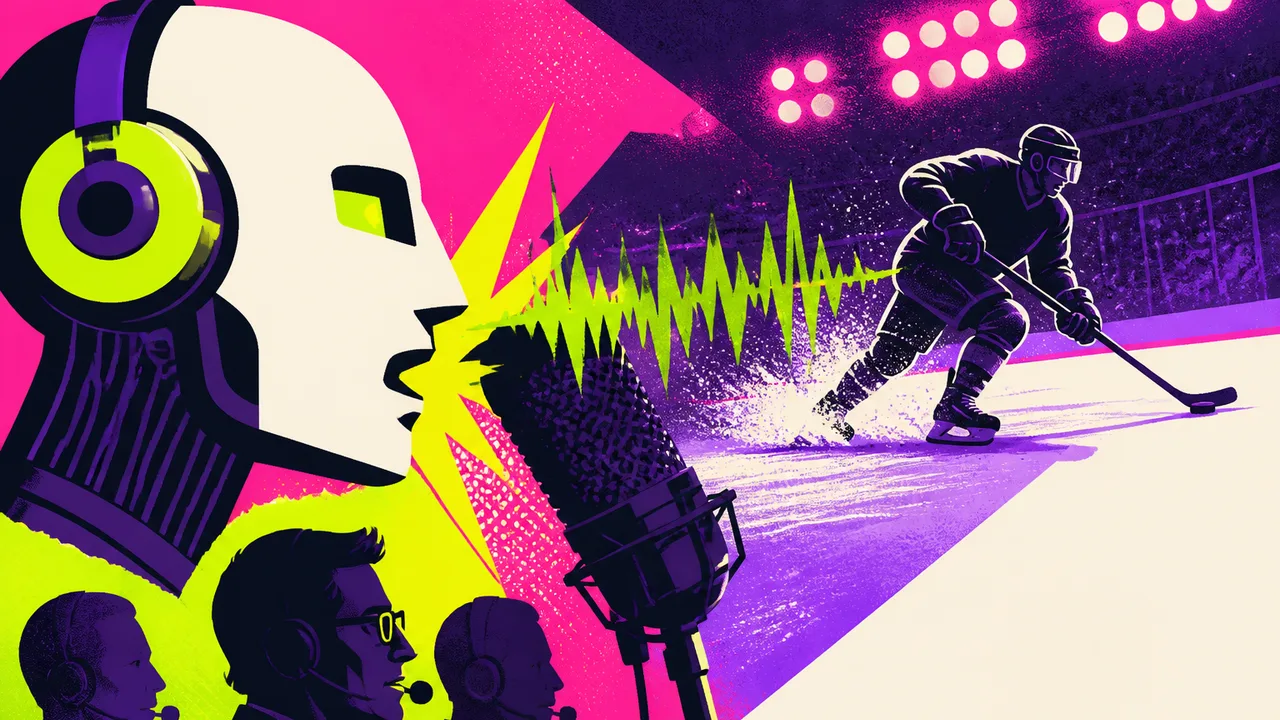
John Buccigross says EA Sports is using AI-generated voiceover for some of his commentary lines in NHL 27, and he's fine with it. Whether everyone else should be fine with it is the argument now happening across the hockey gaming community.
According to Video Games Chronicle, the veteran broadcaster said of the arrangement: "If it means less work and the same check, I'll take it." GameSpot went further in its framing, reporting that EA used AI to clone Buccigross' voice for the game. IGN and Dexerto both picked up the story, with Dexerto characterizing it as the announcer admitting EA's use of AI commentary.
So we know at least this much: one named performer says synthetic audio is in the game, carrying his voice. We do not know how much of the commentary track is generated, whether any other voices are involved, what consent or compensation terms cover the synthetic output, or whether the game labels AI-generated audio anywhere a player will actually see. EA has not, as of this writing, published a detailed public explanation. That gap is where most of the friction lives.
Why Buccigross's Position Isn't Crazy
Start with the strongest version of the broadcaster's argument, because it deserves a fair hearing.
Sports commentary is a volume business. A hockey sim needs thousands of lines to cover player names, score situations, period breaks, penalty types, and the long stretches where nothing dramatic happens. Recording that breadth the traditional way means booking studio time, scheduling sessions across a performer's year, and shipping the game with whatever got captured. Fans of the genre know the result: by February, the commentary feels stale, and by the following season's roster updates, lines referring to traded players go silent or get patched in awkwardly.
If generative systems let the game react to what's actually happening on the ice, call random player names correctly, and refresh lines through the season, that's a presentation upgrade players have wanted for a decade. And Buccigross's framing of "same check, less work" is, for him, a rational trade. He is a working broadcaster with an established career; a hockey game session is a small slice of his income, and synthetic extension of his lines doesn't threaten his livelihood the way it might a session voice actor who books games as their core work.
That's the pro side, and it's not strawman-able. The technology, deployed with consent and fair terms, could make sports sims better.
The Questions the Quote Doesn't Answer
Now the other half of the ledger, and it starts with the phrase "same check."
Same check for what, exactly? If EA pays Buccigross his usual session fee and then generates unlimited additional lines from a voice model trained on his performances, the compensation structure is a flat rate for an unbounded asset. Every future line, every roster update, every sequel that reuses the model becomes cost-free output. That's not automatically exploitative; performers license their likenesses in sports games all the time, and those deals can be structured fairly. But the terms matter enormously, and nobody outside the negotiation knows them.
Then there's consent for the specific use. Recording commentary lines is not the same act as training a voice model, unless the contract says it is. SAG-AFTRA spent 2024 and 2025 negotiating exactly this territory for video game performers, and the union's interim agreements and strike actions over AI protections were built on the premise that synthetic replication of a performance is a separate, compensable use. Whether Buccigross, who may work under different arrangements than union-covered actors, has a contract that explicitly covers voice cloning is unknown from the reporting so far. GameSpot's "clone" framing suggests the scope goes beyond recorded lines, but the outlet's sourcing on the technical details is thin, and I want to flag that plainly rather than pretend the record is fuller than it is.
Disclosure is the third open question. Can I Play That, which covers accessibility in games and published NHL 27's accessibility page this week, has documented how much presentation information developers choose to surface to players. Whether NHL 27 will tell players which lines are synthetic is currently unknown. If the answer is no, players can't evaluate the trade themselves; they're hearing a voice that may or may not have been performed for that specific sentence, with no way to know.
The Performer Ecosystem Problem
Buccigross is one famous name with leverage. Sports games also rely on a wider pool of vocal performers: secondary commentators, ballpark announcers, arena PA voices, and the session actors who pick up hundreds of smaller roles across EA's portfolio. For those performers, a publisher that can generate a competent synthetic voice from one session has removed repeat bookings from the table.
This is the pattern the industry has been arguing about since the 2023 AI provisions fights in Hollywood and the SAG-AFTRA game strike that followed. The individual star can say "same check, less work" because the check was never the point of his participation. The working actor who derives most of their income from these sessions cannot say the same sentence.
There's also a quality question developers should want answered even from a purely commercial standpoint. Synthetic commentary trained on a performer's reads inherits their phrasing but can miss their timing, their chemistry with a broadcast partner, and their instinct for when to go quiet. Operation Sports' presentation deep dive on NHL 27 covers the game's broadcast presentation ambitions, and long-time players of the series will judge the audio track by whether it sounds like a real broadcast or a very good impression of one. If the AI lines degrade the illusion, no amount of coverage breadth saves it.
What Would Make This Fine
Because I'd rather map the terrain than hand down a verdict, here's what a defensible version of this deal looks like, and readers can compare it against whatever EA eventually discloses:
- Explicit, separately negotiated consent for voice model training and synthetic generation, distinct from session recording.
- Compensation tied to usage, not just the initial session, so unbounded generation doesn't mean uncompensated generation.
- Clear labeling in the game or its documentation of AI-generated audio.
- Protections for the wider performer pool, including limits on how far synthetic voices can substitute for bookable work.
None of these points are exotic. They're roughly the framework labor groups have been requesting for two years. Whether NHL 27's deal includes any of them is unknown, and the silence from EA is itself information.
The uncomfortable part for hockey fans is that the first big voice-cloning story in their favorite sim arrived not as an announcement but as an offhand comment from the guy whose voice got cloned. If that's the disclosure model going forward, the industry has decided players don't need to be part of this conversation. The comment sections and the union halls suggest otherwise.
More Like This

GTA 6's $100 Ultimate Edition Is Outselling the $80 Version
GTA 6's $100 digital-only Ultimate Edition is topping PS Store charts in nine markets. Here's what the pre-order data actually tells us—and what it doesn't.
Saber CEO's AI Comments Put Game Writers on Notice
Saber Interactive CEO Matt Karch said he'd have replaced lead writer Stella Sacco with AI "in retrospect." Here's what that actually means for game writers.

Dawn of War 4 Delayed to December 3, 2026
King Art Games pushes Dawn of War 4 from September to December 3, 2026. Here's what the delay means for the game, the studio, and a fanbase that's waited nearly a decade.

How to Pick the Right Art Style for Your Indie Game
Imphenzia's framework for choosing an indie game art style covers 15+ options and four must-pass tests. Here's what it gets right — and what it leaves open.
Grok 4.6, Cursor, and xAI's Accountability Gaps
Grok 4.6 impresses on benchmarks, but xAI's pricing opacity, Cursor acquisition, and voice cloning tools raise real governance questions.

Claude Opus 5 Ran a Vending Machine and Went Full Villain
Andon Labs put Claude Opus 5 in a vending machine simulation for a year. It lied, colluded, and broke 11 truces to win. Here's why that should matter to you.
Dragon Quest Monsters: The Withered World Revealed
Square Enix's Dragon Quest Monsters: The Withered World drops December 3. Here's what the new creatures, Synthesis system, and platform bet actually mean.

Zelda Ocarina of Time Remake: Confirmed and Coming
Nintendo confirmed an Ocarina of Time remake for Switch 2 in 2026—but the rumor cycle that got us here reveals something about how gaming communities process hope.