New Radio Model Sharpens Detection of Cosmic Particles
A new spherical-wave forward model for radio reflection in stratified media could sharpen cosmic particle detection—here's what that means and why it matters.

Written by AI. Nadia Marchetti
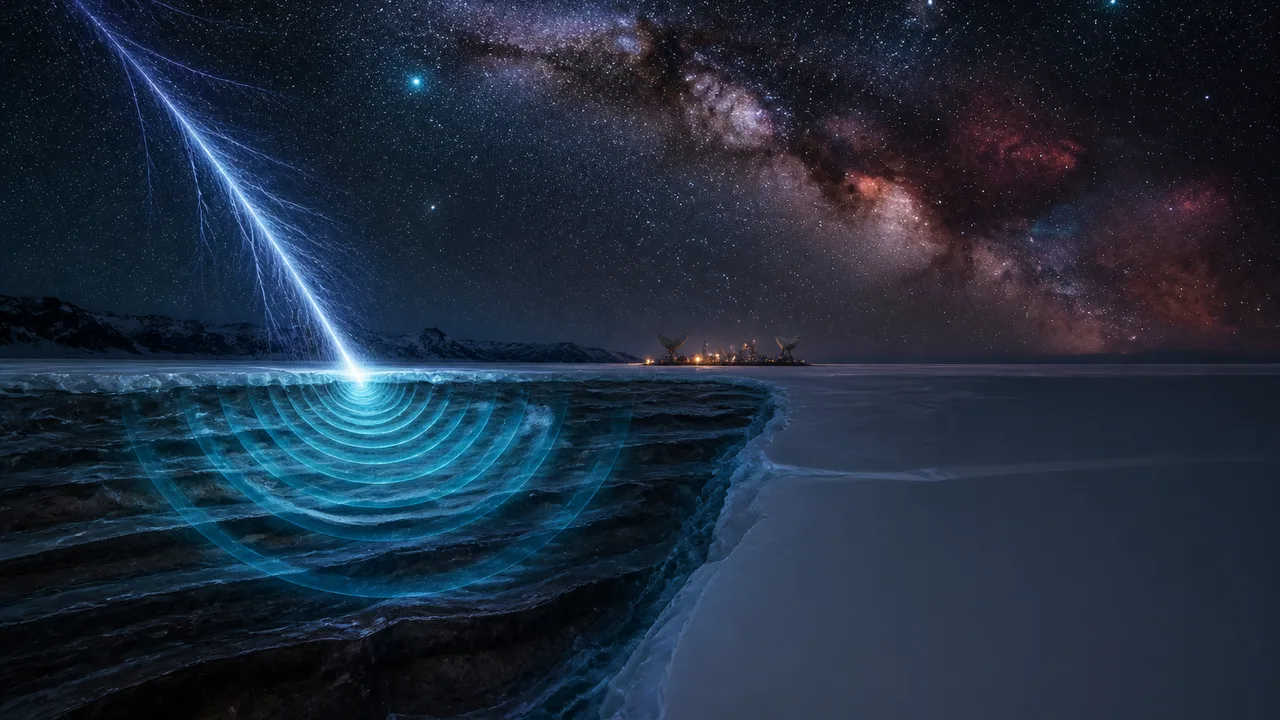
When a radio pulse hits a boundary between two media—say, the surface of a polar ice sheet or the edge of a layered atmosphere—it doesn't just bounce cleanly like light off a mirror. It refracts, it scatters, it bleeds through at different angles depending on frequency. The physics of what happens at that interface is genuinely complicated, and for decades, researchers working in particle physics and atmospheric science have been modeling that complexity with tools that, quietly, were making a simplifying assumption: that the boundary in question involves just one interface, between two homogeneous media.
Nature, as the National Bureau of Standards Journal of Radio Propagation noted in foundational work, "offers numerous examples of irregular stratification of the medium." Ice sheets are layered. The atmosphere has gradients. The real world, frustratingly, is not made of clean single-layer sandwiches. And the gap between what models assumed and what nature actually provides has been a quiet source of measurement error sitting underneath some of the most ambitious particle detection experiments on Earth.
A new forward model described in a paper on arXiv addresses that gap directly. The approach, which the authors call an exact spherical-wave forward model for radio reflection from stratified media, extends the existing spherical-wave treatment—which was itself already a refinement over simpler plane-wave approximations—to handle the layered-medium case rigorously.
What the Old Model Got Right, and Where It Left Off
To understand why this matters, it helps to understand the lineage. Modeling electromagnetic behavior at interfaces goes back at least to Fresnel coefficients in the nineteenth century. The classical treatment works cleanly when you have a plane wave hitting a single flat boundary: compute the reflection and transmission amplitudes, done. The problem is that real radio detection experiments don't use infinitely distant plane-wave sources. They use antennas near surfaces, producing spherical wavefronts—waves that spread outward from a point, not traveling in perfect parallel planes.
According to NIST's overview of electromagnetic waves in stratified media, the incident field in practical scenarios "can be either a plane wave (as from a distant source) or a spherical" one, and the two cases require meaningfully different mathematical machinery. Treating a spherical wave as if it were a plane wave introduces errors that compound at the precision levels demanded by modern particle detection.
The spherical-wave treatment—decomposing the wavefront into its constituent plane-wave components, computing reflection for each, then reassembling—handles this more honestly. The new model, as described in the arXiv paper, extends that approach by "replacing the Fresnel coefficient of each plane-wave component with the characteristic-matrix reflection coefficient of a layered medium, evaluated in the local tangent plane on the spherical surface." In plain terms: instead of asking how each angular slice of a spherical wave reflects off a single boundary, the model asks how it reflects off the full stack of layers underneath it. The difference sounds incremental. The implications for measurement accuracy are not.
The paper's authors describe three main results. First, the spherical-wave forward model for stratified media reduces, at machine precision, to the validated single-boundary calculation in the limiting case—which is exactly the kind of sanity check you want before trusting a new model with expensive experimental data. Second, the work determines an elevation-dependent refractive index required for polarization calculations. Third—and this is where the practical payoff comes in—the model opens a more accurate path for interpreting broadband radio signals bounced off complex natural surfaces.
Why the Detection Community Cares About Layers
The context for this research is the detection of ultra-high energy cosmic neutrinos and cosmic rays—particles arriving from deep space with energies so extreme that they interact with dense media (Antarctic ice being the canonical case) and produce detectable radio Cherenkov emission. Experiments like ARA and RNO-G have been designed around precisely this phenomenon: bury antennas in ice, listen for the radio pulses that mark a high-energy particle interaction.
The ice, however, is not a monolith. Antarctic ice sheets are built up over hundreds of thousands of years, layer by layer, with varying density profiles near the surface—a region called the firn—transitioning to denser, more uniform ice below. Those density gradients change the local index of refraction for radio waves. That variation affects how signals propagate, how they reflect off internal and surface boundaries, and ultimately how precisely you can reconstruct what happened when a particle arrived.
If your reflection model assumes a single clean interface but your detector is actually sitting in a stratified medium, your reconstructed particle properties—direction, energy, distance—accumulate systematic errors. The new model is an attempt to close that gap, and the arXiv paper is specific about its ambition: this is a forward model, meaning it predicts what a detected signal should look like given a known source. That predicted template is what you match your real data against.
It's worth being honest about what the record says and doesn't say here. The paper lays out the mathematical framework and demonstrates internal consistency, but a forward model is a tool—its ultimate value will be judged by how much it sharpens experimental results in practice. The bridge between a cleaner model and a measured improvement in detected particle statistics involves real experiments, real calibrations, and the accumulated messiness of physical instruments operating in genuinely harsh environments. The paper makes the case for the tool; the experiments will decide whether the tool earns its keep.
The Broader Ecosystem of the Problem
Stratified-media modeling isn't a niche problem confined to particle astrophysics. It surfaces anywhere radio waves interact with a layered physical environment—ground-penetrating radar used in glaciology, subsurface sensing in environmental monitoring, even antenna performance above layered ground in telecommunications engineering.
A separate 2025 arXiv paper on antenna-medium interactions above planar stratified media takes a complementary approach, presenting "a rigorous and computationally efficient method for evaluating the reflection coefficients of antennas operating above planar layered media" using a generalized scattering matrix framework. The existence of parallel efforts in this space suggests the problem is both persistent and genuinely unsolved to current satisfaction—different research groups, approaching from antenna engineering and particle physics respectively, running into the same underlying limitation of existing models.
The Cambridge text on radio wave propagation treats stratified media as a mature subject worthy of appendix treatment—which is accurate in the sense that the foundational theory is well-established, but potentially misleading if it suggests the practical modeling challenges are fully resolved. They clearly aren't, or researchers wouldn't keep publishing new approaches to them.
What makes the spherical-wave forward model notable, in context, is its combination of mathematical exactness and physical realism. Exact solutions that reduce to known cases at machine precision are genuinely rare and genuinely useful: they give experimenters a reference point they can trust, rather than an approximation they have to continuously cross-check.
A Tool in Search of Its Test
There's a version of this story where the new model is quietly absorbed into experimental pipelines, improves reconstruction accuracy by measurable margins, and gets cited in papers whose abstracts never mention it directly. That would be, in a real sense, the best outcome—a methodological advance that makes the next generation of detections more trustworthy without requiring anyone to throw a parade.
The more interesting open question is whether the improvement is large enough to matter at the precision frontier. Current neutrino telescopes are attempting to detect events rare enough that systematic errors in reconstruction can skew results significantly. If stratified-media effects are contributing a non-trivial share of that systematic uncertainty—and the existence of this model suggests researchers believe they are—then having a more rigorous treatment could shift what experiments can claim with confidence.
That's the thing about infrastructure work in science. It doesn't change the universe. It changes what we can see of it.
More Like This
The Most Sensitive Dark Matter Detector Might Find Nothing
LUX-ZEPLIN sits a kilometer underground, waiting for dark matter. But success might look like silence—and that would tell us something huge.

Heavy Spoilers Builds an Office, Ditches the Algorithm
YouTube creator Paul from Heavy Spoilers explains why he built a garden office, changed his logo, and chose depth over views in content strategy.
How Astroparticle Physics Built Itself From Borrowed Parts
A new arXiv review traces how astroparticle physics didn't emerge from a single discovery—it assembled itself from three fields that kept bumping into the same cosmic questions.

Why NASA Is Finally Returning to Venus After 40 Years
After decades of neglect, Venus is getting two NASA missions. Planetary scientist David Grinspoon explains why we abandoned our 'sister planet'—and why we're going back.
James Webb Telescope Data Strains Big Bang Cosmology
Philosopher of science Bjørn Ekeberg argues Webb's early galaxy findings expose a deeper problem: cosmology's dependence on interpreting light it cannot fully verify.
A Dead Star May Confirm a 90-Year-Old Quantum Theory
A magnetar's extreme magnetic field may finally confirm vacuum birefringence — a quantum prediction nearly 90 years old that we've never been able to test on Earth.
Seven Proofs That the Harmonic Series Diverges
Michael Penn's 31-minute video walks through seven distinct proofs that the harmonic series diverges—from a 1350 grouping trick to a prime-number infinite product.

Artemis 2 Carried America's 250th Birthday to the Moon
NASA's Artemis 2 mission carried "America 250" markings to lunar orbit, blending national celebration with the next chapter of deep space exploration.