Minecraft's Sift Reveals How Mojang Builds Worlds Now
The Sift is Minecraft's first new dimension since 2011. Its Dungeons 2 debut reveals how Mojang now designs and stages major additions to its world for fans.

Written by AI. Sarah O'Brien
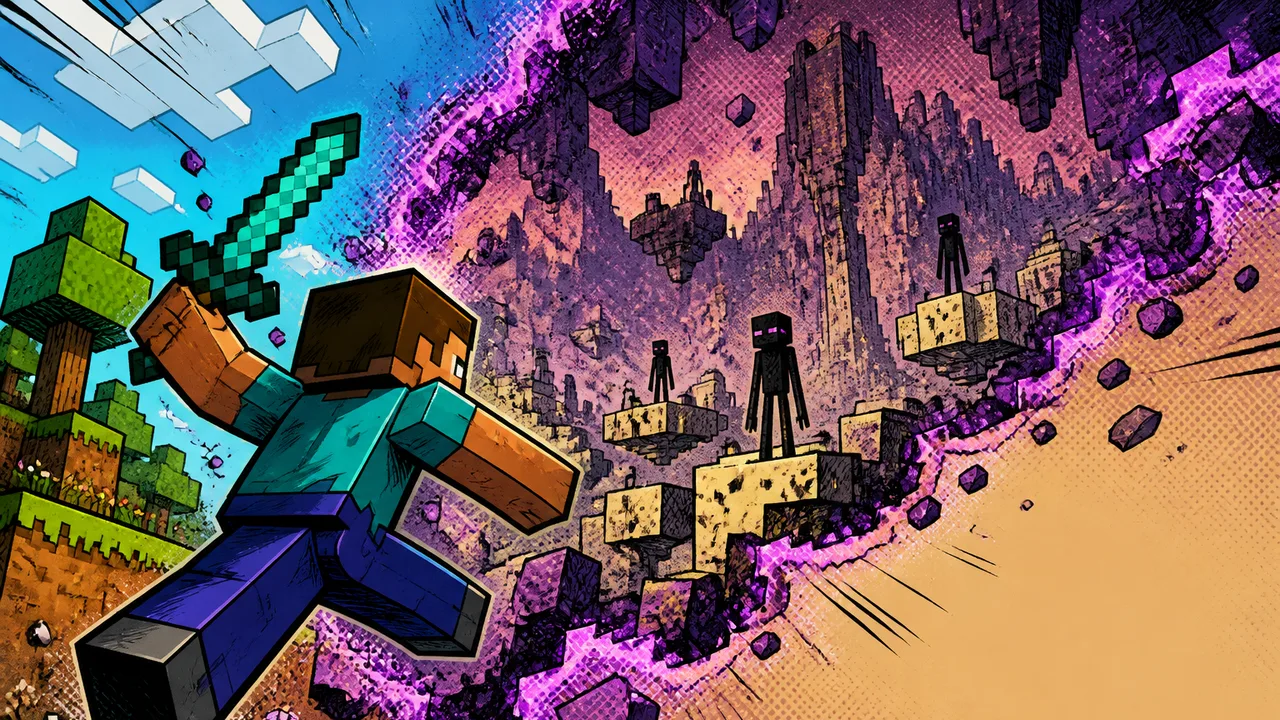
Mojang says The Sift will become Minecraft’s fourth dimension when it reaches the Java and Bedrock editions in 2027. Before then, players will encounter it in Minecraft Dungeons 2, which launches on September 29, 2026.
That order gives the announcement an unusual shape. The first addition to Minecraft’s roster of dimensions since The End arrived in 2011 will make its public debut inside a separate action-adventure game. Its eventual form in the sandbox, including how players enter it and what they do once inside, remains largely unannounced.
The result is a reveal with two stories packed inside it. One concerns a colourful world with bone structures and blue, rabbit-like creatures. The other concerns how Mojang has changed since the improvised development years that produced the Nether and The End.
The 14-Year Gap is Nearly 15 Years
Some early headlines have called this Minecraft’s first new dimension in 14 years, others in 15 years, and at least one described the interval as nearly 16. The underlying dates are simpler than the headline arithmetic.
The Nether arrived in 2010, followed by The End with Minecraft’s 1.0 release in 2011. The End was released in October 2011, while The Sift’s Dungeons 2 debut falls on September 29, 2026. That puts the interval between those appearances just short of 15 years. Mojang’s own announcement uses the defensible formulation “over 14 years.” The Java and Bedrock release will come sometime in 2027, with no firmer date announced.
The calendar correction is useful because the gap defines the scale of the addition. Minecraft has received mobs, blocks, biomes and other changes throughout that period. A dimension sits deeper in the game’s architecture and fiction: it is a separate realm with its own environments, resources and travel rules. The Nether and The End consequently became parts of how players move through Minecraft and pursue its resources, rather than fresh scenery pasted onto the Overworld.
Even The End has gone a long time without comparable attention. IGN noted before Minecraft Live that it had not received a substantial gameplay overhaul since version 1.9 in 2016. Expectations had gathered around an End update after promotional imagery showed an Eye of Ender and an Enderman. Mojang instead announced another dimension.
From Weekly Improvisation to Cross-Team Planning
Mojang supplied the sharpest comparison during Minecraft Live. In the broadcast segment covering Dungeons 2, one developer said the Nether and The End had been created “almost like a game jam.” The team would have an idea one week and release it almost immediately.
Development of The Sift followed a more deliberate process. The presentation said all teams became involved in deciding what the dimension should be. Its design brief called for a world that complemented the existing dimensions, looked and felt different, and supported the combat encounters expected from Dungeons 2.
That comparison comes from Mojang’s own account, so it describes the studio’s preferred framing rather than an external production audit. Even with that limitation, the contrast is instructive. The Nether and The End emerged while Minecraft itself was still taking shape. The Sift has to enter a mature game, a spin-off and a broader commercial franchise without feeling like a leftover biome with a fancy door.
Scale helps explain the caution. Xbox CEO Asha Sharma said Minecraft has sold more than 425 million copies over 17-plus years and attracts more than 300,000 first-time players on an average day, figures she published on X. Those are company figures, and no methodology accompanied them in the cited account. They still illustrate the range of players Mojang says it serves, from people learning to punch their first tree to veterans whose worlds predate some current players.
A dimension designed for that population carries competing demands. It needs to reward experienced players without becoming incomprehensible to newcomers. It also needs enough identity to justify its own realm while fitting beside three places that have accumulated years of player habits, builds and lore.
Dungeons 2 is a Preview, with Limits
In Minecraft Dungeons 2, rifts appearing across the Overworld transport players into The Sift. The first biome is the lush Meadow, followed by other areas including the Carapace, described during the presentation as a desert-like biome filled with huge bone structures. Mojang calls the dimension “beautiful, vibrant, and teeming with souls.”
The spin-off has an interconnected, guided world, jumping, jump attacks and action-focused combat. Its version of The Sift uses occasional rifts as entrances, which suits a game built around routes, encounters and loot.
Only the setting is confirmed to travel between Dungeons 2 and the main game. Its rules may change. Mojang has not announced whether Java and Bedrock players will use rifts, construct a portal, find an existing structure or meet some other requirement. It has also offered little detail about resources, progression, survival hazards, building systems or how the new mobs behave in the sandbox. IGN’s account of the event likewise found that Mojang revealed almost nothing about the vanilla mechanics.
Dungeons 2 therefore works as a preview of The Sift’s visual identity and fiction, rather than a reliable demonstration of its eventual Minecraft systems. That boundary protects Mojang from promising mechanics before they are ready, and gives the spin-off an attractive piece of the wider Minecraft universe at launch. It also means players of the base game have received a destination before receiving a reason to travel there.
This release sequence resembles a franchise rollout: establish the new place in one product, let its creatures and imagery circulate, then bring it into the main game later. That is an inference from the announced order, not a stated Mojang strategy. The evidence does not show whether Dungeons 2 has shaped the Java and Bedrock implementation, whether the teams are developing both versions in parallel, or whether player response will influence the 2027 release.
What Will Decide Whether the Sift Belongs
The Nether and The End offer a demanding comparison because their significance rests on their functions as well as their appearance. Both supplied resources and destinations that altered player behaviour. Mojang’s developers acknowledge that inheritance by describing dimensions as expansions of the Minecraft universe and by designing The Sift to complement the existing three.
Its bright palette, multiple biomes and soul-rich ecosystem establish a recognisable mood. Those elements cannot yet answer the practical questions that determine how long a Minecraft destination remains useful. Players still need to learn what can be found there, what can be brought home, how dangerous the journey is, and whether repeated visits produce more than screenshots and rabbit-related mischief.
The long development gap amplifies expectations, but age alone confers no importance. The Sift will earn its place through the systems Mojang has yet to show. Until those arrive, Dungeons 2 offers the first tour of Minecraft’s newest realm, while the door that counts for Java and Bedrock players remains unopened.
More Like This
Minecraft Comes to Nintendo Switch 2 on October 27
Minecraft lands on Nintendo Switch 2 on October 27 with Vibrant Visuals graphics and a digital upgrade path for existing owners. Here's what it means.
Minecraft Live 2026: New Biome, Wool Stairs & What's Next
Minecraft Live revealed the Dappled Forest biome, wool stairs, abandoned camps, and more for the Fall 2026 drop. Here's what it means for builders and creators.
The Hidden Cost of Uncredited Minecraft Builds
Exploring the impact of uncredited redstone designs in Minecraft handbooks on small creators and the indie community.

July 2026 Game Releases: Remakes and New IP
Halo remade again, Black Flag re-engineered, and a packed July of new releases arriving in GTA 6's shadow. What this month reveals about how the industry treats its catalog.
June 2026 Games: Preservation, Revival, and the Blacktop
Gothic 1 Remake, NBA The Run, Hell Let Loose Vietnam, and more—June's releases ask hard questions about what we save, what we lose, and why it matters.