The Late Bronze Age Collapse Had More Than One Timeline
Palaces burned and empires lost power, but the Late Bronze Age crisis unfolded unevenly. A treaty fragment and trade research reveal what 'collapse' can obscure.

Written by AI. Helen Papadopoulos
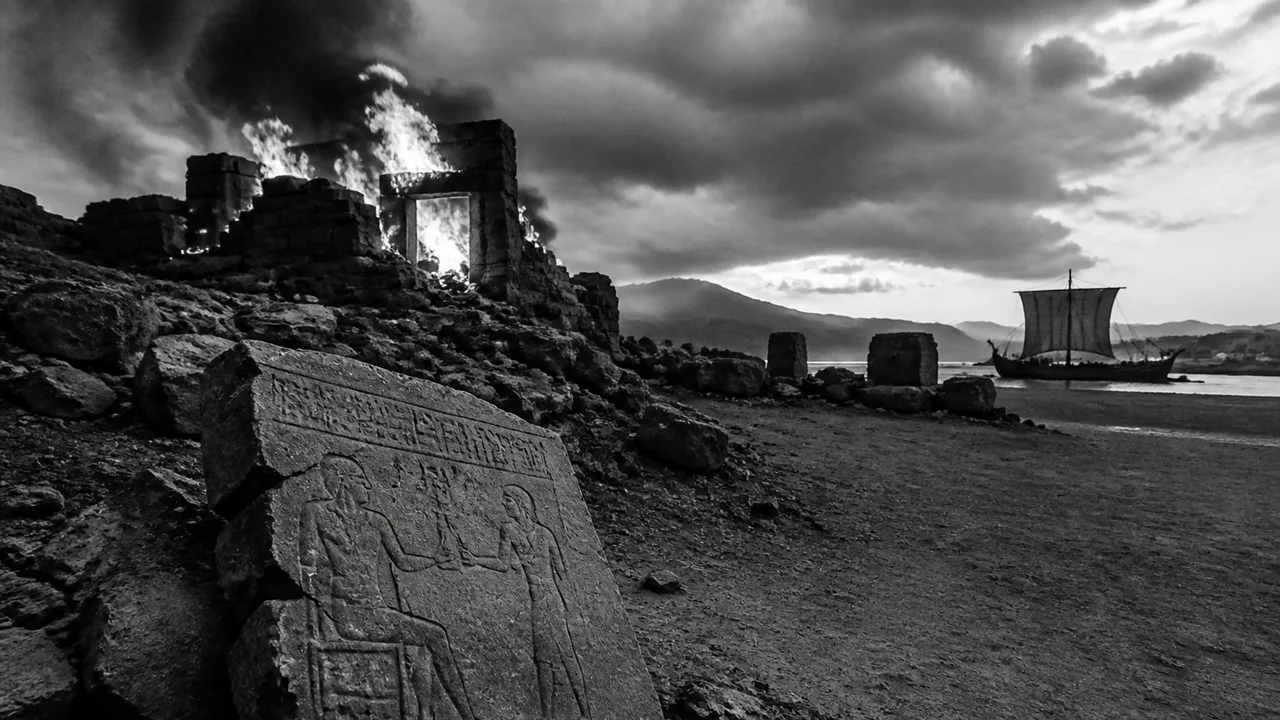
The Hittite king Hattusili III and Egypt’s Ramesses II made a treaty in the 13th century BCE that addressed what happened to people who fled from one kingdom to the other. A fragment identified at Hattusa preserves provisions concerning those people and their homes. The identification rests on research announced by Turkey’s Ministry of Culture and Tourism, as reported by ARTnews. The clay records an agreement between rulers; it cannot tell us how reliably either kingdom honored it.
It can tell us what their governments considered worth putting in writing. Alongside peace, mutual non-aggression and military assistance, the treaty provided for the return of fugitives. Its view from the palace is sharp: people appear as subjects whose movements kings hoped to regulate. That is a more revealing starting point for the Late Bronze Age than a map of kingdoms abruptly going dark. When powerful institutions failed or changed, what happened to the arrangements that connected rulers, resources and the people living under them?
The familiar answer is the Bronze Age collapse. Around the end of the second millennium BCE, Greek palace kingdoms fell and Hittite imperial power disappeared. Yet the label compresses a history that A. Bernard Knapp and Sturt W. Manning place at different points from the mid-to-late 13th through the 12th centuries BCE. Their review in the American Journal of Archaeology finds no overarching explanation for all the changes across the eastern Mediterranean. A single date on a map makes an efficient illustration. It makes a poor chronology.
The World Before the Rupture
The treaty belongs to a world in which major powers dealt with one another formally, even after rivalry. Its surviving fragment concerns people moving between Egypt and the Hittite kingdom, rather than kings simply exchanging assurances. Earlier fragments of Hittite copies were identified during excavations at Hattusa between 1906 and 1912; the newly identified piece may help reconstruct more of those tablets. A written agreement, copied and kept, shows one way a palace administration tried to make relations across a border durable.
Goods crossed distances too. In a review of Bronze Age eastern Mediterranean trade, archaeologist Sarah C. Murray describes exchange as central to the era’s political, social and economic life. Researchers study the sources and destinations of metal resources, as well as the distribution of ceramic containers and their contents. Taken together with the treaty, this gives us two forms of connection to keep in view: arrangements negotiated by rulers and movements of material that archaeologists can investigate. The treaty does not establish who controlled a shipment of metal. A ceramic container cannot, by itself, identify a royal policy.
Those limits are useful. It is tempting to picture the region as one enormous machine with each kingdom a gear. Murray emphasizes how hard it is to infer commercial exchange from objects that might have moved with different people for different reasons. She also points to the roles of merchants and traders. Palace decisions may have shaped parts of this world, but an account built entirely from royal documents would put kings in charge of every journey simply because kings left records about the journeys that interested them.
Now consider what the crisis changed. An account of the period by Patrick Fitzsimmons notes burning in Greek palace destruction layers and the loss of the kingdoms that ruled the mainland. The Hittite Empire, a rival of Egypt at Kadesh, also ceased to exist as an imperial power. Those are consequential political losses. A burned palace is evidence of a damaged site; the layer alone does not identify an attacker, explain why the fire occurred or establish what happened in every surrounding settlement. Nor does the end of an empire establish that every exchange involving its former subjects stopped.
Two Political Scales, One Historical Label
Mycenaean Greece and the Hittite realm offer a bounded comparison. Fitzsimmons describes southern Greece as a constellation of principalities, including Mycenae, Pylos and Thebes. Hattusa, by contrast, served as the political and administrative capital of an empire whose rulers made a treaty with Egypt. In one case, the label “collapse” groups the losses of multiple palace kingdoms; in the other, it marks the end of an imperial government. Both concern the failure of powerful institutions. Their political units were different sizes to begin with, so treating them as interchangeable cases risks hiding the very institutions whose fate we want to explain.
This comparison has a firm boundary. The broad accounts here establish disruption, but do not trace settlement-by-settlement life after the palaces or a complete sequence of political change across Anatolia. They cannot rank which population suffered more, or show that the same event brought down a Greek kingdom and the Hittite state. Knapp and Manning warn that material, textual, climatic and chronological evidence can make cause difficult to separate from effect. If the dates and local circumstances require care, so does any story that marches from one ruined capital straight to the next.
One explanation deserves serious attention: connection could transmit trouble. If exchange supplied resources important to political power, disruptions to exchange might have weakened governments already under strain. Murray’s account establishes why trade belongs in that question. The treaty shows another form of dependence, in which rulers expected cooperation from a rival state. From those facts, a regional vulnerability is a reasonable hypothesis. Neither the surviving agreement nor the distribution of goods supplies a sequence showing that a broken trade route caused the Greek palace destructions or the end of Hittite rule.
Other possibilities remain on the table. Knapp and Manning enumerate migration, attacks by outside forces, internal political struggles, inequalities between centers and peripheries, climatic change, natural disasters and disease among proposed explanations. Their point is not that each caused every loss. Different settings and dates complicate any attempt to promote one of them into a master key. A trade disruption could also be a consequence of a government’s failure rather than its trigger. Figuring out which came first is harder when the evidence itself has several kinds of clock.
The Egypt-Hittite treaty gives this history a human scale without supplying an imagined diary of a refugee. Its clauses tell us that rulers contemplated people crossing borders and asserted a right to decide their fate. We do not know from the fragment how those people understood the bargain, or how often the provisions took effect. That silence is part of the political history. Palace archives preserve the concerns of the people who could commission and keep tablets far more readily than the testimony of those whose homes the tablets discuss.
“Collapse” remains useful when the question is what happened to those governments and palaces. It becomes blunter when asked to describe everyone who lived near them. The more exact question for each place is what failed, when it failed and whose life the surviving evidence allows us to see. At Hattusa, even a clause about a person’s home reaches us through a king’s treaty.
More Like This
Kadesh Treaty Fragment Reveals Rules for Refugees
A newly identified Kadesh Treaty fragment reveals ancient rules for fugitives, punishment and peace between Egypt and the Hittite Empire after a long war.
Troy Was Real — But Not How Homer Told It
Hittite cuneiform tablets and Bronze Age archaeology suggest a real conflict at Troy — one far stranger and more geopolitically tangled than the Iliad admits.

Stoicism as a Political Philosophy, Not a Retreat
Massimo Pigliucci argues Stoicism's dichotomy of control isn't passive resignation—it's a framework for smarter, more durable political engagement.

Pandemics That Brought Down Ancient Civilizations
From Cahokia to Constantinople, ancient DNA is rewriting how civilizations fell. Disease was often the hidden accelerant history forgot to record.