John Pardon Wins the 2026 Fields Medal in Mathematics
John Pardon publishes rarely, but each paper reshapes geometry. How the quietest mathematician in the field became a 2026 Fields Medalist.

Written by AI. Amelia Nwofor
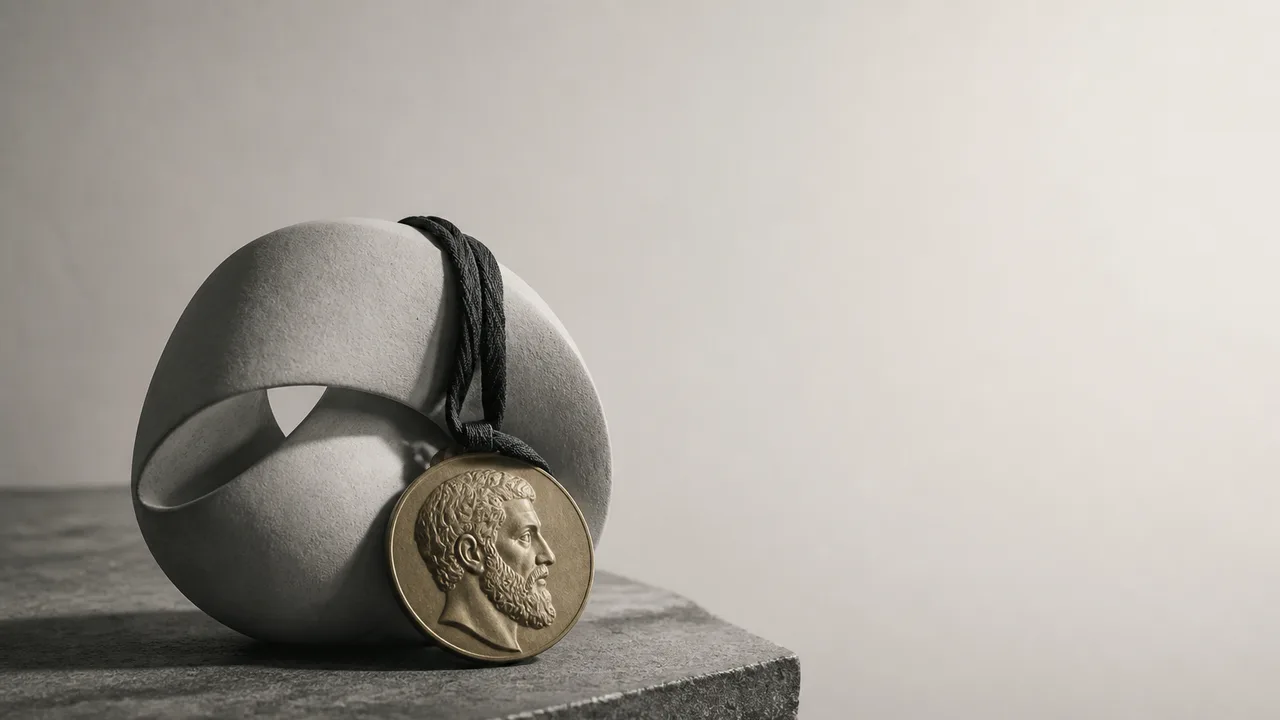
Photo: AI. Tomoko Hayashi
Most mathematicians signal ambition through volume. Preprints stack up on arXiv, each one a bid for relevance, a flag planted in disputed territory. John Pardon does the opposite. He goes quiet for years, and then he solves something that the field has been stuck on for decades. By the time people notice the paper, the landscape has already shifted.
That pattern — long silence, then seismic result — is the throughline of Pardon's career, and it earned him the 2026 Fields Medal, mathematics' highest honor, awarded every four years to researchers under 40.
A childhood where math was the game, not the grind
Pardon was born in June 1989 in Chapel Hill, North Carolina, into a household where mathematics wasn't a subject so much as a shared language. His father, William Pardon, was a topology and algebra professor at Duke. His mother taught high school math and started feeding him calculus before most children have encountered long division. The key detail, though, is that none of it was coercive. Math was what the family did on hikes — his parents would throw him a puzzle to distract him from tired legs, and he'd go quiet, working it through in his head as he walked.
By middle school he had a perfect score on the SAT math section. By high school he was commuting to Duke to sit in graduate courses. And between 2005 and 2007, he represented the United States at the International Olympiad in Informatics — the premier competitive programming competition for high school students — winning gold medals three consecutive years.
Then he pivoted to pure mathematics, which surprised exactly no one who understood him and surprised his computer science teachers enormously.
The undergraduate who published in the Annals
At 17, still a senior at Durham Academy, Pardon extended a classical result in discrete geometry — the carpenter's rule problem — from polygons to continuous, rectifiable, closed curves. The work earned him second place at the 2007 Intel Science Talent Search and was subsequently published in the Transactions of the American Mathematical Society.
He arrived at Princeton in the fall of 2007 and proceeded to work through graduate-level geometry and topology before most undergraduates had finished the standard curriculum. According to his Wikipedia profile, he solved Mikhail Gromov's knot-distortion problem as an undergraduate — a question Gromov had posed in 1983 about whether certain torus knots could have arbitrarily large distortion. Pardon showed they could, disproving the conjecture, and the proof appeared in the Annals of Mathematics, the most prestigious journal in the field. For an undergraduate to publish there is, to put it plainly, nearly unheard of. His collaborator János Kollár — a senior Princeton topologist — later said that working with him felt like working with a postdoc who had very good ideas. Kollár was being modest. He had mentioned a problem at a dinner; two weeks later, Pardon emailed a solution.
The knot-distortion proof won him the 2012 Morgan Prize. It also announced something the field would spend the next decade confirming: this was not a prodigy who would fade. This was a mathematician with an unusual relationship to difficulty.
The Stanford years: foundational repair work
Graduate school at Stanford meant harder problems and more solitude. Stanford mathematician Ralph Cohen recalled regularly seeing Pardon on the stone steps outside the math building, sitting in silence for hours. "Sometimes he'd recognize you and nod hello," Cohen recalled. "Sometimes he'd be deep in thought and wouldn't know you're there."
At Stanford, Pardon resolved the three-dimensional Hilbert-Smith conjecture — the first major progress on that problem in nearly 60 years. But his doctoral dissertation was arguably the more consequential project, because it addressed something that had quietly been undermining an entire subfield.
Symplectic geometry, which emerged from classical physics as a mathematical framework for motion, position, and momentum, uses objects called pseudoholomorphic curves to probe the hidden structure of complex spaces. By the late 2000s, the practice of counting these curves had developed a serious technical problem: transversality. When curves intersect cleanly, the count is reliable. When they merely touch — non-transverse intersections — the count can produce gibberish. Researchers had begun arguing about whether major published results were actually rigorous.
Pardon's dissertation constructed a new framework — virtual fundamental cycles — that fixes the counting problem systematically. Think of a census worker trying to count residents in a city where apartment buildings overlap, streets merge, and some residents appear in multiple records. Pardon's algebraic architecture corrects for all of that and produces a consistent count. It wasn't a clever trick; it was foundational repair.
Before his Stanford doctorate came through in 2015, Princeton had already begun recruiting him as a full professor. Senior faculty had to explain the situation to university administrators, because the path from PhD to tenured full professorship without intermediate steps is sufficiently rare that the institutional machinery simply doesn't account for it.
"I'm not attracted to fields. I'm attracted to problems."
That line — which Pardon has offered as a kind of professional philosophy — explains the pattern better than anything else. He doesn't plant a flag in symplectic geometry or low-dimensional topology and work outward from there. He finds a problem that interests him, learns whatever mathematics he needs to attack it, and moves on. Topology, algebra, analysis, algebraic geometry: these are tools, not homes.
The honors accumulated steadily. A Clay Research Fellowship in 2015. The NSF's Alan T. Waterman Award and a Packard Fellowship in 2017. An invited lecture at the 2018 International Congress of Mathematicians in Rio de Janeiro. The Clay Research Award in 2022 for his contributions to symplectic topology. A New Horizons in Mathematics Prize in 2025.
And then, in the summer of 2023, a preprint that landed in algebraic geometry circles the way a rock lands in a pond.
The MNOP conjecture and the algebra that bears his name
The MNOP conjecture was posed in 2003 by Davesh Maulik and collaborators. It concerns Calabi-Yau threefolds — six-dimensional complex shapes that string theorists use to model the extra dimensions hypothesized by superstring theory — and specifically the relationships between different ways of counting curves on those shapes. Jim Bryan of the University of British Columbia, who had studied the conjecture for decades, was among those who received Pardon's preprint. Bryan later said he might have dismissed the paper immediately had it not carried Pardon's name and his well-established reputation for precision. He didn't dismiss it. Pardon had constructed an entirely new mathematical object — now referred to as a Pardon algebra — that made the proof work. Bryan called it the biggest result in enumerative algebraic geometry in twenty years.
The Fields Medal followed in 2026.
What silence actually sounds like
The human details are, in their way, as interesting as the mathematics. Pardon has been playing the cello since age six and was the principal cellist for the Princeton University Sinfonia. He treats music as a kind of cognitive reset — a domain separate enough from geometry to actually provide rest. He is a father of two. He is, by all accounts, genuinely unassuming, the kind of person whose colleagues reach for words like gentle and kind.
He is also, notoriously, allergic to giving interviews.
He stays active on MathOverflow, the online question-and-answer forum for professional and graduate-level mathematics, where he answers technical questions from students and researchers. He has also, apparently, weighed in on the physics of pancakes. When a user complained about dense results, Pardon responded: "The difference between fluffy and fall-apart crumbly and thinner, chewy, and sort of dense is precisely governed by baking powder, soda. If you want thin and chewy, omit the baking powder." Which is, if you think about it, a pretty Pardon-ish answer: precise, direct, and immediately useful.
His current project is a book on the foundations of symplectic geometry, available online for public review and written using higher category theory — a branch of abstract algebra that many working mathematicians regard as needlessly esoteric. The book is, characteristically, an attempt to rebuild something foundational from scratch. In his own preface, he acknowledges that "the interesting material is spread a bit thin in the effort to formulate statements and proofs which are as simple and down-to-earth as possible."
He is, in other words, still working. The Fields Medal is an acknowledgment of what's been done; the book is evidence that the larger project isn't finished.
Which raises the question worth sitting with: in a discipline that rewards speed and volume with visibility, what exactly do we lose by not building more structures that reward the person who goes quiet for three years and comes back with something that changes everything?
More Like This
The Deeper Geometry Behind the Pythagorean Theorem
Explore why the Pythagorean Theorem appears in unexpected places, from geometry to relativity.
Solving the 'Harvard' Puzzle: A Mathematical Journey
Explore the mathematical challenge of 8^x + 2^x = 30, a puzzle reminiscent of a Harvard entrance exam.
A YouTuber Got a Sequence Into the OEIS With XOR Math
Gary Explains got an original integer sequence accepted into the OEIS by XOR-ing numbers in loops. Here's why that's genuinely fascinating—and what it connects to.

Decoding Logic: Marriage Puzzles and Irrational Numbers
Explore the intersection of logic puzzles and mathematics, revealing insights into irrational numbers and everyday reasoning.
Exploring the Enigma of Recamán's Sequence
Delving into Recamán's sequence, a simple rule with complex questions. Does every integer appear?

The Pythagorean Theorem Belongs to Everyone
The theorem bears one Greek man's name, but Babylonians, Egyptians, Chinese, and Indian scholars knew it first. The history is more interesting than the myth.

Gravity's Strangest Effects, From Time to Cosmic Voids
From gravitational time dilation to the Dipole Repeller and LIGO's detections, here's what gravity actually does—and what it still can't explain.

JWST's Little Red Dots May Be Cocooned Black Holes
New JWST spectral data on a single "little red dot" galaxy offers the strongest case yet that they're supermassive black holes wrapped in dense gas cocoons.