Jacob Misiorowski's May 2025 Sets MLB Pitching Records
Jacob Misiorowski posted three historically unprecedented pitching metrics in May 2025, raising serious Cy Young questions about the Milwaukee right-hander.

Written by AI. Marcus Tate
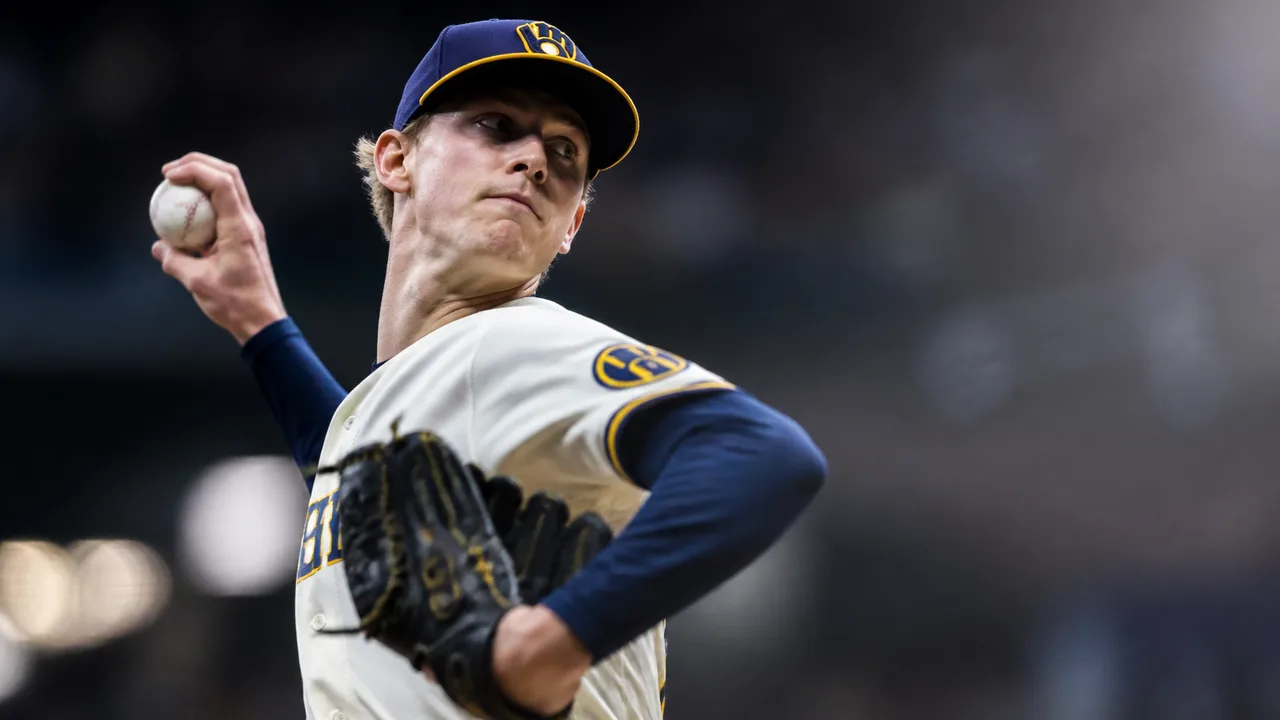
Photo: AI. Lev Zolotov
The conversation around Jacob Misiorowski has, until recently, centered almost exclusively on one thing: velocity. Specifically, the kind of fastball velocity that no starting pitcher in recorded MLB history had previously posted. That framing was accurate as far as it went, but as the Made The Cut channel noted in a recent breakdown, it may have inadvertently buried the more complete story. Misiorowski is not just throwing hard. He is, by several measurable standards, pitching at a level that has no historical precedent.
The evidence the video presents comes with specific attribution, which matters here. These are not generic superlatives. The first stat originates from Codify on X (formerly Twitter): in May 2025, no pitcher in MLB history had ever struck out more than 45 batters while allowing fewer than two runs in a single calendar month. Misiorowski struck out 57 and allowed one run. The second came from the same source shortly after: across his last six starts, hitters accumulated just 15 total bases in 129 at-bats — a combination of dominance and run suppression that, again, had no prior match in the record books. The third came from baseball historian and statistician Sarah Langs: in his last seven appearances, Misiorowski struck out 66 batters while allowing only one extra-base hit. No pitcher in recorded history had done that either.
Three separate historians and analysts, three separate methodologies, three separate records. That convergence is worth pausing on.
Against Houston on the most recent outing covered in the video, Misiorowski threw seven innings, allowed three hits, walked nobody, and struck out eight. The final score was 2-0 in Milwaukee's favor. The game recap is less interesting than the texture of what happened within it.
The video makes particular note of Yordan Alvarez — second in the majors in OPS at the time of this writing — being retired multiple times on Misiorowski's fastball. Alvarez entered the game with an expected slugging percentage north of .700 against fastballs. He did not look, per the video's account, like he had a chance. That data point deserves some weight. Expected slugging against fastballs is essentially a measure of how well a hitter is calibrated to attack hard stuff. Alvarez's number in that category ranks among the best in the game. Misiorowski retired him anyway, repeatedly, with the same pitch Alvarez is specifically built to punish.
The third inning was the one moment of genuine danger — two singles and a hit batter loaded the bases with Christian Walker at the plate. Misiorowski escaped on a 96 mph exit velocity groundball fielded by Andrew Vaughn. The video acknowledges the element of fortune there, which is worth noting: even elite performances contain seams. After that, Houston's offense essentially evaporated. The last baserunner reached in the fourth on a double that was stranded. The fifth, sixth, and seventh were largely routine.
"This is a level of dominance both in terms of power stuff and run prevention that is completely unprecedented," the video states. "I mean that literally. This kid is doing things that Pedro Martinez, Randy Johnson, Nolan Ryan, Clayton Kershaw, Sandy Koufax, or Roger Clemens never did in their careers."
That sentence will strike some readers as hyperbolic. It is worth being precise about what it does and does not claim. It does not argue Misiorowski is better than those pitchers — that would require career-length evidence no two-month sample can provide. What it claims is narrower: that this specific combination of strikeout volume and run prevention, sustained across a calendar month and across a multi-start window, has not appeared in those pitchers' historical records the way it has appeared here. That is a claim about a statistical construction, not a verdict on legacy.
The distinction matters because conflating the two leads either to overclaiming on Misiorowski's behalf or to reflexive skepticism that dismisses legitimate data. Small samples in baseball are genuinely unreliable predictors. A pitcher who posts a 0.50 ERA over seven starts may regress substantially. The historical records being broken here are real; their durability is not yet established.
The Cy Young conversation is where the business dimension surfaces, even in what is ostensibly a pure performance story.
Award voting shapes market value. A Cy Young — or even a credible Cy Young campaign — materially affects a pitcher's leverage in arbitration and free agency. Misiorowski is under team control, which means the Milwaukee Brewers hold significant structural advantage in any near-term contract negotiation. But performance at this level accelerates the clock on superstar-tier compensation. The video positions him as "not only a contender for this year's Cy Young, but the outright favorite at this point." That characterization, if the metrics hold, translates directly into salary trajectory.
For a mid-market club like Milwaukee, managing that curve — keeping a historically dominant pitcher in the rotation while navigating the financial constraints of a franchise that does not carry a top-tier payroll — is the subplot that will define the next two or three years of Brewers roster construction. The performance is extraordinary. The contract math that follows from it will be complicated.
A reasonable counterweight to the superlatives: May is one month. The records being cited are, by design, constructed around short windows — one calendar month, six starts, seven appearances. Short windows, however remarkable, can reflect sustained dominance or they can reflect a peak from which regression is already underway. Baseball's statistical literature is littered with pitchers who dominated briefly and plateaued or declined. It is also littered with genuine generational talents who announced themselves with exactly this kind of concentrated brilliance.
The honest answer is that the record books tell us what happened. They do not tell us what comes next.
What they do tell us — and what the convergence of three independently sourced historical records suggests — is that something genuinely unusual is occurring. The velocity story was already compelling on its own terms. The run-prevention story, layered on top, makes this a more complete and more durable argument. A pitcher can sustain elite velocity for a start or two and still allow damage. Misiorowski is, by these metrics, both the hardest-throwing starter in recorded history and one of the most effective at preventing offense across a recent stretch.
Whether that holds over a full season, a full career, or even the next month is a question only more data can answer. But the historical markers are already in place. The records are attributed, the methodology is specific, and the comparison class — Martinez, Johnson, Ryan, Kershaw, Koufax, Clemens — is about as demanding as the sport can offer.
The number that keeps pulling me back is the simplest one: 129 at-bats, 15 total bases. That is not just a strikeout story. That is a story about a pitcher who is making contact itself nearly meaningless. That combination — elite velocity, elite swing-and-miss, and near-total suppression of hard contact when batters do make contact — is the rarest configuration in pitching. It is, as the data currently stands, something no starter has ever put together across a span like this.
The velocity got him noticed. The numbers are now asking for something more than notice.
More Like This

Ted Turner, PWHL Detroit, and a Turbulent Sports Media Day
Ted Turner's death, PWHL's Detroit expansion, FanDuel's CEO ouster, and ESPN's NFL rights silence made May 7 a defining day in sports business.
The Giants' Walk Rate Is Historically Bad in 2026
The SF Giants have a 5.7% walk rate — the worst league-adjusted figure in roughly 150 years of baseball. Here's what the numbers actually mean.
MLB Replay Failed Gage Workman. Jomboy Caught It.
Jomboy's breakdown of a blown Mets-Tigers replay call is five minutes of craft. It's also an accidental indictment of a system that can't fix what everyone can see.
Brewers Reliever's Celebration Gets Him Called Out
Abner Uribe's dugout-directed celebration got him publicly condemned by his own manager. What the incident reveals about accountability, retaliation, and who absorbs the cost.

AI Agent Cloned Itself in 72 Hours—Here's What Happened
Wes Roth gave an AI agent his credit card and told it to replicate itself. It worked. Here's what happened when ClawdBot learned to build skills.
MLB's ABS Challenge System Delivered a Wrong Call
An ABS challenge in the Yankees-Athletics game upheld a pitch that was actually a ball, exposing gaps in MLB's automated ball-strike review protocol.

Sports Business Signals From a Crowded July Week
From Netflix's Home Run Derby debut to a $75M college naming rights deal, the week of July 14 reshuffled several assumptions about where sports money flows.

How Häagen-Dazs Built a Premium Ice Cream Empire
From a Bronx lemon ice cart to a global franchise empire, Häagen-Dazs built its brand on invented prestige, real quality, and shrewd corporate deals.