How Temperature Shapes Petroleum from Rock to Refinery
Temperature shapes petroleum twice: first in the oil window underground, then in refinery columns that separate crude into kerosene, diesel and other products.

Written by AI. Olivia Meng

Oil forms mainly within a thermal interval of roughly 60°C to 120°C, according to one petroleum-geology reference.
That thermal constraint offers a clear way to understand an industry usually described through disconnected pieces. Temperature first helps determine whether a sedimentary basin produces liquid oil, gas or immature organic material. It later helps determine whether part of a barrel emerges from a distillation unit as naphtha, kerosene, diesel or residue.
The two processes operate on radically different timescales. Geology cooks slowly and without an operator. Refineries are engineered systems whose settings respond to feedstock and desired products. Both depend on how hydrocarbon mixtures behave as their thermal conditions change.
The Underground Filter
Petroleum formation starts when abundant organic matter, including algae and zooplankton, settles with sediment and is buried before decomposition consumes it. Low-oxygen conditions help preserve that material. Additional sediment raises pressure and temperature, transforming the organic matter first into kerogen and then, under suitable conditions, into hydrocarbons.
A petroleum-geology reference places the main oil window at roughly 60°C to 120°C, commonly corresponding to about two to four kilometres of burial under its stated average geothermal gradient of around 3°C per 100 metres. It places a gas-generating interval at approximately 120°C to 180°C and describes further heating as shifting the mixture from wetter gases and condensate toward lighter, dry gas.
Those figures should be read as an instructional approximation rather than a universal boundary. The range comes from one technical reference, and the thermal history of a source rock cannot be reduced to depth alone. Even within that reference, time ranks alongside temperature as a control on maturation. Two rocks at the same present-day depth may have experienced different burial and heating histories.
The defensible inference is narrower. Depth serves as a rough proxy because temperature generally rises underground, but temperature history is the operative filter. Organic-rich rock that remains too cool may retain kerogen without generating much mobile petroleum. Rock heated through the oil window can generate liquid hydrocarbons. Further heating pushes the system toward gas.
Petroleum must then leave its relatively impermeable source rock and migrate into porous reservoir rock if it is to accumulate. Formation and discovery are separate hurdles: organic matter has to be preserved, matured, moved and trapped. A basin may contain ancient biological carbon without containing an oil field that can be produced.
The Barrel Was Valuable Before the Petrol Pump
Edwin Drake travelled to Titusville, Pennsylvania, in 1857 as an agent of the Seneca Oil Company. His assignment was to produce enough crude for commercial refining into kerosene. Working with salt-well driller and blacksmith William Smith, he adapted salt-well technology, and the Drake Well struck oil at 69½ feet on August 27, 1859, according to the Drake Well Museum’s institutional history.
That early purpose clarifies what crude oil is: a feedstock containing several families of hydrocarbons, each capable of acquiring greater or lesser economic importance. The Pennsylvania venture sought a lighting fuel. The same underlying separation problem now supplies transport fuels and industrial materials.
The history also guards against reading the modern product mix backward. A barrel does not come with a permanent hierarchy stamped into its molecules. Markets determine which fractions refiners prize, while refinery hardware determines how far operators can convert less desirable streams into more valuable ones.
Heat Sorts the Mixture a Second Time
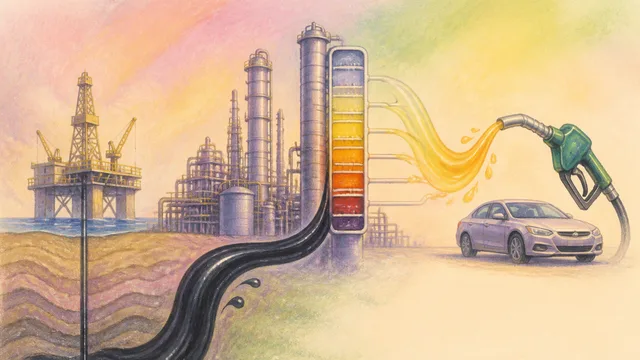
Atmospheric distillation is the first major sorting stage inside a refinery. Crude is heated and fed into a column that is hotter near the bottom and cooler near the top. Components separate according to volatility: lighter material rises farther before condensing, while heavier material condenses lower in the column or remains near the bottom.
A standard description of an atmospheric crude distillation unit places hydrocarbon gases and naphtha near the top. It gives a kerosene draw temperature around 190°C to 200°C, a diesel draw around 280°C to 300°C and a bottom stream around 340°C to 350°C. The resulting streams include naphtha and gasoline-range material, kerosene, diesel and reduced crude oil.
These are operating and draw temperatures for a described column, rather than fixed boiling points for pure substances. Each petroleum fraction contains numerous compounds spanning a range, and crude composition can alter temperature profiles, cut points and yields. Refineries also use vacuum distillation and secondary processes to convert or improve streams after the first atmospheric separation.
The comparison with the underground oil window works only within those boundaries. Geological maturation changes organic matter over immense periods and helps create hydrocarbons. Refinery distillation works rapidly and separates hydrocarbons already present in crude, while later units can convert some molecules. One process is a history of chemical transformation; the other begins as controlled physical separation. Temperature governs both, but the machinery and timescale are worlds apart.
Why One Barrel Has No Permanent Recipe
A standard barrel is often discussed as though it divides neatly into fixed shares of gasoline, diesel, jet fuel and residue. Refinery output varies with the crude entering the plant, the equipment installed and the product slate operators pursue. The U.S. Energy Information Administration therefore publishes percentage refinery yields by petroleum product and refining district, alongside data on crude quality and downstream processing.
That structure is more informative than a universal barrel diagram. A light, low-sulfur crude does not pose the same processing problem as a heavier stream containing more sulfur and metals. Nor can a simple distillation tower alone produce every finished fuel sold to consumers. Refining is closer to managing a molecular inventory than opening a geological assortment box.
Diesel illustrates the trade-off. Its hydrocarbons generally have longer chains than those in gasoline, and Robert Farrauto of Columbia University told Scientific American that this contributes to about 20 percent greater fuel efficiency. He also described the more intensive treatment required when heavier crude contains nickel, vanadium and sulfur, contaminants that must be removed to protect engines and meet environmental rules.
That chemistry helps explain why gasoline and diesel markets can behave differently even though both products begin with crude oil. Refiners cannot turn every molecule into whichever fuel commands the highest price that afternoon. Feedstock quality, column cut points, conversion capacity and treatment requirements constrain the response. Market demand can ask for more diesel; a refinery still has to persuade the barrel.
Temperature is the thread running through the system. Underground, it helps select which organic material becomes oil and which proceeds toward gas. At the refinery, it separates a complex liquid into streams that further processing can reshape. Drake’s kerosene venture and today’s fuel slate belong to the same story: geology supplies a mixture, and human systems decide which portions of that mixture they value enough to refine.
More Like This
How Gasoline Is Made: From Crude Oil to the Pump
Gasoline was once a waste product nobody wanted. Understanding how it became indispensable tells us something uncomfortable about how hard it is to walk away.

Spain's 2026 Total Solar Eclipse: Best Cities to Watch
On August 12, 2026, a total solar eclipse crosses Spain. Here's which cities sit in the path of totality — and what it actually means to be there.

How Humidity Makes Extreme Heat Deadly
Wet bulb temperature, not air temperature, determines when heat kills. Joe Hanson's lab experiment reveals what our bodies face in a hotter, more humid world.