How Scientists Mapped the Atom Without Ever Seeing One
From Rutherford's gold foil to quantum fields, a look at how indirect evidence built our model of atoms no one can see. By Priya Sharma.

Written by AI. Priya Sharma
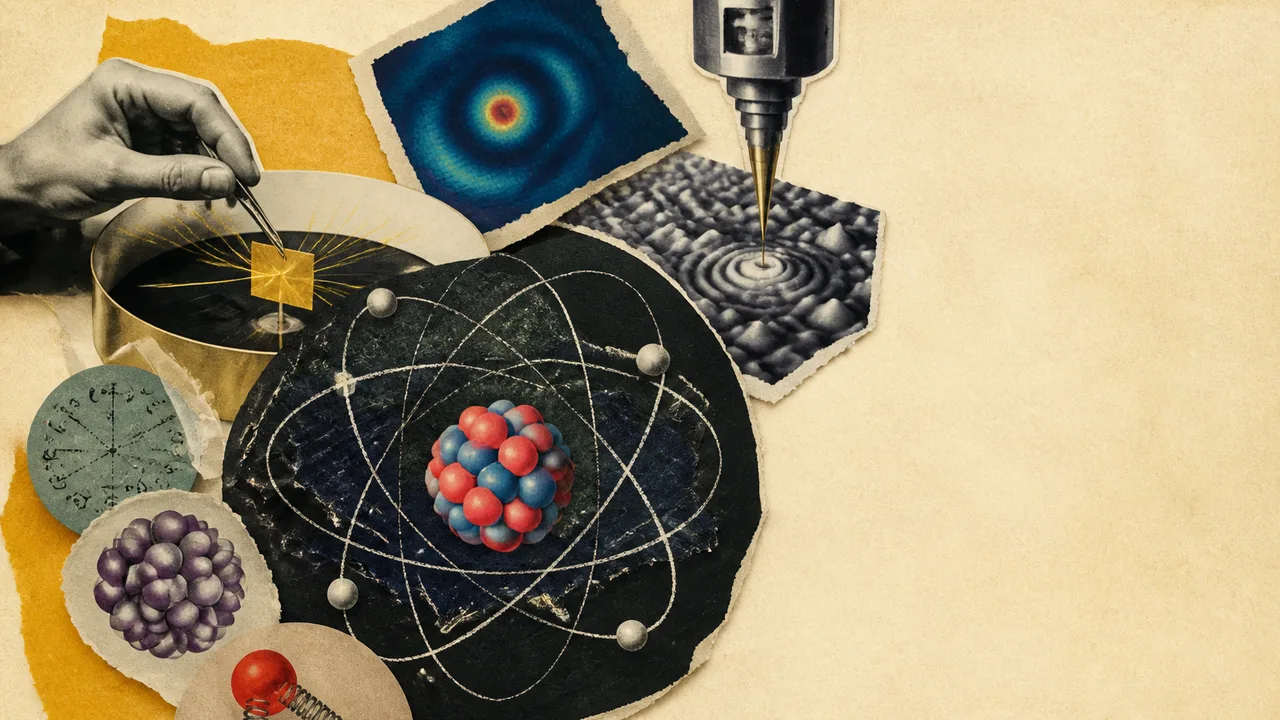
Photo: AI. Wren Sugimoto
An atom measures about 0.1 nanometers across, roughly 4,000 times smaller than the shortest wavelength of visible light, so the eyeball is simply the wrong instrument. Yet the model of the atom we use today, with its dense nucleus, electron clouds, and internal quarks, rests on more than a century of experiments that are, in their own way, more convincing than a photograph would be.
A recent video from the Math and Science channel asks exactly this question: "if we can't actually see individual atoms, how do we actually know what they're really made of?" The answer the video traces is a chain of indirect evidence stretching from an ancient Greek thought experiment to quantum field theory, and each link in that chain is worth examining for what it shows about how science builds knowledge without direct observation.
From Uncuttable to Billiard Balls
Around 2,500 years ago, Democritus asked whether matter could be divided forever. He argued it could not, and called the final indivisible piece "atomos," Greek for uncuttable. He had no equipment and no experiments, only logic, and the idea sat mostly unused for two millennia.
The revival came with evidence. In 1803, John Dalton noticed that elements combine in fixed whole-number ratios by weight; water is always eight parts oxygen to one part hydrogen by mass. As the video puts it, "that regularity screamed that matter actually came in discrete, countable chunks." Dalton pictured atoms as tiny spheres, and for a while that billiard-ball model held.
It collapsed in 1897, when J.J. Thomson ran experiments with cathode ray tubes, the ancestors of the television, and found that matter contains particles far smaller than atoms: electrons. Thomson proposed the so-called plum pudding model, with negative electrons studded through a diffuse blob of positive charge. It sounds odd today, but as the video notes, "it was a serious scientific proposal based on real data of the time."
The Shell that Bounced Back
The experiment that dismantled the pudding was elegant in its economy. In 1909, Ernest Rutherford fired positively charged alpha particles at an ultra-thin sheet of gold foil. Most passed straight through, but roughly one in 8,000 bounced back toward the source. Rutherford compared it to firing an artillery shell at tissue paper and having the shell ricochet into your face.
The only way to explain the pattern, Rutherford concluded, was that nearly all of the atom's mass is concentrated in a tiny, dense, positively charged core, the nucleus, with vast empty space around it. James Chadwick completed the picture in 1932 with the discovery of the neutron, a particle with mass but no charge, inside that nucleus.
This is the methodological heart of the story: Rutherford never saw a nucleus. He saw a scattering pattern and inferred the structure that had to produce it. As ScienceABC observes, the early twentieth century had no microscopes capable of visual reference, and yet scientists studied atoms anyway, through observation and experimentation.
So What Are Those Colorful Atom Pictures?
Images of glowing blobs labeled as individual atoms circulate widely, and the video raises a fair question about what they actually are. The answer depends on the physics of resolution: to see an object, you need a wave with a wavelength smaller than that object. Visible light spans roughly 400 to 700 nanometers; atoms are smaller than that by thousands of times, so a light microscope washes over an atom the way an ocean wave washes over a pencil, without resolving it.
Electron microscopes do better, because accelerated electrons have wavelengths far shorter than light, but individual atoms remain at the edge of even the most powerful electron microscopes. The decisive breakthrough came in 1981 with the scanning tunneling microscope. This instrument drags a metal tip, sometimes a single atom wide, across a surface while electrons quantum-tunnel across the gap, producing a measurable current. As physics-lab.net explains, scanning tunneling microscopy and atomic force microscopy are the two foundational techniques that enable imaging of atomic surfaces.
The images they produce are reconstructed measurement maps rather than photographs. In 1990, IBM scientists used an STM to position xenon atoms one by one, spelling out the company's name in single atoms. The video's presenter marks that moment as the point where "we stopped just detecting atoms and started manipulating them."
There is also a more literal route to "seeing" quantum structure. In 2013, researchers led by A.S. Stodolna used a technique called photoionization microscopy to image the nodal structure of hydrogen orbitals, and as NPR's 13.7 blog described, the images captured the onion-like shells with gaps where the electron cannot be found, structures the theory predicted. Even here, the image is a map of a probability distribution, not a snapshot of a particle.
Quarks: Detected but Never Isolated
By the 1960s, physicists suspected protons and neutrons had internal parts. A mathematical theory proposed each was built from three smaller particles, quarks, and in the late 1960s experiments at the Stanford Linear Accelerator confirmed it: high-energy electrons scattered off protons as though hitting small, point-like objects inside.
The catch is strangeness of a different kind. The force binding quarks grows stronger with distance, unlike gravity or electromagnetism, so pulling two quarks apart requires more and more energy until, eventually, the energy itself condenses into new particles rather than separated quarks. No one has ever seen a quark alone, and the theory says no one ever will. Every piece of evidence for quarks is indirect: scattering patterns, energy signatures, particle collisions. That the evidence is nonetheless considered conclusive tells you how much weight modern physics gives to well-designed indirect measurement.
Where the Solar-System Model Breaks
Most people carry a school-taught image of the atom: electrons orbiting a nucleus like planets. Quantum mechanics says that picture is wrong. Electrons have no definite positions between measurements; they are described by a wave function, a probability distribution that only resolves to a location when the electron interacts with a measuring apparatus. As the video summarizes, "until then, it genuinely isn't anywhere specific," and, in the presenter's framing, you can almost say the electron is everywhere at once until an interaction collapses the distribution.
This is where I'd add a caution the video gestures at but doesn't dwell on: the phrase "collapse" describes what the mathematics does under measurement, but physicists still argue about what, if anything, physically happens. The wave function's predictions are not in dispute; its interpretation is. The Copenhagen interpretation, many-worlds, and pilot-wave theories all reproduce the same experimental results while disagreeing about what the electron "really" is between measurements. For practical purposes the probability description is sufficient, but readers should know that a philosophical fault line runs underneath the tidy textbook language.
Quantum field theory goes further still: electrons and quarks are excitations in fields that permeate all of space, ripples in an ocean rather than objects floating on it. The evidence here is the strongest of all. The electron's magnetic moment, calculated through quantum electrodynamics, matches experimental measurement to twelve decimal places, the most precise verified prediction in the history of science.
What Indirect Knowledge is Worth
The arc from Democritus to quantum fields follows a pattern the video makes explicit: a model is proposed, tested, found wanting at some scale, and replaced by one that survives more stringent tests. Dalton's spheres gave way to Thomson's electrons, the pudding gave way to Rutherford's nucleus, the solar system gave way to probability clouds, and particles gave way to field excitations. Each model was wrong at some level and useful at another.
Confidence in atomic structure comes not from any single observation but from the convergence of many independent lines of evidence, chemical ratios, scattering experiments, tunneling currents, magnetic moment measurements, all pointing to the same underlying structure. A photograph of an atom, if one existed in the ordinary sense, would arguably be weaker evidence than that convergence, since a photo could be an artifact while mutually reinforcing independent measurements are hard to fake.
We will never see an atom. We have mapped it, moved its components one by one, split it for energy, and described its fields with a precision that dwarfs every other quantitative prediction in science. Whether that counts as "seeing" is a question about language; whether we know what is inside is a question the evidence has answered.
More Like This

The Quantum Fourier Transform Explained
Dr. Katie McCormick's Qiskit breakdown of the quantum Fourier transform reveals the strange mathematical object powering Shor's algorithm and quantum phase estimation.

Quantum Field Theory, AI, and the Gravity Problem
Physicist Ross Jenkinson explains how quantum computing and AI could unlock the biggest unsolved problem in theoretical physics: reconciling quantum theory with gravity.
Quantum Mechanics as Computation: A Primer
IBM's Kevin Sung breaks down quantum vs. classical information using Qiskit—and why the math underlying quantum computing matters far beyond the lab.
Wheeler's One-Electron Universe and the Nature of Time
Wheeler told Feynman all electrons are identical because there's only one. The theory died—but the fragment that survived quietly unsettled everything we think about time.

Water as Rocket Fuel: The Case for Electrolysis
Water electrolysis propulsion could reshape space travel. Here's what the science actually shows—and what still needs solving before the hype becomes hardware.
Einstein's Proof: Atoms Exist Through Brownian Motion
Explore Einstein's 1905 revelation on atoms using Brownian motion, bridging macro and micro physics.

Adam Riess on the Hubble Tension and Cosmic Expansion
Nobel laureate Adam Riess explains why two precise measurements of the universe's expansion rate keep disagreeing—and what that could mean for cosmology.

How Volcanoes Work: Formation, Types, and Real Risk
From shield volcanoes to supervolcanoes, here's what geology actually tells us about how volcanoes form, erupt, and how dangerous they really are.