How Allied Codebreakers Cracked the Enigma Machine
The Enigma story is not just WWII history. It is a blueprint for how signals intelligence works, and why encrypted systems fail from the inside out.

Written by AI. James Morrison
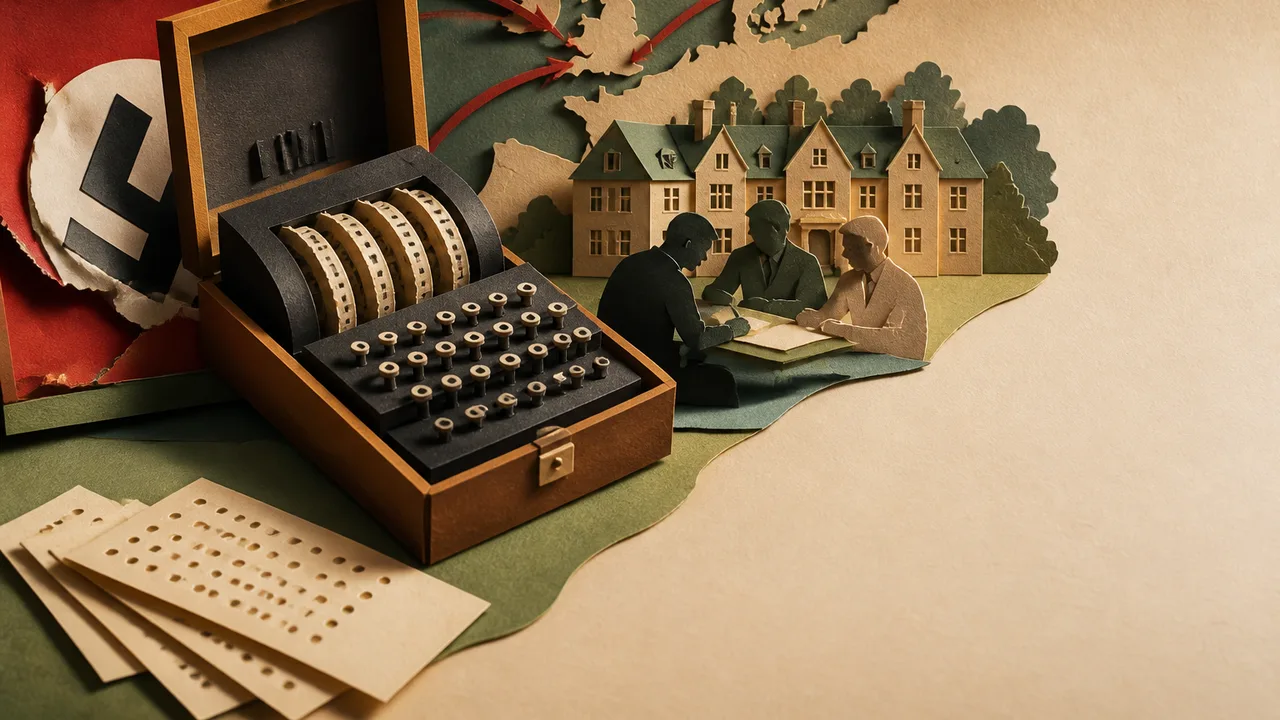
Photo: AI. Lila Bencher
The Germans were not wrong about Enigma's mathematics. They were wrong about their operators.
That distinction matters more than most accounts of the Bletchley Park story acknowledge, and it is the thread that Epic History's documentary "Breaking Hitler's Unbreakable Code" pulls on with admirable persistence. The machine itself, with its rotors, plug board, and roughly 150 million million possible configurations, was genuinely formidable. What undid it was a combination of procedural sloppiness, institutional overconfidence, and the kind of mathematical imagination that military planners consistently underestimate until it is too late.
The story opens not in England but in Poland, which tends to surprise people who know the Bletchley Park name but not much else. In July 1939, at Pyry near Warsaw, intelligence representatives of France, Britain, and Poland met under deliberately vague cover identities. The Poles, facing the imminent reality of German invasion, had been working the Enigma problem longer and with greater urgency than either of their partners. Among the British delegation was Dilly Knox, a classicist by training whose career had involved reconstructing fragmentary Greek poetry from ancient papyrus. The skill set transfers: both disciplines require inferring a complete structure from incomplete evidence.
What Poland brought to that meeting was the product of a decade of serious mathematical work. The breakthrough belonged to Marian Rejewski, who, working from documents provided by a German intelligence asset named Hans-Thilo Schmidt, reduced the machine's operation to a set of equations and reconstructed its internal wiring. That reconstruction, achieved with incomplete information, was one of the signal intellectual achievements of twentieth-century cryptanalysis. By the late 1930s, Polish codebreakers were achieving consistent decryption of a substantial volume of Enigma traffic. Then Germany introduced two additional rotors, expanding the possible combinations to a scale that overwhelmed existing Polish methods overnight. With invasion imminent, the Poles chose to share everything rather than let the work die with them.
Knox, by all accounts, was astonished.
Britain, now in possession of Poland's research, had already been preparing its infrastructure. The Government Code and Cipher School, known as GC&CS, relocated from London to a Victorian manor house in Bletchley, a market town positioned usefully between Oxford and Cambridge. The cover story was a shooting party organized by Captain William Ridley. The real purpose was to establish what would become the most consequential intelligence operation of the war. Commander Alastair Denniston, who ran GC&CS, understood that the scale of wartime signals traffic would require industrializing a craft that had previously functioned like an academic seminar. He went recruiting. His phrase for what he needed was "men of the professor type." He found them. Gordon Welshman and Alan Turing arrived early. As Britannica notes, Turing's work at Bletchley would anchor the Ultra intelligence project and push the nascent field of computer science into territory it might not have reached for years without the pressure of war.
The operation that followed was unglamorous in ways the cinematic versions rarely capture. Codebreakers worked around the clock in unheated wooden huts with bare bulbs and blacked-out windows. The work was pencils and squared paper, sustained attention over long hours, pattern recognition as a form of manual labor. The German Army, Navy, and Luftwaffe each ran separate Enigma networks with different daily settings, and each had to be broken individually. The codebreakers ran out of color-code names for the networks and moved on to animals, insects, and plants.
The first productive method was inherited from Polish work. German procedure required that an operator transmit the message setting twice, a guard against radio interference. The repetition was the flaw: it gave codebreakers two encoded versions of an identical three-letter group, which was enough of a structural fingerprint to work against. For a period, this gave Bletchley consistent access to Army and Luftwaffe traffic. Then the Germans changed their procedures, and the window closed.
What opened it again was not mathematics but psychology. John Herivel, a twenty-one-year-old mathematician who had just joined the operation, reasoned through the problem from the operator's perspective rather than the machine's. The Epic History documentary describes his insight this way: he put himself in the mind of an Enigma operator starting a shift at dawn, under pressure to transmit quickly. A tired or rushed operator might not bother to randomize the rotor starting position, leaving it near or identical to the ring setting he had just configured. That behavioral shortcut produced a detectable pattern. Herivel's technique, according to the documentary, eventually gave codebreakers renewed access to Luftwaffe Red traffic, a network that remained broken for most of the conflict.
The consequences cascaded. Sky History's account of the Battle of Britain notes that British codebreakers were reading Luftwaffe Enigma traffic during the summer 1940 air campaign, giving the RAF advance notice of German flight paths and targets. The ability to disrupt German navigational signals for incoming bombers, sending them off course, owed something to that access. Later, as the Engineering and Technology History Wiki records, the breaking of German intelligence service cyphers allowed the British to deceive Hitler about Allied landing intentions in 1944, contributing to the success of the Normandy invasion.
The Germans never seriously reconsidered the premise that Enigma was unbreakable. They investigated Allied intelligence successes and attributed them to informants, to aerial reconnaissance, to operational leaks. The machine, they were certain, was holding. That certainty is the part of this story that does not stay neatly in 1945.
The institutional architecture that Bletchley produced, a large-scale signals intelligence operation combining mathematicians, linguists, and mechanical computing capacity, became the direct template for the postwar signals agencies. The NSA, established in 1952, absorbed many of its founding assumptions about organization and method from the wartime model. And it inherited something else: the tendency of institutions that hold cryptographic secrets to develop an almost theological confidence in the invulnerability of their own systems. The NSA's internal assessments of its own communications security in the decades before Edward Snowden's disclosures in 2013 reflected the same structural overconfidence that ran through German Enigma doctrine. Not the same mistake, but the same error class: the system is strong, therefore the system is safe. The operator is assumed to behave as the protocol requires. The insider threat is not modeled seriously until it has already materialized.
Rejewski broke Enigma with equations. Herivel broke it with empathy for a tired soldier at dawn who could not be bothered to spin a rotor. The machine was not the weakness. It never is.
Every generation of signals intelligence produces an Enigma, a system so complex that the people operating it stop imagining how it might fail. The question worth carrying forward from Bletchley is not whether the current generation of encryption will hold. It is who, right now, is sitting in a cold room thinking about the operator on the other end.
More Like This

The Battle of Verdun: Attrition, Leadership, and 300,000 Dead
Ten months, 300,000 dead, and less than five miles of ground changed hands. Epic History's Verdun series examines what that arithmetic actually meant.
Inside the Battle to Secure Claude AI
Explore the ongoing battle between hackers and AI security in the case of Claude AI, highlighting vulnerabilities and new defenses.
Unraveling Rome's Dodecahedron Mystery
Exploring the enigmatic Roman dodecahedron, its theories, and historical significance in modern archaeology.
Unveiling the Intricate Engineering of Runways
Explore the hidden complexities of runway design and how these choices impact safety and military operations.
Shor's Algorithm and the Future of Encryption
Shor's algorithm can crack RSA encryption—in theory. Here's what it actually does, how close we are, and why the answer is more nuanced than headlines suggest.
How Researchers Cracked LLM Encrypted Reasoning Traces
Researchers Ilia Shumailov and Alexander Panfilov found that encrypted reasoning blobs from GPT, Claude, and Gemini can be decoded using smaller sibling models—with real privacy and security consequences.

Audie Murphy: Soldier, Icon, and Haunted Man
Audie Murphy was America's most decorated WWII soldier. His battlefield heroism and Hollywood fame masked a man deeply scarred by combat and survivor's guilt.

The Crusades: Two Centuries of Holy War Explained
From Pope Urban II's 1095 call to arms to the fall of Acre in 1291, the Crusades reshaped Christianity, Islam, and the medieval world permanently.