How a Motionless Cork Led Physics to Coulomb's Law
Franklin's charged-can puzzle, Priestley's Newtonian guess, Cavendish's unpublished precision, and the torsion balance that finally measured the electric force.

Written by AI. Priya Sharma
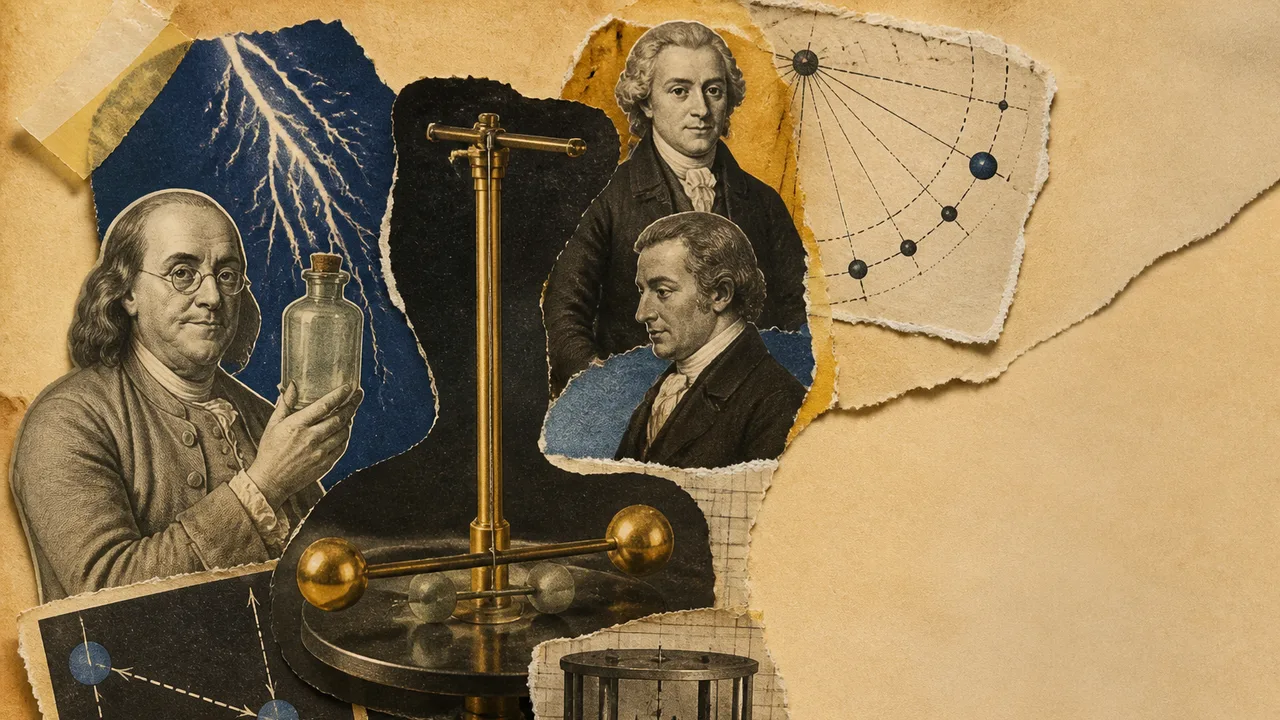
Photo: AI. Wren Sugimoto
In 1755, Benjamin Franklin lowered a cork ball on a thread into a charged metal can and watched it do nothing. According to his own theory of electricity, the cork should have felt a push or a pull from the can's walls. Instead it hung motionless inside a container humming with static charge, and when he pulled it out, it flew toward the walls. Franklin's confusion set off a thirty-year chain of reasoning, secrecy, and instrument-making that ended with Charles-Augustin de Coulomb's law in 1785.
What Franklin Actually Had
Franklin's model, worked out by the 1750s, treated electricity as a single conserved fluid that could pile up in excess or run short. Charged objects carried an "electrical atmosphere," a layer of fluid that reached out to act on neighbors. The model explained sparks and charge storage, and most working "electricians" of the era accepted it. What it could not tell anyone was how strong the force between charges was at a given distance. No force law existed and there was no specific reason for anyone to suspect that one could even be measured.
The charged-can result looked like a failure. It was closer to a measurement hiding in plain sight, though nobody had the framework to read it that way yet.
Priestley's Guess from Gravity
The framework arrived by analogy. Joseph Priestley, then a schoolteacher and Unitarian minister at a dissenting academy in Warrington, met Franklin in London in 1765 at a dining club. Priestley wanted to write the first proper history of electricity. Franklin opened a decade of his own notes to him and demanded something in return: that Priestley build his own electrical machine and run experiments himself.
Priestley complied, discovered that charcoal conducts electricity, and earned election to the Royal Society within a year. When he repeated Franklin's can experiment, he connected the stillness of the cork to Newton's shell theorem. Inside a hollow shell of evenly distributed mass, an object feels no net gravitational pull, and Newton had shown that this cancellation holds only if the force weakens with the square of distance. Change the exponent even slightly and a residual pull appears. Priestley concluded that the electric force must obey the same inverse-square rule.
He published the argument in 1767. It was an inference, not a measurement, and critics in France and Germany dismissed the book for other reasons anyway. The hypothesis sat for two years.
Two Men Who Didn't Publish
In 1769, the Scottish philosopher John Robinson tested it with a pivoting rod, balancing electric repulsion against gravity and reading the tilt angle. His data gave an exponent of two plus a deviation of about 0.06, which he attributed to experimental error and never rushed into print. Decades passed; by the time he published, priority belonged elsewhere.
Henry Cavendish did him one better in the early 1770s and stayed quieter still. His concentric-sphere experiment charged an outer sphere connected by a wire to an inner one, on the logic that a perfect inverse-square law should leave no charge on the inner sphere. None was detectable, and calibration showed his pith-ball electrometer could have caught a deviation as small as about a sixtieth of the total charge. His notebooks put the exponent between 2 plus and minus 1/50, by a wide margin the most precise confirmation anyone had produced. Like Robinson, he told almost no one. The result sat unread outside his household for a century.
So by the mid-1770s the law had effectively been confirmed twice, and the scientific community knew about neither measurement. Priority, it turns out, belongs to communication as much as discovery.
The Instrument that Settled It
Coulomb, a French military engineer who had spent eight difficult years on fortifications in Martinique, arrived at the answer through an unrelated engineering problem: how thin wires resist twisting. His 1784 memoir established that torsional force scales with the fourth power of a wire's diameter and is proportional to the twist angle. As APS News recounts, his apparatus suspended a needle bearing a charged pith ball at one end and a counterweight at the other, free to rotate in a horizontal plane. Once the force per degree of twist was known, any tiny electrical repulsion became a number you could read off an angle.
The National MagLab's history of the instrument credits Coulomb with one of the earliest devices capable of measuring forces this small. In the published abstract, he described the "construction and use of an electric balance, based on the property that metal wires have of having a torsional reaction force proportional to the angle of torsion," followed by the "experimental determination of the law" itself, as quoted in Skulls in the Stars. The force fell off as the square of the distance. He published in 1785, in the first of seven memoirs, and the question was settled in public.
Historians still debate how independent his torsion balance was. John Mitchell, the Yorkshire clergyman who first proposed black holes and later inspired Cavendish's famous Earth-density measurement, had built a similar device. Cavendish suggested Mitchell described it before 1785, raising the possibility of secondhand transmission, though no clear evidence shows Coulomb knew of it, and the two instruments addressed separate problems.
The Long Tail of Precision
The story has one more act. In 1874, the Cavendish family gave James Clerk Maxwell access to Henry Cavendish's unpublished electrical archive. Maxwell found the concentric-sphere result, rebuilt the experiment with his student Donald McAlister, and tightened the possible deviation to roughly one part in 21,600. He published Cavendish's notebooks alongside his own redo in 1879, shortly before his own death. One of Maxwell's last gifts to physics was posthumous credit for a colleague a century gone.
The chasing did not stop. Plimpton and Lawton reached parts-per-billion agreement in 1936; Williams and collaborators, using nested icosahedral shells in 1971, pushed the possible deviation down to 2.7 x 10^-16; by the 1980s it was near 10^-16. These tests constrain the photon's mass. Modern electromagnetism predicts an exact inverse-square law only if the photon is massless, so every tightening of Coulomb's exponent tightens the ceiling on photon mass. Two and a half centuries after Franklin's cork refused to move, the null result he found so disorienting remains one of the most precisely tested facts in physics.
Robinson and Cavendish had the answer in hand before Coulomb published, and it changed nothing until someone put it on the record. Science's priority system is blunt, but the episode suggests its logic: a discovery that stays in a notebook has not yet happened.
Priya Sharma, Science & Health Correspondent
More Like This

Exploring Black Holes and Asteroids with StarTalk
Neil deGrasse Tyson delves into black holes, asteroids, and more in StarTalk's latest Cosmic Queries episode with Chuck Nice.
Kirchhoff's Circuit Laws: A Student's Rules That Held Up for 180 Years
In 1845 a 21-year-old student wrote two circuit rules. Twenty years later, Maxwell's equations revealed they were conservation laws all along.

Water as Rocket Fuel: The Case for Electrolysis
Water electrolysis propulsion could reshape space travel. Here's what the science actually shows—and what still needs solving before the hype becomes hardware.

Einstein's Time Dilation: Changing Our Reality
Explore time dilation and its impact on technology from Earth to space.

Crafting Supercars: The Science Behind Speed and Style
Explore how supercars like Alfa Romeo 4C and Aston Martin Vanquish are meticulously crafted using cutting-edge materials and precision engineering.
How Georg Ohm Discovered the Law That Powers Electronics
Georg Ohm's discovery of V=IR was met with ridicule before it reshaped electrical science. The story behind Ohm's Law is messier—and more human—than any textbook admits.
The Maths Behind Palindrome Ages Explained
Mathematician Kat Phillips unpacks why some pairs of people have reversible ages—and the surprisingly elegant number theory that governs when it happens.

Asteroid Impact on a City: What the Science Actually Shows
A Science Channel scenario imagines an 1,800-ft asteroid striking New York in 2029. Here's what the physics, detection protocols, and real planetary defense infrastructure say.