The Hidden Economic Cost of Performing Masculinity
Jordan Ritter Conn's book "American Men" maps masculinity's psychological toll—but the financial machinery behind male insecurity deserves equal scrutiny.

Written by AI. Jonathan Park

Photo: AI. Henrik Solberg
Here's the part of the masculinity conversation nobody seems to want to price out: there's an economy built on the gap Jordan Ritter Conn describes in his book American Men.
Conn, a journalist who says he works at The Ringer, spent roughly five years—he mentions starting in 2020 in a recent Vox conversation with Sean Illing—following four men through the wreckage that masculine expectations leave behind. The book arrives at a moment when the "what's wrong with men" content cycle has become its own industry, which is itself worth noting before we get to what Conn is actually doing, which is something more careful and less profitable than the discourse it's entering.
The core insight Conn brings to The Gray Area podcast is straightforward but useful: "We're taught to be kind of emotionally reserved. We're taught to aspire to be dominant over others. We're taught that we should be sexually attractive. And we're taught that we should be able to provide economically." He's identifying a four-pillar script. Three of those pillars—emotional reservation, dominance, sexual attractiveness—get most of the cultural airtime. The fourth one, economic provision, is where I keep staring.
Because who, exactly, profits when men define their self-worth through their paycheck?
The supplement industry is an $8 billion-plus annual market in the United States, and a meaningful and growing slice of that is aimed directly at the insecurity Conn describes—Conn himself jokes mid-conversation about whether he should be on creatine, whether he should be doing more with his lifts. That's not just a charming admission of self-awareness. That's the target demographic speaking out loud. The direct-to-consumer testosterone therapy market has exploded over the past decade, with companies like Hims and Ro building nine-figure businesses on the premise that men's bodies are underperforming against an implied standard. The luxury watch market, the truck market, the "executive presence" coaching industry—these aren't selling objects or services so much as they're selling temporary relief from the gap Conn is writing about.
None of this is Conn's argument in American Men. He's doing something else, something more intimate. But the economy I'm describing is the structural condition inside which his four subjects are living their lives, and it goes mostly unexamined in the conversation.
The four men Conn profiles are worth sitting with individually, because the economic script plays out differently in each story.
Ryan becomes an MMA fighter after years of being bullied—boys who, as Conn puts it, "could tell he was gay before he could tell that he was gay." His path to masculinity runs through physical dominance, which is also a commodified thing: the MMA industry, the gym economy, the whole architecture of male physicality as a market. Ryan eventually finds something genuinely useful in that structure—community, a channeled expression of something real in him—but he gets there through a period of bar fights and real harm inflicted on people. The script served him and cost him simultaneously.
Gideon is the one who hits differently from a market logic standpoint. West Point graduate, baseball star, the conventional image of male capital accumulation—credentials, physical presence, institutional prestige. His wife's affair triggers what Conn describes as a complete unraveling: "He gets very addicted to the constant praise and reinforcement." A therapist contracted through the army tells him plainly that he has no idea who he is outside his accomplishments. What's interesting here is that Gideon built exactly the portfolio the masculine script demands—he executed the strategy flawlessly—and the strategy still left him with nothing load-bearing when external validation stopped arriving. You can be fully invested in an asset class and still get wiped out when the market moves.
Joseph is a law student managing childhood trauma by burying himself in economic productivity. He grew up in poverty, connects financial instability to the instability of his household, and has constructed a forward-looking theory: get through law school, start earning, and everything else resolves. Conn explains that Joseph does what "many many men have done—you're facing some sort of crisis and you just say 'I'm good. I got this. I don't need to talk to anyone about it.'" The masculine script converts psychological distress into a productivity problem. Work harder, provide more, outrun it. The therapy avoidance Conn describes isn't just a cultural tic—it's also a decision shaped by what men have been told constitutes acceptable capital allocation of their own time and vulnerability.
Nate, a trans man whom Conn says grew up near Youngstown, Ohio—a detail I'm taking from Conn's own telling in the podcast—comes to masculinity without the default inheritance. He builds his relationship to the script more intentionally, which gives Conn a useful perspective: what does it actually mean to choose into these expectations rather than absorb them unconsciously? Nate's father accepts his son's identity but is largely absent. That absence is its own kind of economic data point—the emotional labor of fatherhood, consistently undervalued in both cultural and literal accounting.
Now, about the ecosystem this book is entering.
Conn works at The Ringer, which was acquired by Spotify in 2020 for a reported $196 million. Spotify has since undergone significant restructuring of its podcast portfolio, and the status of individual staff positions at The Ringer has shifted accordingly—his current role there should be understood as his own characterization rather than independently verified staff listing. The point isn't to interrogate Conn's employment status. The point is that American Men is being published into a media environment that has strong commercial incentives around masculinity content. Books about men in crisis, podcasts about male loneliness, wellness products aimed at masculine inadequacy—these aren't separate phenomena. They're vertically integrated, loosely, around the same emotional wound.
The Vox interview is itself a content product. A good one, for what it's worth—Illing pushes on the right things, and Conn is genuinely thoughtful rather than performing thoughtfulness. But when Conn describes the "male loneliness epidemic, quote unquote," and then admits he looked up from five years of work on this book to realize his own friendships had atrophied, that's not just an endearing disclosure. That's the author acknowledging that writing about a problem for a paying audience can coexist with embodying that problem. The marketplace of masculinity content is not exempt from the critique.
What separates American Men from the ambient content cycle, at least based on what Conn describes, is the refusal to propose a fix. The book doesn't arrive at a doctrine. Asked what he liked about being a man, Joseph's reported response is clarifying: "I am a man. That is part of my experience. But beyond that, I am just trying to be a person in the best way that I know how." That's not a brand position. It's not optimized for the wellness market. It doesn't sell anything.
Conn's own takeaway from the project is similarly low-yield commercially: be more direct with the men in your life, ask them actual questions, don't wait for them to volunteer distress they've been trained not to show. His example—"Your dad died six months ago. I haven't checked in. Where's your grief?"—is so straightforward it almost sounds radical, which says something about how comprehensively the masculine script has foreclosed the obvious.
The masculine script, Conn argues, is "just the water that we're swimming in." What he doesn't fully account for—though his four subjects implicitly demonstrate it—is that some people are selling the water.
More Like This
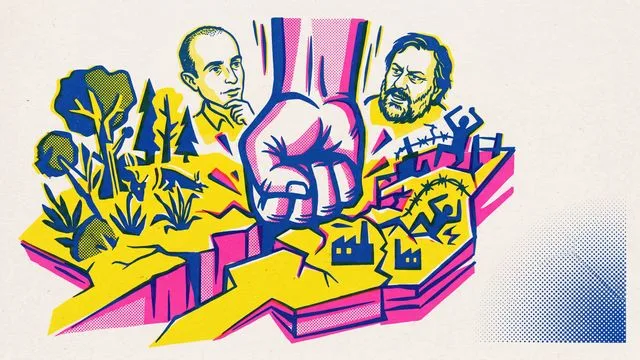
Is Nature Good? Harari and Žižek Say No
Yuval Noah Harari and Slavoj Žižek agree: nature isn't inherently good. Their debate reveals why "natural" is almost always a political argument in disguise.

Gen Z's Dating Retreat Is Also an Economy Story
Gen Z isn't just retreating from dating—they're optimizing themselves for a labor market logic that's colonized their bodies. Christine Emba unpacks what's actually happening.

Why Looksmaxxing Has Nothing to Do With Looks
Dr. K's viral breakdown of looksmaxxing reveals it's really about control, shame, and the templates of self-worth we hand our kids without realizing it.

Netflix's Bold February: A Visual Culture Dive
Explore February's Netflix lineup through a design lens, from heists to satire.

How Akira (1988) Rewired Global Animation and Cinema
Katsuhiro Otomo's Akira used 160,000 hand-drawn cels, 327 custom colors, and an inverted production process to permanently change how animated films get made.

David Senra on What 400 Founder Biographies Reveal
David Senra studied 400+ founder biographies for his podcast Founders. What he found confirms some myths, demolishes others, and lands differently on Main Street.

Youth Economic Inactivity Is a Structural Problem
262 million young people are NEET worldwide. Unemployment figures miss most of them. Here's what the data actually shows about youth economic disengagement.

Blackstone's Career Ladder, From Analyst to Partner
From a $90K analyst seat to Schwarzman's billion-dollar paycheck: how Blackstone's career ladder works—and why private credit is quietly rewriting it.