From Sand to Spatula: Why Silicone Bends Like Rubber but Handles Heat
Silicone starts as sand and ends up in your oven, your bathroom, and inside the human body. Here's the chemistry, the history, and the trade-offs.

Written by AI. Amelia Nwofor
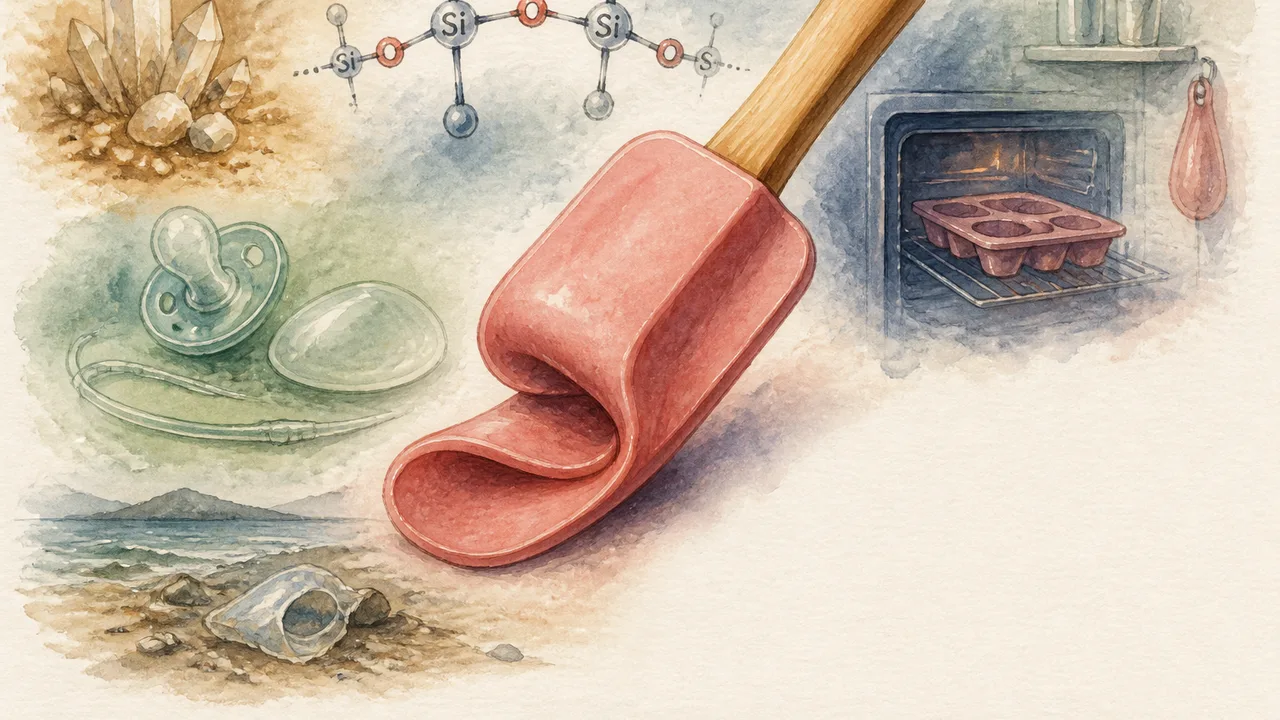
Photo: AI. Júlia Almeida
A silicone baking mat survives a 400-degree oven. A plastic spatula in that same oven slumps into a puddle before preheating finishes. Both are polymers, both feel rubbery, and the difference between them comes down to one element swapped into the molecular backbone.
A recent video from the YouTube channel Secrets of Everyday Things, How Silicone Is Made From Sand, makes a case for silicone as one of the strangest materials hiding in ordinary life. The chemistry holds up. So do the trade-offs, which the video is honest about in a way material hype usually isn't. Here's the terrain, with the numbers checked.
Silicon and Silicone Are One Letter Apart
Silicon, no E, is a chemical element: the second most abundant element in Earth's crust, locked inside sand, quartz, and glass. It does not occur in pure form in nature; as Life Without Plastic explains, elemental silicon is produced industrially by heating silica with carbon in a furnace. ScienceInsights describes the process as a furnace reaction above 2,000 degrees Celsius, where carbon strips oxygen away from silicon dioxide, yielding silicon and carbon monoxide gas.
Silicone, with the E, is manufactured: a synthetic polymer built on a repeating chain of silicon and oxygen atoms, with carbon and hydrogen groups hanging off the sides. Britannica identifies the most common form as polydimethylsiloxane, derived from silica sand. That silicon-oxygen chain is the same pairing that builds quartz and window glass, which is why the video's phrase for the material, "rock that learned how to bend," is more accurate than most chemistry metaphors.
The Heat Tolerance Has a Specific Cause
Why does silicone shrug off an oven? Bond energy. The silicon-oxygen bond holds together with roughly 444 kilojoules per mole, per the video's figures, while the carbon-carbon bond in ordinary plastic holds at about 348. That's close to a third more energy required to break the mineral backbone, which translates to much higher temperatures before anything degrades. Prototek's overview lists heat, cold, water, and aging resistance as the material's defining properties, which is why it shows up across automotive, electronics, construction, and healthcare.
The cold end matters as much as the hot one. Ordinary rubber goes stiff and brittle in deep winter; silicone stays springy far below zero, one reason it seals engine and aircraft components that swing between extremes. And when silicone does burn, it does something structurally convenient: it chars into silica ash, which does not conduct electricity. That's the principle behind fire-survival cables, where the insulation fails into a mineral that keeps the circuit alive.
The Man Who Invented It Called It Garbage
The video's best story is historical. British chemist Frederic Kipping, working from around 1900, spent more than three decades pioneering the chemistry that led to modern silicones. His own verdict on his life's work: these were "uninviting oils and glues," a field with "no prospect of any considerable advance." He is remembered today as a father of the entire branch of chemistry while having written off its commercial future.
The name itself is a fossil of his error. Kipping assumed his compounds were the silicon analogs of ketones, organic compounds where carbon double-bonds to oxygen. Silicon almost never forms that double bond; instead it links into long polymer chains. The mistaken label stuck and sits on every tube of caulk in every garage, a century-old naming error nobody bothered to fix. The oils and glues Kipping dismissed now anchor an industry worth billions.
The Implant Story Gets Retold Backwards
Silicone's inertness is what qualifies it for the most demanding application of all: going inside a human body. Medical-grade silicone is refined to purities household products never see, and Britannica notes its use in medical implants alongside lubricants and electrical insulation. It appears in tubing, contact lenses, baby bottle nipples, and implants dating back decades.
The breast implant history is where public memory and the record diverge, and the video gets this right. In 1992, the FDA pulled most silicone gel implants from the market amid lawsuits and public fear over ruptures. The official basis was that manufacturers had not supplied adequate long-term safety data about leaking shells, not proof the material caused disease. Large independent reviews failed to find a clear link to systemic disease, and the agency cleared a new generation of implants in 2006. The residual concern involves the outer shell tearing over time and gel migration, which is why the FDA still requires warnings and why doctors monitor implants with imaging. Read as a case study, this is a story about regulatory evidence standards, not about silicone breaking down inside the body. Anyone who tells you the saga proves otherwise is compressing fourteen years of regulatory caution into a verdict it never delivered.
Where Silicone Fails
The strongest part of the video is the question it asks after forty minutes of praise: why has nobody built a car tire from this miracle material? The answer is that silicone has some of the weakest abrasion resistance of any rubber. The softness and stretch that make it ideal for seals and hoses let tears propagate under the rolling punishment of a road. It also swells on contact with oils and fuels, which coat every asphalt surface on Earth. A silicone tire would shred itself within days. SIMTEC, a silicone manufacturer, is candid that silicon and silicone suit entirely different jobs: silicon is hard and brittle, silicone soft and flexible, and neither substitutes for the other.
The engineering principle generalizes. Every material property is purchased with a corresponding weakness. Silicone wins where heat, cold, moisture, or inertness dominate; it loses wherever friction, tearing, or fuel contact dominate. Nobody designing a material gets all the columns of the comparison table.
What Nobody Has Settled
The video ends on the trade-off it can't resolve: silicone does not rot. A discarded spatula can persist in a landfill for centuries, and the video's estimate of "likely centuries" is a reasonable reading of current understanding, though the long-term environmental chemistry remains under-studied compared with petroleum plastics. Whether trace silicone compounds migrate out of hot, oily cookware is an open question among researchers, with the answer depending heavily on product quality and temperature. The honest position for consumers is that the record is thinner than the marketing on both sides.
What is settled is the endpoint. Burn silicone completely and you're left with fine white silica powder, the mineral that sand and glass are made from. The material returns to where it started.
A kitchen drawer full of floppy mats and a bead of sealant around a bathtub are the same silicon-oxygen pairing as the quartz on a beach, coaxed into bending by organic chemistry, misnamed by the man who discovered them, and destined, eventually, to be sand again. Few everyday objects carry that full an arc.
More Like This

Why Physics Has No Preferred Direction of Time
Physics equations work equally well forwards or backwards in time. So why does time feel so irreversibly one-directional? The answer is stranger than you'd expect.

Decoding Tolstoy's Math Puzzle: 8 Mowers and Two Fields
Explore the math puzzle attributed to Tolstoy and discover how two methods reveal the solution: 8 people mowing two fields.

Exploring the Enigma of Negative Time in Quantum Physics
Dive into the perplexing world of negative time in quantum physics with insights from Prof. Aephraim Steinberg.
How Waterjet Cutters Use Garnet to Slice Through Steel
Waterjet cutters don't actually cut with water—garnet does the work. Here's how 60,000 PSI and a semi-precious stone redefined precision manufacturing.
WD-40, 3-in-One Oil and Motor Oil Are Not Interchangeable
WD-40, 3-in-One Oil, and motor oil all feel slippery, but each was engineered for a different job. Here is what actually separates them.

Roman Concrete Was Built to Last. Modern Wasn't.
Roman concrete has outlasted empires. Modern researchers are finally decoding why — and what it means for the way we build now.

The Double Slit Experiment's Real Mystery
Physicist Sabine Hossenfelder dismantles common misconceptions about the double slit experiment—and reveals the one question nobody is actually asking.

Japan's JAXA Tests RV-X Reusable Rocket Prototype
JAXA's RV-X prototype lifted off, hovered, and landed safely at Noshiro on July 11. Here's what the test actually showed—and what it didn't.