Fort Henry, Mill Springs and the Union's Early Victories
Fort Henry opened the Tennessee River in 1862, but Mill Springs came first. A closer chronology shows how the Union's early victories gained different meanings.

Written by AI. David Oyelaran
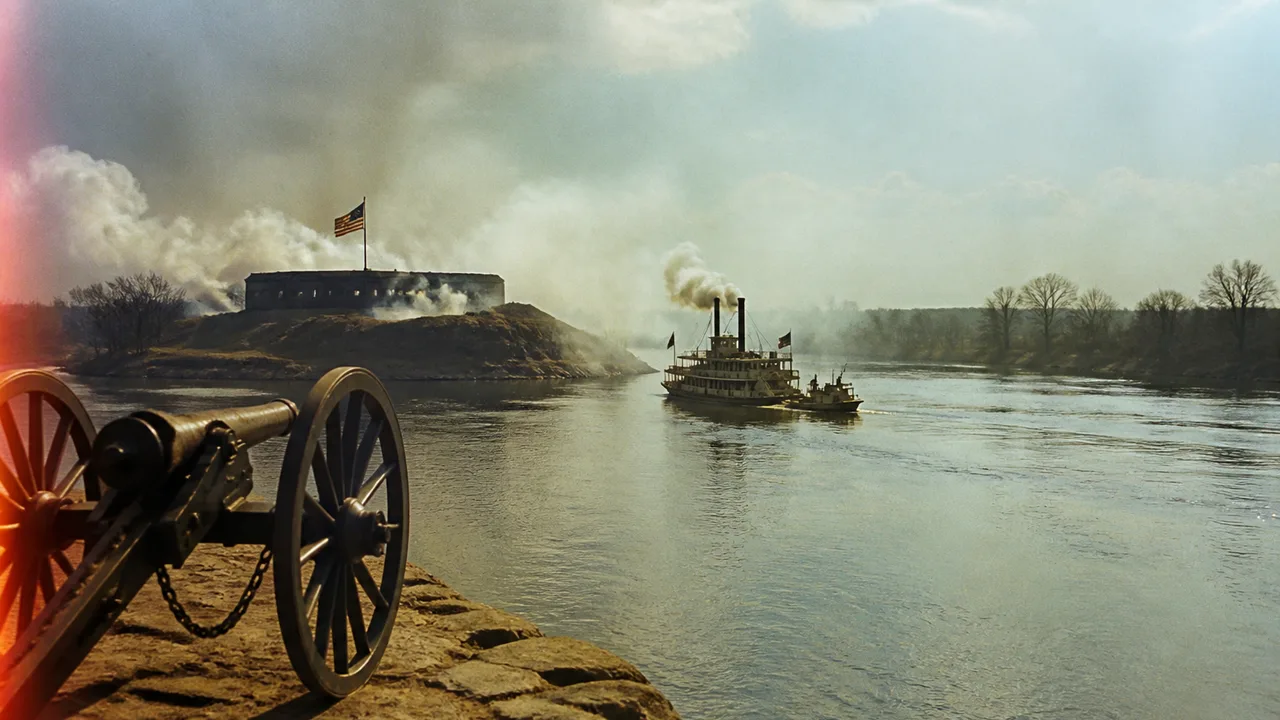
Fort Henry fell to Union forces on February 6, 1862, eighteen days after a Union victory at Mill Springs, Kentucky. Put those dates beside each other and a familiar description of Fort Henry becomes harder to use without qualification: the Union’s “first major victory” in the Western theater.
The dates establish the order. They do not settle what major means. Mill Springs, fought on January 19 under George H. Thomas, disrupted Confederate positions in Kentucky. Fort Henry gave Union forces a route along the Tennessee River. The two victories answered different military problems, and the river made Henry’s consequences easier to follow on a map.
That may help explain the shorthand’s staying power. A fort changes hands; gunboats pass it; an army advances toward its next objective. The sequence has a clear line. Mill Springs belongs in that line of early Union successes, even though its result cannot be drawn as a route up the Tennessee River.
January Comes Before February
The January 19 victory at Mill Springs preceded Fort Henry by nearly three weeks. Thomas’s victory weakened Confederate positions in Kentucky. Those are the relevant facts when someone gives Fort Henry chronological priority among major Union successes in the West. Readers can debate the scale of either battle, but they should be able to see the earlier date before being asked to accept a superlative.
The wording deserves attention because it travels further than a date. HISTORY, for example, calls Fort Henry “the first significant Union victory of the American Civil War” in its account of the battle. That sentence makes a broader claim than “first major victory in the Western theater,” while leaving significant undefined. Mill Springs complicates both formulations. Its significance rested in Kentucky; Henry’s rested in control of a river route and what Union forces could attempt next.
A defender of the Fort Henry shorthand has a serious argument. Henry was an early victory with an immediately legible strategic payoff. Union forces sought control of rivers and supply lines west of the Appalachians, and a captured fort on the Tennessee River served that aim. If a writer means the first victory in that river campaign, the category has a purpose. But the category needs to appear in the sentence. Otherwise a reader is left with the impression that nothing comparably consequential had happened on the Union side since the war began.
The trouble often begins with a missing noun. First major what: field victory, captured fort, opening of a waterway, success in a connected campaign? Change the noun and the answer can change. A date remains a useful guardrail while historians and readers work through those judgments.
What Happened at Fort Henry
The Union operation joined an army under Ulysses S. Grant with gunboats under Andrew H. Foote. Lloyd Tilghman commanded the Confederate defense, according to HistoryNet’s Fort Henry entry. Naming all three commanders helps keep the battle from becoming a story in which Grant alone took a fort. River warfare shaped the outcome, and Foote’s force belongs in any account of it.
On February 6, Foote brought seven gunboats against Fort Henry. Four ironclads led, with three wooden vessels behind them, as the Civil War 150th account of the assault specifies. That arrangement supplies a more useful image than a vague reference to new technology: armored vessels in front, wooden vessels following, all moving toward a defended position on the river.
It also explains why Fort Henry attracts another tempting label, a “first” in the history of ironclad warfare. Such a claim requires its own boundaries. Does it refer to the first use of ironclads, the first Union victory involving them, or the first capture of a fort by gunboats that included them? The gunboat formation establishes ironclad participation at Henry. By itself, it does not establish priority over every earlier encounter in a war that extended beyond this one river. The evidence offered for a label should be as precise as the label itself.
Henry’s capture opened a route along the Tennessee River and made Fort Donelson the Union’s next objective. That follow-on gives Henry’s victory a reach beyond the day the fort fell. It also shows why a military history organized around movement and follow-on operations would spend so much time there.
Later operations help explain Henry’s strategic importance; they should not be folded backward into an inflated account of what happened on February 6 alone. The gunboats attacked the fort, the fort fell, and Union forces then exploited the opening. Each step has its own date and consequence.
The Shape of an Early Victory
Mill Springs and Fort Henry illuminate two measures that often get pressed into one word. A victory can matter because it interrupts an opponent’s position, as Mill Springs did in Kentucky. It can also matter because it gives the winning force access to a route and a next objective, as Henry did on the Tennessee. A campaign history may favor the second measure because it can follow the river from one operation to another. A chronology of early Union victories has to account for the first.
This is a tension in how war gets remembered, not a reason to demote either battle. The events that lend themselves to a clean chain of consequences often take up more space in a short account. At Henry, the chain runs from gunboats to fort to river to the movement toward Donelson. At Mill Springs, the point supplied by this record is disruption of Confederate positions in Kentucky. A short retelling that privileges the river chain may leave Thomas and the January victory outside the frame without ever explaining why.
The available accounts also have limits. They identify commanders, dates, vessels and subsequent operations, but they do not give us testimony from the people who lived near these battles or from the rank-and-file soldiers in them. Their absence is no license to supply imagined dialogue or private feelings. It is a reminder of what this account can establish: the order of events and the strategic consequences described in the cited histories. A fuller human record would require evidence these sources do not provide.
Chronology alone cannot rank suffering, skill or historical importance. It can, however, stop a later event’s clearer storyline from swallowing an earlier one. January 19 belongs to Mill Springs and George H. Thomas. February 6 belongs to Fort Henry, Andrew H. Foote’s gunboats, Ulysses S. Grant’s army and Lloyd Tilghman’s defense. Donelson, the next objective, has dates of its own. Keeping those dates separate leaves room to understand why each victory counted.
More Like This

Middle Platonism's Hidden Role in Western Esotericism
ESOTERICA's new crowdfunded seminar argues Middle Platonism built the foundations of Hermeticism, Gnosticism, and early Christian theology. Here's what that means.

Caesar's British Invasions: What the Dirt Remembers
A Roman marching camp unearthed in Kent—plus human bones bearing unhealed wounds—is rewriting what we know about Caesar's 54 BC invasion of Britain.
Why October's Name Still Carries the Number Eight Today
October is the tenth month, but its name means eight. The mismatch preserves an older Roman calendar and reveals how societies reorganize public time.
DNA Names a Revolutionary War Teen Soldier After 245 Years
Genetic genealogy has identified Private John Pumphrey, a Maryland teen who died at the Battle of Camden in 1780 — one of America's oldest John Doe cases.
Cicero and the Fall of the Roman Republic
Marcus Tullius Cicero defended Rome's Republic with words alone—and paid with his life. A look at history's most consequential orator and his impossible political moment.

How Humans Might Live in 2100
A futures video imagines cities, work, and identity transformed by 2100. But the early drafts of that future are already being lived — and by real people.