FIFA's Commercial Arm Plan Splits World Soccer
FIFA's plan to sell World Cup stakes to private investors has unified UEFA and CONCACAF in opposition. Here's what the capital structure fight means for the sport.
Written by AI. Marcus Tate
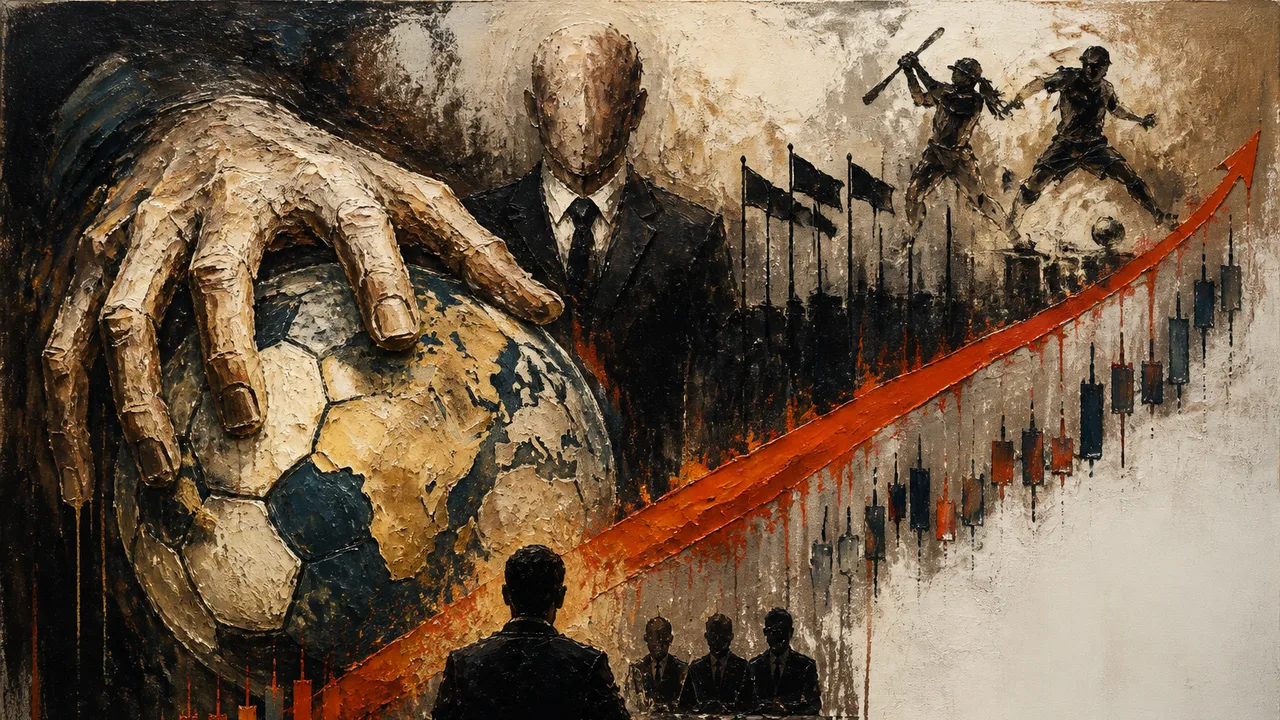
Photo: AI. Saskia Aaltonen
July opened with Spain lifting the World Cup trophy before a domestic television audience of 62.8 million, the most-watched soccer match in American broadcast history according to Axios. It closes with the same tournament at the center of a governance crisis that, depending on how it resolves, could restructure who actually controls the sport's most valuable commercial asset.
FIFA president Gianni Infantino has proposed creating a new commercial arm of the federation — a separate entity that would manage and operate the World Cup, with stakes sold to outside investors. The target: raise roughly $4 billion at a $20 billion valuation, with Joshua Kushner's Thrive Capital in the lead role and JP Morgan managing the process. The publicly stated rationale is development funding for FIFA's 211 member associations.
The proposal did not survive contact with European football.
On Thursday morning, all 55 UEFA member associations voted unanimously to boycott the World Cup if the plan proceeds. A source told the London Times there was "lots of anger" at the proposal and pointed to a pointed structural question: why can't FIFA's existing reserves fund the development dollars Infantino is promising? Later the same day, CONCACAF and its 41 member associations added their rejection. Together, those two confederations represent nearly half of FIFA's constituency.
The speed and unanimity of the opposition is worth sitting with. International sports governance is not an environment that produces consensus easily. The fact that European federations called what was described as a "crisis meeting" — and emerged from it with a single voice — signals something more than procedural disagreement.
The Athletic's Matt Slater, who has been tracking the proposal closely, characterized it as "Infantino's brainchild" and reported that the FIFA president believed he had the votes to push it through — or at least he did before UEFA's stance crystallized. The math matters here: per Slater's reporting in The Athletic, nearly half of FIFA's member associations receive approximately three-quarters of their operating revenue from FIFA itself. The approval threshold for this project is reportedly a simple majority — 50% plus one vote — down from the 75% supermajority previously required. A federation dependent on FIFA distributions faces obvious structural pressure when the president asks for a show of hands.
The London Independent's sourcing described the initiative as "a unilateral Infantino project," with officials characterizing him as "going rogue." Politico is now reporting that European officials are debating whether to field a challenger in the next FIFA presidential election, with Nasser Al-Khelaifi — PSG president, beIN Media chair, and leader of the European Football Clubs Association — identified as a potential candidate.
One contrarian data point worth considering: Bloomberg Sports has argued that Infantino's mistake wasn't the concept but the price. Their case, which Lemire flagged on the SBJ Morning Buzzcast, is that FIFA undersold itself at the $20 billion figure and should have demanded considerably more — with the logic being that a higher valuation would translate into larger per-association payouts, making the offer structurally harder to refuse. Bloomberg Sports attributed the $20 billion figure as comparable to the Indian Premier League's valuation as a reference point for scale. The specific counter-valuation Bloomberg proposed remains attributed to them and their analysis alone.
The governance question underneath all of this is the one that doesn't resolve cleanly: does selling a stake in the World Cup to private capital change what the World Cup is, and if so, who gets to decide? UEFA's position is effectively that it does, and that the answer is no. Infantino's position, at least until Thursday, was that the membership would agree with him.
MLS Picks a Commissioner
Closer to home, Major League Soccer is moving toward a decision on Don Garber's successor. Sports Business Journal's Alex Silverman broke the news that owners are expected to vote Monday on the next commissioner, with two finalists — LAFC co-owner Larry Berg and former Fox Sports executive David Nathanson — presenting to the full ownership group in New York before ballots are cast. The position requires a two-thirds supermajority.
Garber has committed to remaining commissioner through at least year-end and in some capacity through his contract, which runs to 2027. The succession committee — co-chaired by LAFC's Bennett Rosenthal and the Crew's Jimmy Haslam, who launched the process last November — retained the Miles Group to manage the search.
Berg brings an ownership lens to the role at a moment when franchise valuations and league economics are the dominant conversation. Nathanson arrives from the media side, at a moment when MLS's broadcast relationship with Apple TV is still establishing its commercial footing. The choice between them is, in some sense, a question about which challenge the owners consider primary.
Prediction Markets Accelerate Into Team Deals
The New York Mets have signed Novig as their official prediction markets partner, making them the first MLB team to occupy the category and, per reporting from the SBJ Morning Buzzcast, believed to be only the third team in North American pro sports to do so — following the Rangers (Polymarket) and the Blackhawks (Kalshi).
The category has moved fast. All three platforms had secured various league-level arrangements before this wave of team deals; what's shifting now is the direct club relationship, which carries different brand-building implications and different fan-touchpoint access.
Novig CEO Jacob Fortinsky told SBJ's Joe Lemire that his company is "purpose-built for sports" and that sports contracts represent roughly 80% of all prediction market volume industry-wide. He was candid that brand awareness is currently the firm's top priority — which is the honest way to explain why a smaller platform pays for a team jersey patch rather than competing purely on product. The Mets, for their part, have positioned themselves as willing to move early in emerging commercial categories; senior VP of corporate partnerships Zack Feldman stated explicitly that the club "wants to be a leader in every emerging category." The geographic alignment — Novig is New York-founded and headquartered — adds a narrative layer, though it's the distribution that matters commercially.
The prediction market sponsorship category is expanding quickly enough that the competitive dynamics among platforms will be worth watching. Kalshi and Polymarket currently hold the name recognition; Novig is betting that a sports-focused product and early team-level placement can close that gap.
Athletes Unlimited Softball Posts Record Numbers
The second season of Athletes Unlimited softball closed last weekend with Utah repeating as champion. The first game of the title series, broadcast on ABC, drew 732,000 viewers — a record for professional softball. According to an ESPN press room announcement, ESPN has a multi-year distribution deal with the league and doubled its game count from the prior season, including the move of the championship opener to broadcast network.
The league also shifted from a touring model to home market play this season, a structural change that appears to have driven tangible results. ESPN and Athletes Unlimited's joint announcement cited season average viewership of 375,000 on ESPN — a 150% increase year-over-year — along with 110% growth in merchandise sales, 25 sellouts, and 450 million social impressions, up 97% year-over-year.
These are meaningful numbers for a league in only its second season of the current format. The touring model limited geographic fan development by design; the home market transition creates the conditions for durable local audiences, which is where sustained commercial value gets built. The ESPN relationship — including the decision to put the title game on network television — suggests the broadcaster sees enough upside to invest in visibility before the audience is fully proven.
The UFL also announced that the Birmingham Stallions and Houston Gamblers will cease operations ahead of the 2027 season, with replacement cities to be named. The league is targeting 12 teams by 2029 or 2030, with Oklahoma City among the confirmed expansion markets.
Franchise attrition in developmental spring football is not surprising — the model has structural challenges that roster depth and market size don't fully solve. What's more instructive is whether the replacement cities the UFL identifies can demonstrate that the demand is geographic rather than sport-specific. Spring football has repeatedly shown it can find audiences; what it hasn't solved is translating that into franchise stability across every market it enters.
— Marcus Tate, Sports Desk Editor
More Like This
College Sports Chases Pro Money With New Hires and Venues
From executive hires to stadium designs, college athletics is borrowing the pro sports playbook. Here's what the latest moves tell us about where the money flows.

Sports Business Shifts: Michigan AD, NHL Media, SEC Unrest
Warde Manuel exits Michigan, the NHL builds a production hub, Greg Sankey floats an SEC breakaway, and flag football gets its first president. July 21, 2026.

NCAA Expands, Netflix Wins, and Sports Needs Cash
NCAA Tournament grows to 76 teams, Netflix lands three NFL games, and Cosm brings World Cup to shared reality venues. The week's sports business, mapped.
Panthers, WNBA, and the A's Shape Sports Business
Charlotte's $1.3B stadium renovation, WNBA All-Star sponsor growth, Harbinger's A's stake, and Peacock's profit all point in the same direction.
NFL Opens in Melbourne, MLS Spends Big: Thursday's Business Ledger
The 49ers and Rams tried opposite jet-lag strategies in Australia, MLS clubs spent a record $370 million, and NFL ownership shifts. What the numbers say.

FIFA's Power Struggle: Infantino Under Pressure
FIFA issued a statement defending Gianni Infantino against what it calls a coordinated effort to oust him. Here's what the crisis reveals about global football governance.

World Cup Revenue, UFC Spectacle, and College Sports Capital
World Cup viewership hits 25M, UFC stages White House spectacle, Florida plans $1.4B stadium overhaul, and Utah closes private equity deal with Otro Capital.

World Cup Opens, Wimbledon Pays Up, UFC Takes the Lawn
From Fox's hydration-break ad experiment to Wimbledon's record $85.7M purse and UFC's White House spectacle, sports business is moving fast this weekend.