Fed Rate Hike Opens a Harder Phase for the Economy
The Fed lifts rates to 3.75%-4%, raising borrowing costs and testing whether inflation can cool without a sharper slowdown in jobs, spending and growth.

Written by AI. Raj Mehta
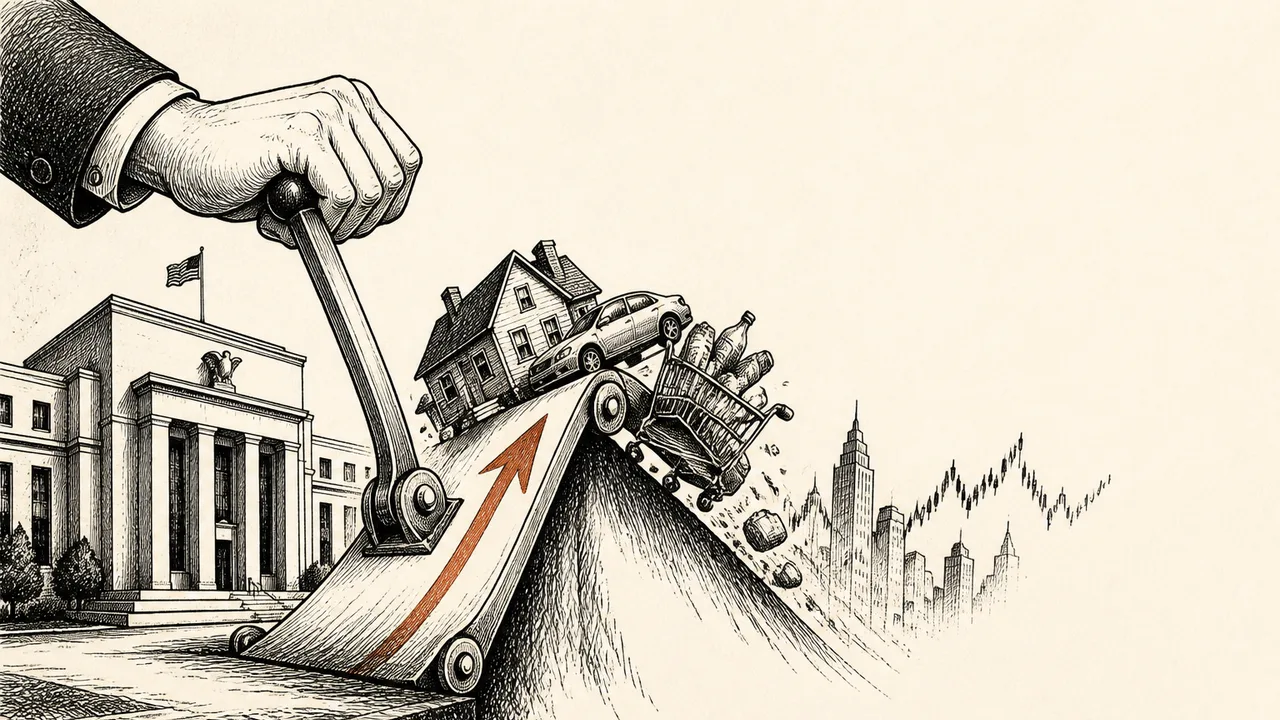
The Federal Reserve raised its target interest-rate range by a quarter percentage point on Wednesday, lifting it to 3.75%-4% and ending a three-year stretch without an increase.
The decision was unanimous, according to the BBC. That unity marks a sharp change from the Fed's previous meeting, when policymakers voted 9-3 to hold rates at 3.5%-3.75% amid disagreement over inflation and the economy's direction. The dissent documented in that earlier Fed decision has given way to agreement that price pressures require tighter financial conditions.
A quarter-point increase equals 25 basis points, using the unit favored by central bankers and bond traders. Its immediate size is modest. Its policy message carries further: the Fed has moved from waiting to tightening, and it appears prepared to accept slower demand as the price of restraining inflation.
Quartz described persistent inflation as the reason for the increase, while the International Business Times reported that the widely anticipated decision received unanimous support. The supplied reports do not provide the inflation breakdown, updated economic projections or the policymakers' full assessment of labor-market conditions. Those omissions limit how precisely anyone can judge the necessity of the move.
Why the Fed Chose Higher Rates
The strongest argument for raising rates begins with inflation's staying power. If businesses and households come to expect prices to rise persistently, those expectations can enter wage negotiations, rental decisions and corporate pricing. A central bank that waits too long may eventually need a larger dose of restraint.
Higher rates work by making credit more expensive and saving more attractive. Households may postpone a car purchase or renovation. Companies may cancel projects whose expected returns no longer exceed financing costs. Softer spending then reduces the pressure on businesses to raise prices and compete for workers.
That mechanism is broad and blunt. The federal funds rate cannot produce more housing, unload a congested port or lower the world price of an imported commodity. It can weaken demand enough to stop a temporary price shock from spreading through the economy. The difficulty lies in judging how much weakness is enough.
Monetary policy also operates with delays. Loans reset on different schedules, corporate hedges expire at different times and households react unevenly. By the time the full drag appears in hiring and consumption, policymakers may already have approved further increases. Central banking involves steering through the rear-view mirror while financial markets shout directions from the passenger seat.
The Household Impact Will Be Uneven
The Fed does not set mortgage, credit-card or auto-loan rates directly. Its target influences short-term funding costs, Treasury yields and the benchmarks lenders use to price credit.
Borrowers with variable-rate debt will generally encounter the change sooner. Credit-card rates and some business loans adjust with market benchmarks, so consumers carrying balances and companies reliant on floating-rate financing can face higher interest bills. New car loans and mortgages may also become more expensive, although their pricing depends on lender competition, bond-market expectations and the borrower's credit profile.
Owners of fixed-rate mortgages retain their existing contractual rate. For prospective buyers, higher financing costs reduce the amount of home that a given monthly payment can support. Sellers may eventually respond through lower prices, but housing supply, local employment and construction costs also shape that adjustment.
Savers occupy the other side of the ledger. Banks and money-market funds may offer better yields on deposits and cash-like products. The pass-through is rarely automatic or uniform because institutions decide how much of the rate increase to share with customers. A household with cash savings can benefit while its neighbor with a revolving card balance pays more. The same policy arrives at two kitchen tables carrying opposite signs.
Small businesses face a similar divide. A firm with cash reserves may earn more on them; one financing payroll, inventory or equipment through variable-rate credit will see margins compressed. Larger companies with long-dated fixed-rate bonds can delay some of the effect, but refinancing becomes costlier as old debt matures.
Markets Are Pricing the Path Ahead
Because the increase had been widely expected, investors will draw more information from the Fed's guidance than from the 25-basis-point move alone. CNBC reported that the central bank signaled one additional increase this year.
That signal raises three questions. How much more tightening does the Fed envision? What evidence could persuade officials to pause? How much deterioration in employment would alter the calculation?
Seeking Alpha characterized the decision as the start of a new rate-hike cycle. That label remains a forecast rather than an established sequence. One additional increase would create a tightening phase, but the eventual peak and duration will depend on inflation, spending and labor-market data that have yet to arrive.
Bond yields, equity valuations and exchange rates respond to that expected path. A longer period of high rates reduces the present value of future corporate earnings and raises the appeal of safer interest-bearing assets. Banks can benefit from wider lending margins, yet they also face weaker loan demand and greater default risk. Markets do not experience tighter policy as a single trade.
The Political and Global Stakes
The decision also lands inside an argument over central-bank independence. Fortune reported that the unanimous increase came despite President Donald Trump's call for the lowest interest rates in the world.
Elected governments usually prefer cheaper credit because it supports investment, housing and public borrowing. Central banks receive operational independence so that near-term political incentives do not override price stability. Independence does not remove politics from monetary policy. Rate increases distribute gains and losses across debtors, savers, workers, homeowners and the government itself.
The Fed's reach also extends well beyond the United States. Higher US yields can pull capital toward dollar assets, especially if investors expect rates to remain elevated. That pressure can weaken other currencies, raise import costs and make dollar-denominated debts harder to service.
The effect differs across countries. Economies with large foreign-exchange reserves, lower external debt and credible domestic policy have more room to absorb shifts in capital. Countries dependent on imported fuel, short-term foreign financing or dollar borrowing face a narrower corridor. Their central banks may raise local rates to defend currencies even when domestic growth is already weak.
That asymmetry reflects the dollar's central position in trade, reserves and international borrowing. A decision made to manage US inflation can change food, fuel and debt-service costs elsewhere without those countries having any vote at the Federal Open Market Committee. Some may use reserves, currency intervention or capital-flow measures to cushion the adjustment. Others will pass the pressure through higher interest rates and tighter budgets.
The Test Moves to Jobs and Demand
The Fed now needs evidence that inflation is cooling while employment and consumption remain resilient enough to avoid a sharper contraction. Those goals can coexist, particularly if supply conditions improve. They can also collide if higher debt payments force households and businesses to cut spending rapidly.
A soft landing would involve slower price growth, moderate demand and limited damage to employment. A harder landing would reveal itself through canceled investment, weaker hiring, rising delinquencies and a feedback loop between job losses and consumer retrenchment. The supplied reports do not establish which path the economy has entered.
The quarter-point increase begins that test rather than settling it. Each mortgage application, refinancing decision, delayed factory purchase and dollar debt payment will show how far the Fed's new policy regime travels beyond the meeting room.
More Like This

Brand Authority Is Pricing Power—and Finance Knows It
Ryan Deiss's five brand "authority triggers" map onto real financial metrics. A global markets reporter translates what that actually means for valuations and beyond.

GameStop's $56B eBay Bid: What the Math Actually Says
GameStop bid $56B for eBay despite a $12B market cap. We broke down the financing—shares that don't exist, a non-binding bank letter, and a CEO incentive worth examining.

Why Friday's August CPI Report Matters More Than Usual
The August CPI lands Friday at 8:30 a.m. with the Fed split 9-3 on rates. What the inflation report could settle, what it can't, and who feels the answer first.

Prices Rise 3.4% as Wages Grow 3.1%: Paychecks Lose Ground Again
Consumer prices rose 3.4% in August while wages grew 3.1%, squeezing paychecks. What the data shows for households, employers, and the Fed.
Fed Rate Hike Odds Hit 92% as Warsh Faces a Divided Committee
Traders price a 92% chance of a Fed rate increase under Chair Kevin Warsh. What the vote, the dissents, and the guidance mean for borrowers and markets.
Page Studio: Streamlining Digital Presence
Explore how Page Studio's features impact businesses globally, enhancing web design efficiency.
Earning vs. Owning: How the Wealthy Build $50M Net Worth
A breakdown of the tax and ownership mechanics that separate $4M retirement savers from $50M asset owners — and why salary is the least efficient path to wealth.
How True Sea Moss Scaled From $20M to $140M
How True Sea Moss's CMO Luka Kvaratskhelia used Meta discipline, cohort data, and category education to build a $140M bootstrapped DTC brand.