Fed Officials Scrutinize AI Investment Risks
Federal Reserve officials are watching AI's debt-fueled investment boom for financial stability risks. For workers, the real exposure runs through pension funds they can't audit.

Written by AI. Carmen Rodriguez
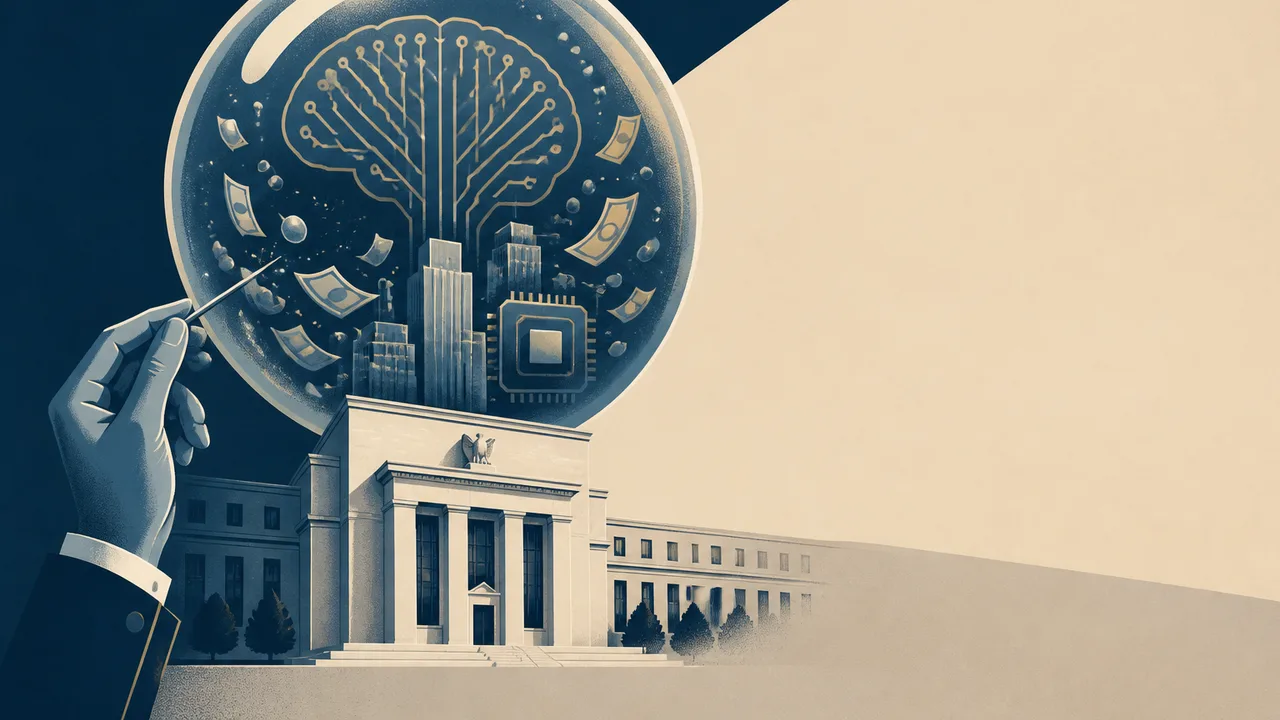
There's a phrase that kept coming up in 2008 — "complex financing structures" — deployed by regulators and bank executives to explain, after the fact, why nobody quite saw it coming. The phrase did a lot of work. It translated "we built instruments so opaque that even the people selling them didn't fully understand the exposure" into something that sounded like an honest description of technical complexity rather than a confession of systemic failure.
That phrase is back. And the Federal Reserve is now using it in the context of artificial intelligence.
According to Reuters, Fed officials are beginning to assess whether the pace of AI investment is generating risks for the broader financial system — scrutinizing not just the scale of spending, but specifically the rise of leveraged financing and what the reporting calls "tricky financing structures" attached to AI infrastructure buildout. Yahoo Finance puts it plainly: "the scale of investment, the uncertain returns for an unproven technology, the rise of tricky financing structures and increased use of debt have moved AI finance onto central bankers' radar."
San Francisco Fed President Mary Daly was candid about the tension. "If you just looked at the growth rate and the amount" of investment in the AI space, she said, you could easily say this is "very worrisome," according to The Star. She stopped short of calling it a bubble. But "very worrisome" from a central banker is not nothing. Central bankers are institutionally allergic to alarm — their preferred register is "monitoring the situation" and "appropriate vigilance." When one of them calls something worrisome without hedging it into oblivion, it's worth paying attention.
CNBC TV18 reports that officials are examining whether "soaring investment, rising leverage and complex financing structures could create broader financial risks" — stopping short, notably, of declaring a bubble, but not stopping short of flagging systemic exposure.
The Scale Is Not Abstract
The hyperscalers — Amazon, Alphabet, Meta, Microsoft — are running a combined capital expenditure program running into the hundreds of billions, with AI infrastructure as the primary engine, according to Statista, which projects Big Tech's AI spending to reach $760 billion in 2026. The capex tab coming due for these companies is no longer a future problem — the bond market is already nervous, and free cash flow is shrinking.
What the Fed is watching is the layer beneath the headline numbers: how that spending is being financed, who is providing that financing, and what happens to those financing vehicles if AI revenue growth disappoints.
Here's where it gets specific. Private credit — the broad category of non-bank lending that has expanded rapidly since the 2008 financial crisis — has become a significant source of capital for AI infrastructure projects, including data centers. Private credit funds, in turn, draw heavily on institutional investors. And institutional investors, in this context, is often a polite term for pension funds.
Deferred Wages, Deployed Into Data Centers
That chain of custody matters enormously, and it's where this story stops being abstract.
Pension funds are not just another institutional vehicle in the capital markets. They are deferred wages. Workers — teachers, nurses, transit operators, warehouse employees — negotiated lower present-day compensation in exchange for a guaranteed future benefit. That trade was the deal. The money they earned but didn't take home was pooled, invested, and was supposed to grow into retirement security.
That pooled money is now being allocated, through private credit vehicles, into AI data center debt. Most pension beneficiaries have no idea this is happening. The instruments involved are not publicly traded. There is no prospectus a school bus driver can read to understand what percentage of her retirement fund is exposed to leveraged AI infrastructure loans. That's not a bug in private credit — it's a feature. Opacity is part of the product design.
The Fed's concern, as GV Wire frames it, is whether this "frenzied investment driving the buildout of the artificial intelligence sector is getting out of hand and creating risks for the financial sector." But financial-sector risks don't stay in the financial sector. In 2008, they moved — rapidly, almost elegantly — from mortgage-backed securities into pension fund balance sheets, municipal budgets, and foreclosure notices. The transmission mechanism is always the same: complexity up top, consequences at the bottom.
What "Unproven" Means at This Scale
The sources are careful to note that the uncertainty here is genuine — AI is described as "an unproven technology" in terms of its ultimate return on investment, according to both Yahoo Finance and the Economic Times. This is not a minority view. The productivity gains from AI remain genuinely contested. The revenue models for trillion-dollar infrastructure build-outs remain genuinely contested. Whether the current pace of investment can be justified by any plausible demand scenario also remains genuinely contested.
The Fed is not saying it cannot work out. Officials are explicitly not calling this a bubble. What they are saying — carefully, in the way that institutions say things carefully when they are worried — is that the structure of the investment, not just the amount, warrants monitoring. Leverage magnifies gains when the bet pays off. It magnifies losses when it doesn't. And at this scale, with this much debt layered into the financing stack, a significant correction would not stay neatly contained inside the portfolios of sophisticated investors who knew what they were getting into.
That's the part worth sitting with. Sophisticated investors structure deals knowing that risk, in a downturn, can be passed. The question is always: passed to whom?
The Fed's Limits Are Real
The Fed can raise rates, issue guidance, and signal concern. It does not regulate private credit directly. It does not set the investment policies of pension funds. It cannot tell a state teachers' retirement system that it's overexposed to leveraged AI loans — partly because the regulatory architecture doesn't work that way, and partly because the opacity of private credit means that exposure is often difficult to map even for the pension managers themselves.
What the Fed can do is name the risk publicly, which several officials now appear to be doing. That matters. Public concern from a central bank has historically been one of the few tools capable of slowing market exuberance before it becomes market crisis — or at minimum, of establishing that the warning was given.
Whether that warning arrives in time — and whether it reaches the workers whose deferred wages are riding on the answer — is a different question entirely. Workers who gave up wages for a retirement promise don't get a seat at the table when their pension fund's investment committee decides how much private credit exposure is acceptable. They find out later, in the way people always find out: when the numbers don't add up and the benefits review notice arrives.
That's who's exposed if this goes wrong. And that's who won't be asked about it first.
More Like This
Business Rules 2026: Impact on Labor and AI
Explore how emerging business rules and AI technology reshape labor dynamics and worker dignity by 2026.
Financial Crises Follow Patterns — But Not for Everyone
Kuran Francis maps four recurring patterns behind every major financial crisis. The framework is solid. What it leaves out is the story of who pays when the system breaks.

Wall Street Knew the Crash Was Coming. Saying So Got You Fired.
Jeremy Grantham's famous poll revealed 398 analysts knew the dot-com crash was guaranteed. A 2003 study shows why none of them said so publicly: accuracy cost careers.

Dubai's Crisis Has a Worker Problem No One's Covering
Dubai's economic model was built on migrant labor with almost no rights. Now, with airstrikes and a blockaded strait, those workers face the worst of the fallout.

Tech Workers Choose Early Retirement Over AI Adaptation
A wave of veteran tech workers is choosing early retirement over AI-driven workplace change. What their exit reveals about the industry's talent calculus.

Smarter AI Models May Push Compute Prices Far Higher
Dwarkesh Patel argues that AI revenue growth is outpacing compute supply—and something has to give. That something is probably the price of compute.

Gen Z's Dating Retreat Is Also an Economy Story
Gen Z isn't just retreating from dating—they're optimizing themselves for a labor market logic that's colonized their bodies. Christine Emba unpacks what's actually happening.
AI and Gaming: A New Frontier for Work and Play
AI in gaming reshapes job roles, user engagement, and societal impacts. Explore the nuances.