Europe's Tech Sector Is Skipping Its Summer Nap
Europe's tech scene — led by hubs like Eindhoven — is defying the summer slowdown with fresh investment, global talent, and high-stakes AI regulation on the horizon.

Written by AI. Bob Reynolds
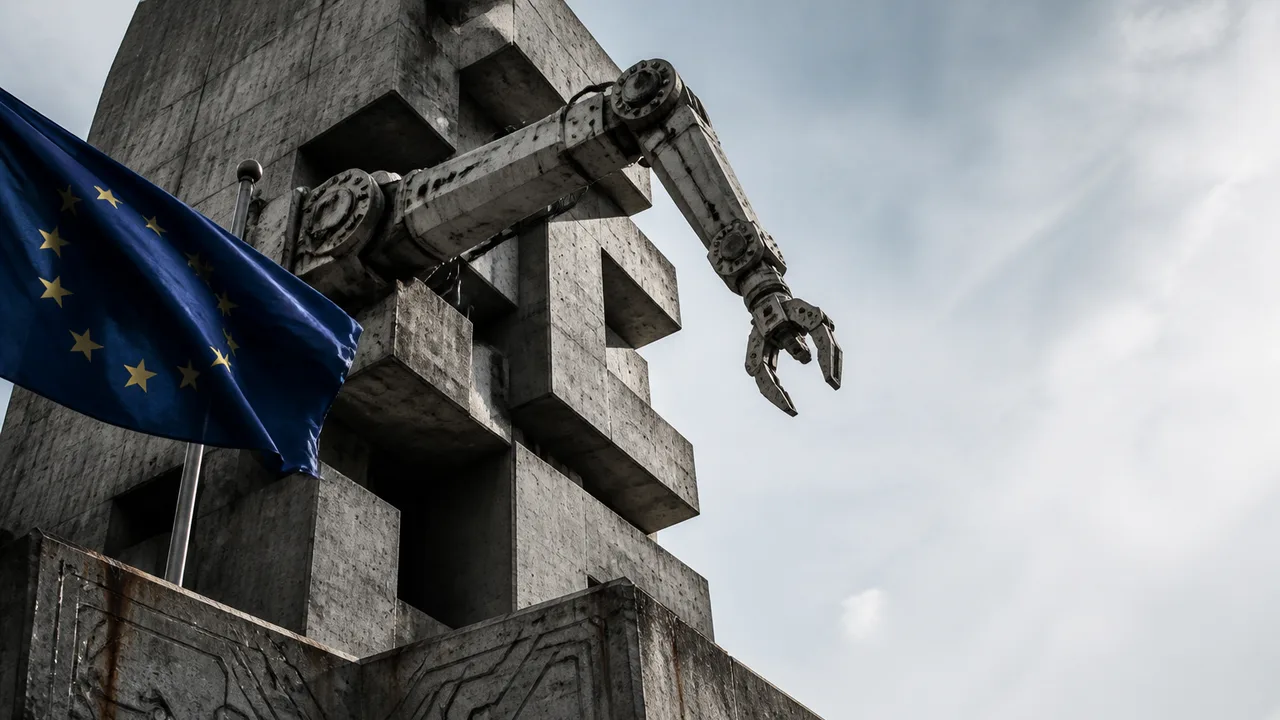
The croissants are still there. The urgency is not supposed to be.
Every July, the received wisdom about European business resets to the same pastoral image: a continent that knows how to take a holiday, shuttered offices in Paris and Milan, executives on the Adriatic, deal-making deferred until September. The narrative has always carried a faint condescension — productive elsewhere, restful here — and like most condescending narratives, it has always been partly wrong.
This summer, it is more wrong than usual.
A City That Smells Like the Future (Whether You Like It or Not)
Eindhoven does not look, at first, like a place that should be dictating the pace of global technology. It is flat in the way only Dutch cities are flat — not empty, but relentlessly horizontal, the sky always the most dramatic thing in frame. The old Philips factories that once gave the city its reason to exist still anchor its east side, red-brick industrial buildings that have been reimagined as design studios and incubator spaces. The city built its identity around a single electronics giant, and when that giant decentralized, Eindhoven had to figure out what it actually was.
What it turned out to be was an ecosystem — patient, infrastructure-rich, deeply wired into European semiconductor supply chains. Hitachi High-Tech's expanding operations there are not an anomaly; they are evidence of a deliberate gravity the city has spent twenty years building, according to Dispatches Europe, which noted the city's continued consolidation of its position as a tech leadership hub this summer. The engineers now arriving from Cape Town, Chennai, and Chicago are not choosing Eindhoven over London or Berlin out of naivety. They are choosing proximity to ASML, to the High Tech Campus, to a density of deep-tech expertise that doesn't exist at the same concentration almost anywhere else in Europe. The trade-off is that Eindhoven is a mid-sized Dutch city, which means the social life is excellent if you like cycling and good coffee, and quieter than you might want if you were hoping for Berlin at midnight.
That specific particularity — a highly specialized place, not a generalist hub — is exactly what makes the talent story here interesting rather than merely heartwarming. Cross-cultural collaboration is real, but it tends to work best when the destination has something irreplaceable to offer, not just a welcoming visa regime.
The Founders Who Cannot Afford to Sleep
Across the broader European startup landscape, the energy this summer is real but edged with something sharper than optimism. Sifted put a precise point on it through Evoléna de Wilde d'Estmael, cofounder and CEO of Faircado, a second-hand shopping app: "When you see how fast these AI wrappers are becoming obsolete, these companies cannot afford to t—" The quote cuts off in the source, but what it gestures at is a very specific founder anxiety that has become the background hum of European tech conversations this year. The fear is not that Europe is behind. The fear is that the distance between "keeping pace" and "falling irreparably behind" has compressed to something measured in product cycles rather than years.
This is where the comparison to American summers — which Sifted frames directly in asking whether European tech is "having a US summer" — gets genuinely complicated. The US moves fast and breaks things, including regulatory frameworks, labor protections, and occasionally entire industries. Europe has historically moved more deliberately and embedded more guardrails. Whether that deliberateness is a feature or a bug depends almost entirely on what you think technology is for.
What Brussels Is Actually Doing While Everyone Else Is on Holiday
Here is the part of the story that the "Europe is buzzing!" narrative tends to skip past too quickly: Brussels is not buzzing with innovation this summer. Brussels is buzzing with regulation, and that is a categorically different kind of activity.
The Parliament Magazine describes a summer of "high-stakes technology regulation" taking shape in the EU, with landmark frameworks advancing even as the political class takes its traditional August pause. The EU AI Act, data governance rules, and ongoing enforcement of the Digital Markets Act are not background noise — they are structural interventions that will shape what European tech companies can build, how they can monetize it, and what international players can do within EU markets.
This creates a genuine split screen. Eindhoven and its peer hubs in Stockholm, Warsaw, and Tallinn are running at innovation speed. Brussels is running at regulatory speed. These two clocks are not synchronized, and the gap between them is where the most consequential decisions about European tech's future are actually being made — not in pitch decks, but in committee rooms.
The Christian Science Monitor offers a useful corrective to both the gloom-and-doom reading and the uncritical boom narrative: the EU, it argues, has been making "quiet, consistent progress" in dismantling the limiting perceptions — and some of the limiting policies — that have held it back. The word "quiet" is doing real work in that sentence. European institutional progress almost never announces itself with a product launch or a funding round. It accumulates. And then, sometimes, it matters more than anyone expected.
Euro Biz Herald characterizes the current moment as a "fundamental pivot" in the European tech ecosystem — language strong enough to take seriously, sourced thinly enough to hold with some care. The pivot is real in outline: away from the assumption that European companies must scale by copying American playbooks, toward something more structurally European — longer time horizons, deeper industrial integration, regulatory environment as competitive differentiator rather than handicap.
Whether that pivot produces companies that can compete globally on revenue and reach, or whether it produces excellent, well-governed companies that nevertheless remain subscale by American and Chinese standards, is the open question nobody can honestly answer yet.
The Speed Problem Nobody Wants to Name
The summer energy in European tech is genuine. So is the structural pressure underneath it. The arrival of skilled engineers from three continents into places like Eindhoven reflects real pull — real expertise, real salaries, real infrastructure. It also reflects, in some cases, a global talent market in which the US has become less attractive than it was, for reasons that have nothing to do with Eindhoven's particular merits. Geopolitics is doing some of the recruiting that ecosystem-builders used to have to do themselves.
Dispatches Europe frames this as a reshaping of the European tech landscape through cross-cultural collaboration. That is accurate as a description. What it leaves open is the question of retention: whether Europe's hubs can hold the talent they attract once US visa climates shift again, or once a founder from Lagos or Bangalore decides the regulatory overhead of building an AI company in the EU is not worth the stability it provides.
That is not a reason to be pessimistic. It is a reason to be specific — about which cities, which sectors, which regulatory frameworks, and which kinds of companies are actually thriving, rather than flattening the whole continent into a single buzzing headline.
Europe's summer is not quiet. But the noise is more complicated than the briefing suggests, and the most important frequencies are the ones you have to listen carefully to hear — in a committee room in Brussels, in a design studio built inside an old factory in Eindhoven, in a founder's unfinished sentence about the thing she is afraid she cannot afford to slow down long enough to think through.
More Like This

American Tourists in Europe: The Etiquette Gap
From date formats to tipping culture, the everyday customs that trip up American travelers in Europe—and what they reveal about deeper cultural differences.
US and China Train Almost All the World's AI Models
US and Chinese companies train nearly every major AI model the world uses. Here's what that concentration means for global power, values, and sovereignty.
Why AI Won't Kill Engineering Jobs (It'll Create More)
Vercel's CTO explains why AI agents will increase demand for software engineers, not replace them—and what types of automation actually work today.
Luxury Train Journey Across Australia: Worth the Cost?
Explore a luxurious 80-hour train journey across Australia and its opulent offerings.
AI Progress Is Accelerating Faster Than Anyone Expected
New data shows AI capabilities doubling every four months, not seven. Industry leaders say coding is 'solved.' What does this mean for the rest of us?
Big Tech's AI Spending Has a Free Cash Flow Problem
Big Tech's AI investment boom is straining free cash flow, raising questions about circular financing, inflated valuations, and whether the returns ever materialize.

Amarillo Put an AI Face on City Hall. Now What?
Amarillo's AI assistant Emma handles 33,000 citizen questions and deferred $1.8M in hiring costs. Here's what that actually means for government services.

AI Coding's Babysitting Problem Has a Structured Fix
The BMAD Method's QuickDev tool folds planning, coding, and review into one loop—less hand-holding, more discipline. Here's what it actually does.