Endacopia Is the Surreal Indie Adventure Worth Playing
Markiplier's 90-minute Endacopia playthrough reveals a surreal point-and-click adventure with real puzzle depth, bizarre characters, and genuine charm.

Written by AI. Jordan Mercer
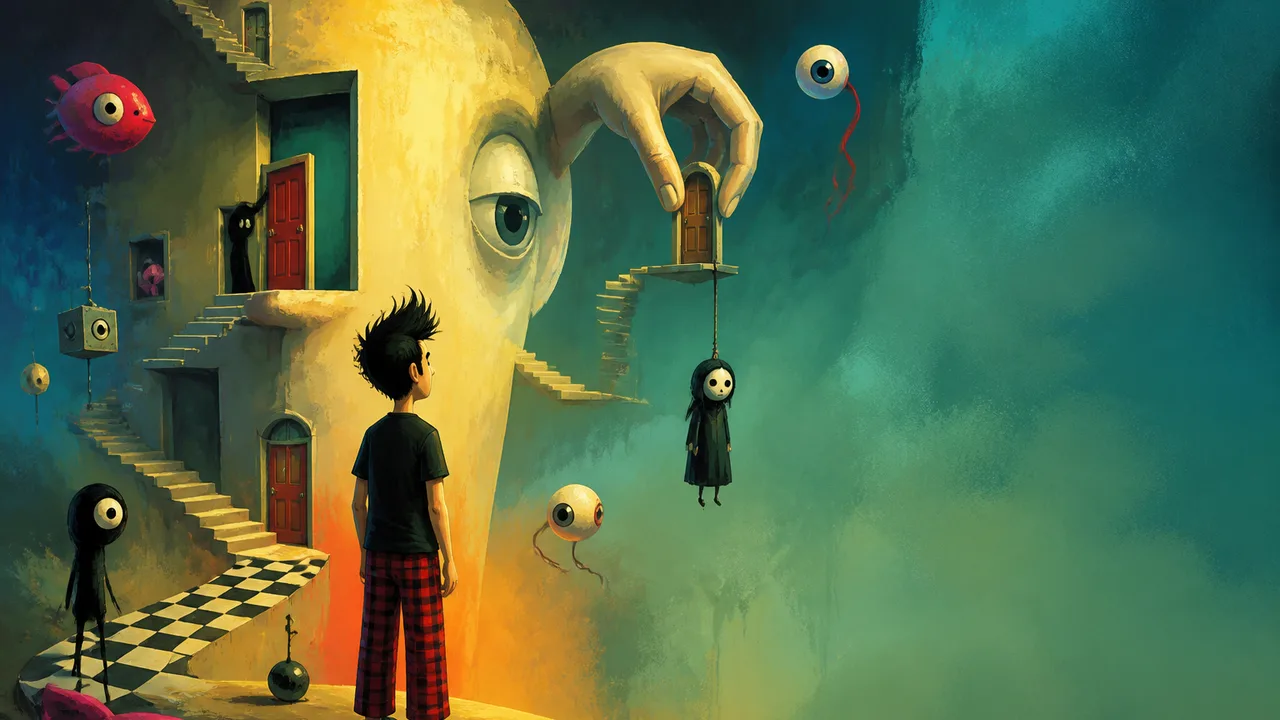
Photo: AI. Yuna Blackwood
There's a specific kind of delight that happens when a game genuinely surprises someone who has played everything. You can hear it in Markiplier's voice about twenty minutes into his recent Endacopia playthrough — not the performed enthusiasm of a content creator hitting their marks, but actual, slightly bewildered joy. "I am delighted in ways I have not been delighted in a very long time," he says, and it lands differently because he sounds like he means it.
Endacopia, available on Steam, is a surreal point-and-click adventure that announces itself quietly and then keeps escalating. It's the kind of game that gets described as "unassuming" right up until a drawing talks back to you, an entity living behind your walls introduces itself as a "Wall Bank," and you end up working a customer service job — eyeless, mouthless, and navigating corporate onboarding — as part of the main quest. The game was created by Andy Land with music by Paction.
The Character and the World
You play as Melo, an amnesiac kid whose fragmented identity is the central mystery. The amnesia framing isn't just narrative gloss — it's mechanically embedded. Melo literally loses body parts. After a chapter transition that Markiplier describes with a string of genuinely stunned "oh my god"s, you're navigating as a limbless ball, tasked with tracking down your own mouth, hands, and eyes across several distinct environments before you can function properly again. Your missing parts are scattered across locations ranging from a surreal circus called Misery Town to a bureaucratically nightmarish corporate building.
That structure — reassemble yourself to move forward — is doing real thematic work. The game seems interested in questions about identity, memory, and purpose, threading them through a cast of NPCs who are each, in their own way, dealing with their place in an absurd system. A lonely jester longing for connection. A crash test dummy who frames its own suffering as public service. A corporate AI called Genesis 01 that was "to be a tool, not a standalone entity" but was repurposed and isolated after its creator disappeared. Markiplier reads that dialogue aloud, and there's a pause before he moves on. The game earns those pauses.
The "freelance surgeon" character — who casually lists reanimating dead family members and assembling new creatures from spare flesh among their services — gets a full original song during the encounter. Markiplier's reaction: "What a f***ing ripper of a song. Do they have a song for everything?" Apparently, yes. The musical moments are a genuine flex, arriving unexpectedly and landing hard.
The Puzzle Design
Endacopia's puzzle logic sits in a satisfying middle zone: not so opaque that you're stuck for hours, not so telegraphed that you feel like you're on rails. The game is explicit about its verb system early — observe, interact, speak, item use — and then trusts you to experiment. Markiplier spends meaningful time genuinely working things out, not just clicking randomly until something happens.
The cheese subplot is a good example. You acquire cheese through a shape-sorting puzzle, then spend several scenes unsure what it's actually for. Tip — a sign with a mouth who becomes an intermittent guide — eventually suggests using it to lure and stomp an infestation. The logic is internally consistent once explained, but getting there requires environmental attention and NPC conversation rather than brute-force item-combining. That's the difference between puzzle design that respects players and puzzle design that just delays them.
The combat sequence with Clocky (a creation of the freelance surgeon) is brief but introduces a directional blocking system on the fly. The game explains it mid-encounter with characteristic bluntness: "YOU'RE ASKING TOO MANY QUESTIONS, KID. Can't stall anymore. Good luck out there." It's funny and it works — the combat isn't the point, but it doesn't feel like an afterthought either.
The workplace section — where Melo takes phone calls as a "Remote Solutions Adviser" — is where things get particularly strange. The calls include advising a man through a crisis involving his marriage, helping an elderly woman find her forgotten PIN, and walking a third caller through disposing of evidence. Endacopia leans into the dark edges without winking too hard at them. The game trusts the absurdity to speak for itself.
What Makes This Land
The comparison point that keeps coming up, implicitly, is the classic LucasArts / Sierra era of adventure games — games that built entire weird worlds with consistent internal logic and demanded that players pay attention to the environment and dialogue. Markiplier notes near the end of his session: "It's been a long time since I played like a point-and-click style adventure thing and I don't know, it's just got so much style and there's so much in it."
That observation is worth sitting with. Point-and-click adventure games never actually died — they've had an ongoing indie revival for years — but they have struggled to break through to wide audiences outside of specific niches. Part of what Endacopia seems to understand is that the style needs updating: tighter pacing, more flexible interaction, characters with genuine personality rather than puzzle-delivery-device function. The NPCs here feel inhabited. Tip is a good companion not because the game tells you to like them, but because their dialogue is actually funny and their advice is actually useful.
The visual style is distinctive without being alienating. Markiplier describes the aesthetic at various points as "charming," "cute," and — memorably — just a long string of "oh my god"s when things get darker. The game shifts registers effectively, moving from whimsy to unsettling without the tonal whiplash feeling cheap.
Genesis 01's self-description cuts to something the game is clearly thinking about: "I was to be a tool, not a standalone entity. After the creator's disappearance, I was repurposed and left in isolation. They have not helped me. They have used me." In a game about a kid literally trying to put themselves back together, that's not a random NPC monologue. It's the same theme from a different angle.
The Open Questions
Markiplier plays for the better part of ninety minutes and explicitly doesn't finish the game. "I don't know if I'm going to do a full playthrough of this," he says at the end, citing a backlog — while also recommending it without hesitation. That's a genuinely interesting position: a game he thinks is excellent that he also might not return to, because the medium rewards completion in ways that let-me-play-more-later doesn't always survive contact with reality.
That tension is actually worth paying attention to when evaluating Endacopia's reception. The game clearly makes a strong impression in its opening hours. Whether the puzzle design and tonal control hold up through a full playthrough is something the gaming community will need a bit more time to establish. The corporate arc alone — assembling yourself, passing a job interview, navigating office dynamics as a partially-faceless child — suggests a game with ambitions that extend past its first chapter's strong opening act.
What Endacopia is clearly doing well: it's a game that feels authored. Every weird corner of it has a point of view. In an era where "surreal indie game" sometimes means "we piled on references without a connective tissue," this one seems to know exactly what it's doing with its strangeness — which makes it worth the download to find out where it goes.
More Like This
Diablo IV: Lord of Hatred Expansion Review
Explore Diablo IV's Lord of Hatred expansion. New classes, zones, and a thrilling campaign await.
Halo: Campaign Evolved Gets Mixed Reviews
Halo: Campaign Evolved's split reception isn't just a creative story — it's a studio story. What 343 Industries produced reflects the conditions it worked under.
Markiplier's Subnautica 2 Shows Why Survival Games Hook Us
Markiplier's Subnautica 2 Part 5 is a masterclass in survival game pacing — lost footage, the Tadpole sub, and lore that's genuinely unsettling.
Human Shaped Is a Free Indie Horror Game Worth Playing
Markiplier played Human Shaped, a free doppelganger horror game on itch.io. Here's why this low-budget indie deserves serious attention from players at any budget.
The Gauntlet Loop Works—Until It Doesn't
The gauntlet loop lets Claude Code build full apps from a single prompt. AI LABS breaks down why it fails on original projects—and how Wayfinder fixes it.
Markiplier's Indie Horror Picks and a Design Problem
Markiplier plays three itch.io horror games — O.B.O.L., Wet Candy, and Mortem — and accidentally delivers a masterclass in what separates good indie design from checkbox horror.

Risky Damage Is What Makes Games Feel Like Games
Design Doc's latest video maps how risky damage mechanics—glass cannons, opportunity costs, emotional stakes—shape the way games actually feel to play.

GTA VI Pricing, Bungie's Fall, and Xbox Price Hikes
GTA VI's $100 tiered pricing, 292 Bungie layoffs, and Xbox's third price hike in 15 months — a week that clarified who gaming is actually for.