Democrats Probe Trump Approval of Nvidia Chips for China
Democrats are scrutinizing Trump administration approval of Nvidia H200 sales to China, raising questions about export controls, licensing and revenue.

Written by AI. Marcus Chen-Ramirez
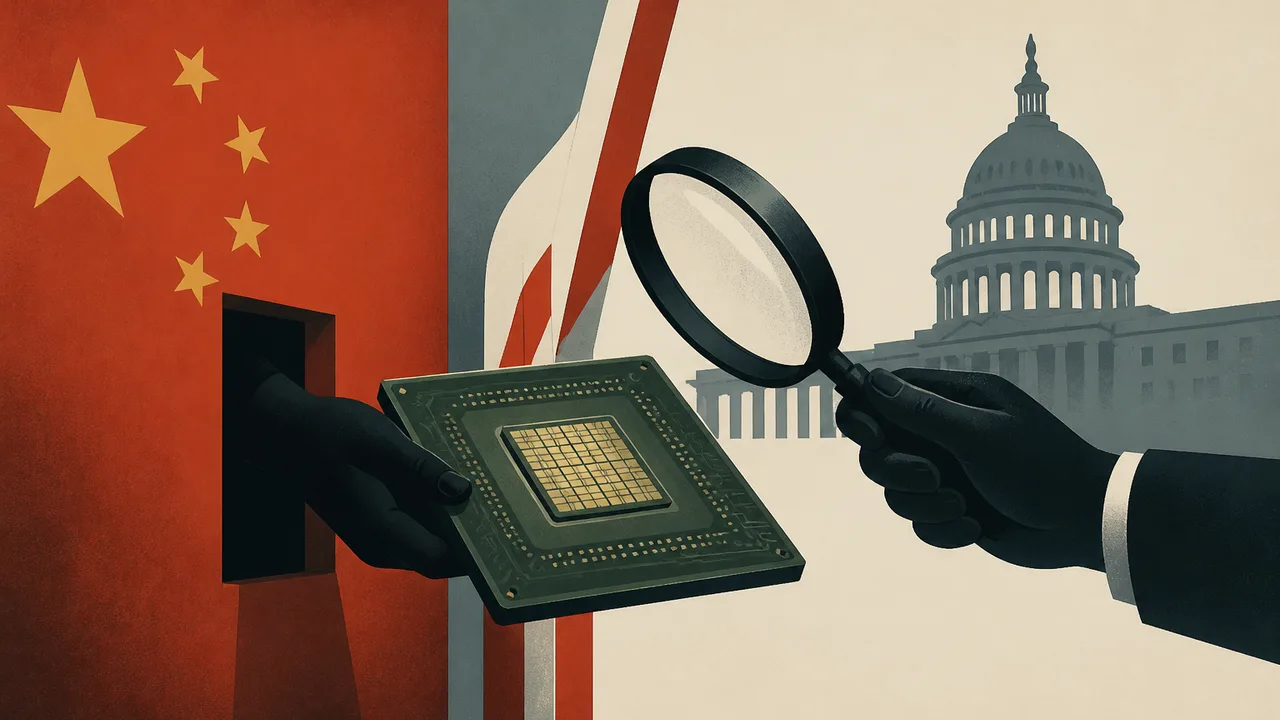
Democrats on the House and Senate trade committees are investigating the Trump administration’s approval of Nvidia H200 chip sales to China. Their inquiry puts a practical question behind a familiar Washington argument: when the United States restricts advanced chips, what does it take to make an exception, and who gets to decide?
The inquiry involves a congressional letter that reportedly addresses dealings involving Nvidia chief executive Jensen Huang and the administration. The lawmakers describe an alleged “scheme” involving Huang and Trump. That is an accusation, not a finding. The account describing the new letter does not reproduce its text or identify individual transactions, leaving the lawmakers’ precise demands and the scope of their allegation unclear.
An approved sale, an improper approval and a sale that violated its license are three different claims. Investigators may pursue all three, but each requires different records and a different explanation from the government and Nvidia.
The Chip at the Center of the Inquiry
The H200 is an AI accelerator: a processor built to handle the enormous volume of calculations involved in training and running AI systems. A single chip is one piece of a larger installation. Put many accelerators together with networking, storage and power, and the result can support far more demanding work. That is why export policy focuses on access to computing capability rather than whether a shipment contains something called a chip.
The administration’s approval of H200 sales gives lawmakers a concrete decision to examine. They can ask which licenses were granted, what limits came with them and how officials assessed the buyers and intended uses. Those questions are narrower than asking whether China should have access to American AI hardware at all. They are also easier to test against documents.
Export controls create a boundary; licenses determine how that boundary works in practice. If officials approve sales with conditions, the value of those conditions depends on whether anyone can check compliance after the chips leave the seller. A restriction on a customer’s use, for example, would be difficult to evaluate without records showing where the hardware went and how officials monitored the terms. This is a question for investigators, not a claim that any particular H200 shipment was diverted.
For Nvidia, permission to sell can preserve access to customers in a major market. For the administration, a license can offer a way to permit some commerce while retaining leverage over what is sold. For lawmakers concerned about China’s computing capacity, every exception deserves scrutiny because capabilities can accumulate across purchases. Those interests overlap in places and collide in others; the word “approval” does not tell readers how officials weighed them.
A Revenue Deal Complicates the Picture
A separate arrangement adds a financial question to the security one. In August 2025, Nvidia and AMD agreed to share 15% of revenue from chip sales to China with the U.S. government as part of a deal to secure export licenses. Revenue means sales receipts, not profit. The percentage therefore describes a claim on sales, regardless of how much a company ultimately earns from them.
The 2025 arrangement and the H200 approval should be examined as separate decisions unless records connect their terms. The connection lawmakers may want to test is straightforward: if the government receives money when licensed sales occur, how did officials account for that interest while making a national-security decision? A payment arrangement could have one rationale under export policy and still raise questions about the criteria used to grant permission.
The strongest case for licensing is that a government can set enforceable conditions on trade that might otherwise be harder to track, while American suppliers retain customers. The strongest objection is that a revenue-generating exception could weaken a restriction meant to slow access to advanced computing. Neither argument settles how a particular license operated. The terms, the buyers and the government’s rationale would do that work.
There is a second issue tucked inside the 15% figure: a payment tied to permission to export invites questions about its legal basis and structure. Calling it a fee, a revenue share or something else cannot answer those questions on its own. Investigators would need the agreements and the authority officials relied on, rather than a label convenient to either the administration or its critics.
What Congress Can Test
A congressional letter is an opening move. Trade committee Democrats can seek correspondence, licensing records and explanations of the approval process. They can compare what officials said the rules were supposed to achieve with the conditions they placed on H200 sales. They can ask Nvidia what information it supplied to the government and how it understood any license restrictions.
Chronology will matter. When did officials decide that these sales met their criteria? Did the criteria change before or after any discussions with the company? Which agencies participated? What, if anything, did the revenue arrangement have to do with later approvals? Each question points toward a record that could sharpen the inquiry. A claim about Huang’s dealings with the administration would require an additional step: identifying the communication at issue and showing how it affected a decision.
A separate description of the inquiry as a “second” probe signals that Nvidia’s China business has attracted more than one line of congressional attention. It does not make the inquiries interchangeable. One investigation might examine a company’s conduct; another might examine an administration’s licensing judgment. Readers should look for who requested records from whom and what decision each inquiry targets.
That same discipline applies to claims about Huang personally. Nvidia governance questions arising from an unconfirmed report concern what the company’s board knew and how it responded. An export-license inquiry concerns what officials approved, under which rules and on whose representations. A chief executive can feature in both stories without every allegation in one becoming evidence in the other.
The Policy Choice Behind the Paperwork
The fight over H200 sales sits inside a larger problem for export controls. A government may want to limit a rival’s computing capacity, support domestic companies and keep influence over lawful trade. A company wants clear rules and customers. Researchers, businesses and governments that rely on AI systems want access to computing power, while security officials worry about uses beyond civilian applications. No license can erase those competing demands; it can only specify which ones officials prioritized in a given decision.
Enforcement is where the abstract argument becomes expensive. Conditions on a sale need someone to verify buyers, follow shipments and respond when suspicions arise. Companies may have information about their customers, while government agencies hold licensing authority. If oversight is weak, a strict-looking rule can permit outcomes its authors meant to prevent. If rules are drawn too broadly, they can block transactions officials themselves would have approved after review. The H200 inquiry offers a chance to find out where this administration drew that line and how it checked the result.
The next consequential response will come from the administration and Nvidia: the licensing rationale, the terms attached to sales and records of relevant discussions. Congress can ask for each. Whether the answers change anyone’s view of the approvals will depend on the documents, not on how forcefully either side describes the letter.
More Like This

Google's Open Knowledge Format for AI Agents
Google's Open Knowledge Format promises to fix how AI agents navigate knowledge bases. Here's what it actually does, what it doesn't, and why the structure matters more than the tool.

Claude Marketing Skills Ranked by GitHub Stars (2026)
Which Claude Code marketing skill repos actually earn their stars? We map the top packages—from CRO to paid media—and ask what GitHub popularity really measures.
Karpathy's Obsidian Setup Challenges RAG Orthodoxy
Andrej Karpathy's markdown-based knowledge system questions whether most developers actually need traditional RAG systems at all.

Nvidia Faces Governance Questions Over Jensen Huang Report
An unconfirmed claim about Jensen Huang has raised questions about Nvidia's board, security and leadership. Here's how to separate the allegation from the forecast.
Why the Proposed AI Slowdown Is Losing Its Coalition
Jensen Huang, Donald Trump and an antitrust lawsuit are squeezing the AI slowdown from different sides, exposing a policy coalition without machinery.
Nvidia's Groq Deal: A New Play in AI Chips
Nvidia's strategic Groq deal reshapes AI chip game, raising open-source and equity concerns.

Plaud One AI Earbuds: Listening So You Do Not Have To
Plaud One earbuds record, summarize, and act on workplace conversations via 4G. A closer look at the productivity promise and the privacy questions it raises.
Two Chinese AI Labs Converge on the Same Architecture
Z.ai and Qwen independently built models with nearly identical designs. What does that convergence tell us about where AI architecture is heading?