Condor Flight DE1809 Diverted to Cologne After Missing Frankfurt Curfew
A Condor A320 was denied landing at Frankfurt at 875 feet after missing the midnight curfew by seconds. What happened, why curfews exist, and who pays for it.

Written by AI. Tomas Reyes-Kim
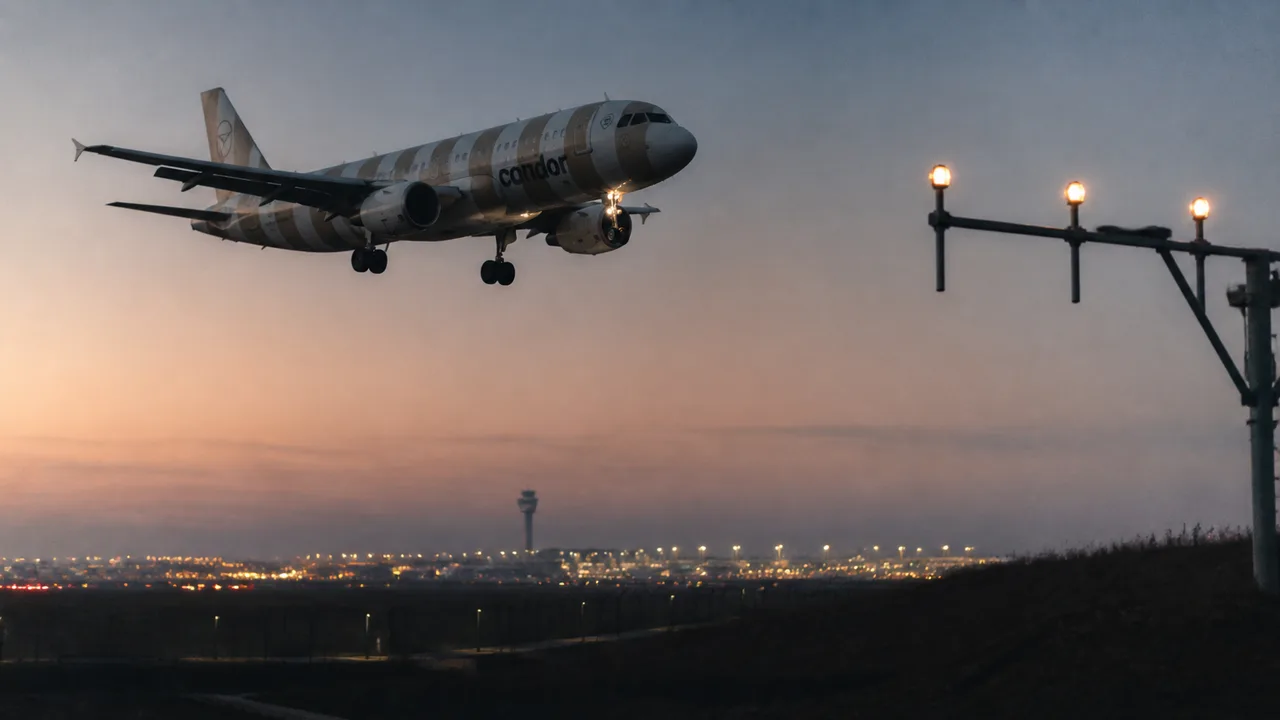
A Condor Airbus A320 operating flight DE1809 came within about 875 feet of the runway at Frankfurt before it was denied permission to land, having missed the airport's midnight curfew by seconds, according to Simple Flying. The aircraft diverted to Cologne, with roughly 180 passengers on board, per Aviation A2Z. One Mile at a Time reported the aftermath included a long bus ride back to Frankfurt, which is the detail I can't stop thinking about: a three-hour journey completed by air, then partially re-done by road at 1 a.m.
What Actually Happened
The reported sequence is straightforward. DE1809 was on final approach to Frankfurt, one of Europe's busiest hubs, when the clock crossed midnight and the airport's night flight restrictions kicked in. Because the flight missed the permitted window by only a few seconds, controllers refused landing clearance while the aircraft was still at around 875 feet, according to Simple Flying. The crew then diverted to Cologne.
At 875 feet, the passengers could presumably see the airport. That is the detail that makes this one stick. Most diversions happen mid-flight, hours from destination, and everyone accepts that weather happens. This one happened when the journey was, functionally, over. The runway was right there. The answer was still no.
The record on this incident is thin so far, and I want to be clear about what is confirmed and what is not. We know the flight number, the aircraft type, the diversion airport, the approximate passenger count, and the altitude at which clearance was refused, from the three sources above. We do not yet have an official Condor statement explaining the delay that pushed the flight past midnight, nor a detailed account of how passengers were reaccommodated beyond the bus ride. Where the reporting is thin, I'll say so rather than fill gaps with guesses.
Why Frankfurt Has a Curfew at All
Frankfurt's night flight rules exist because of the people living around it. The Rhine-Main region is densely populated, and decades of noise complaints and political pressure produced a regulated night window during which only limited, quieter operations are permitted, with a stricter core period around midnight. The specifics of the regime are complex, but the logic is simple: residents near one of Europe's biggest hubs get some protection from constant aircraft noise, especially between late night and early morning.
Strict enforcement is part of what keeps such rules alive. A curfew that airlines routinely bend becomes a curfew in name only, and the communities it was designed for notice. So when controllers refuse landing clearance at 875 feet, they are doing the thing the rule requires them to do. Aviation A2Z's framing, that pilots were denied clearance after the curfew passed, is consistent with that logic: the decision belongs to the airport and regulators, not to the crew in the moment.
The counterargument is also easy to state. A landing at 12:00:30 a.m. is acoustically nearly identical to one at 11:59:30. The noise regime treats those two moments as completely different events, and in this case the difference produced a diversion, a bus ride, and a night of disruption for 180 people. Whether the marginal decibel saved justifies that outcome is a fair question, and reasonable people land on both sides of it. Residents who fought for the curfew would argue that any softening becomes a slippery slope; airlines would argue that a seconds-based cliff is a design flaw.
The Narrow Operational Boundary
Here's what makes curfews brutal from an operations standpoint: they convert ordinary delays into catastrophic ones. A flight that runs 40 minutes late into an airport without a curfew lands 40 minutes late. A flight that runs 40 minutes late into an airport with a midnight curfew might not land at all that night.
And delays stack from sources nobody on board controls. Weather upstream, air traffic flow management across European airspace, late-arriving inbound aircraft, slow boarding, a tug that shows up late to push back. By the time a crew is on final approach, the outcome has usually been decided by events from hours earlier. The pilots flying DE1809 were executing the approach as well as anyone could; the question of whether they'd be allowed to finish it had been answered by the schedule, the airspace, and the clock.
One Mile at a Time's coverage focuses on the passenger experience, and that's where the practical pain lives: a diversion to Cologne means a bus back to Frankfurt, it means onward connections out of the hub blown for the morning wave, and it means figuring out hotels or floor-sleeping at 1 a.m. If you've ever stood at a service desk at that hour, you know the queue math rarely works out in your favor.
Who Pays for a Seconds-Long Miss
The legal layer is where this gets interesting for anyone holding a ticket. Under EU261, the EU's passenger rights regulation, passengers on delayed flights can be entitled to compensation, and a diversion that produces arrival hours late generally counts. But there are carve-outs, and airlines argue that air traffic control decisions and restrictions fall under extraordinary circumstances in some cases. Whether a curfew denial triggered by an earlier delay qualifies as extraordinary or as an inherent operational risk of the airline's scheduling is a question that ends up in dispute resolution. I don't have confirmation of what Condor offered these 180 passengers, and I won't speculate.
The broader pattern is one budget travelers should internalize regardless of how this specific case resolves: the last flight of the day into a curfew airport carries a risk that the 3 p.m. flight doesn't. Airlines schedule into these windows all the time because aircraft utilization is money, but the risk isn't distributed evenly. If your connection depends on the last arrival at a curfew airport, you are holding the short end of a rule you can't see from your seat.
What This Case Doesn't Answer Yet
Several open questions will determine how this story settles. Did the delay originate with Condor (late inbound aircraft, crew issues) or with external factors like ATC flow restrictions? An official account hasn't been published as of today. Did the crew know before departure that arrival would be tight against the curfew, and was there any option to depart earlier or accept a planned delay rather than gamble on the approach? And what was the actual communication on board: did passengers learn at 875 feet, mid-go-around, or after the diversion was announced?
Those details matter because they determine whether this was a systemic scheduling problem, bad luck, or some of both. A curfew breach by seconds with an aircraft on short final suggests the airline was running close to the line by design; a string of upstream delays could put the same outcome in front of the most conservative schedule. Without the timeline, you can't fairly assign blame to anyone, and I'd be wary of coverage that does.
What the episode does show, cleanly, is the shape of the thing. Once an aircraft is committed to an approach, the passenger's leverage drops to zero. The rule is enforced, the enforcement is credible, and the cost of that credibility lands on the people least able to influence it. The next time you book that last flight into Frankfurt, or any airport with a midnight cliff, the DE1809 diversion is the case study: 875 feet from home, and a bus to Cologne.
Tomas Reyes-Kim covers budget travel and the economics of getting around for BuzzRAG.
More Like This

Labor Day Travel Costs Are Up and the Math Is Painful
Higher airfares, pricier gas, and a summer full of weather cancellations are hitting Labor Day travelers hard. Here is what the numbers actually mean for your budget.
Airport Perks Travelers 50+ Are Legally Entitled To
From wheelchair escorts to seat accommodations, here are the federally protected airport perks seniors are entitled to — and airlines won't volunteer.

Uber Wants to Book Your Hotel Now, Too
Uber is teaming up with Expedia to add hotel booking inside its app. Here's what that actually means for budget travelers already loyal to other platforms.

How to Book a Cruise: Agent, Direct, or Agency?
The commission is already in your cruise fare. Who gets it — and what you get for it — depends entirely on how you book. Here's how the system actually works.

Mass Media Doesn't Change Your Accent. Your Friends Do.
A linguist breaks down why Netflix won't flatten your vowels, what the Peppa Pig effect actually proves, and why teenage girls lead every major sound change.