China's Space Plane Appears Docked in New U.S. Image
A U.S. intelligence image appears to show China's space plane with another craft in orbit. Explore what the picture reveals about docking, surveillance and intent.

Written by AI. Mei Zhang
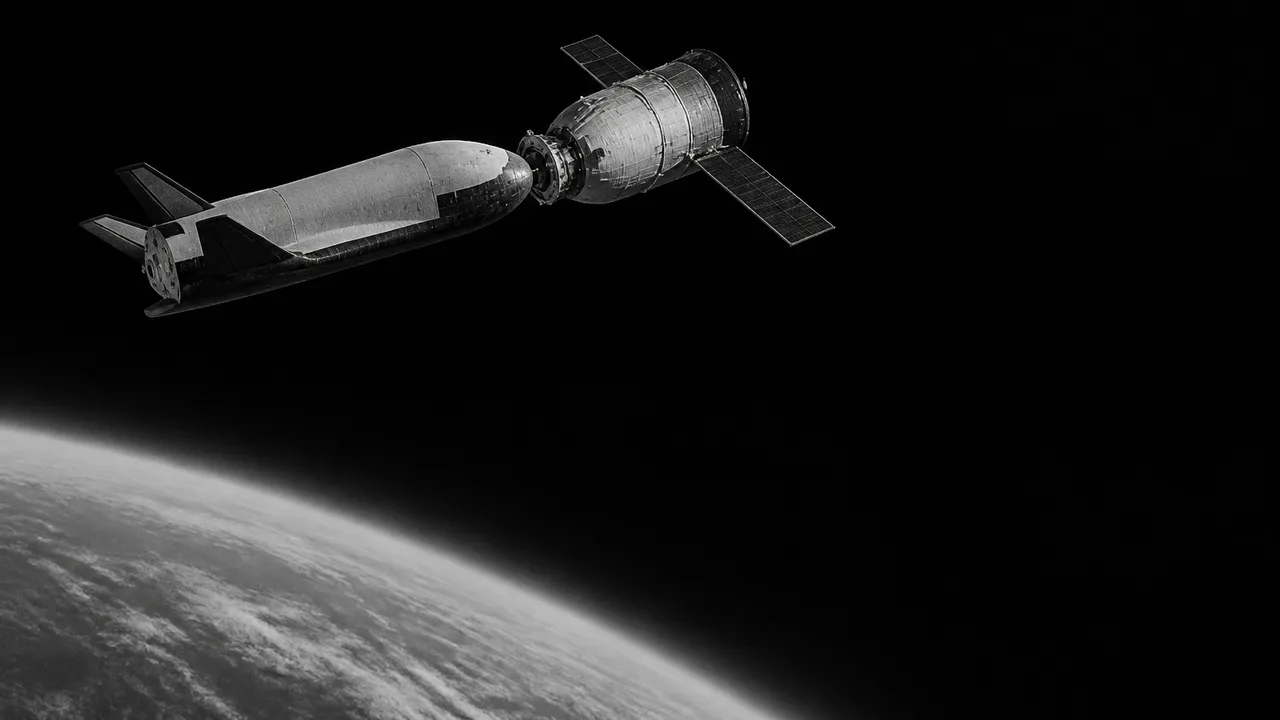
A U.S. military intelligence agency has released an image that reportedly shows China’s space plane docked with another spacecraft in orbit. For a program that rarely offers the public a close look at its hardware, that is a useful piece of the puzzle. It is also a small piece: the photograph alone cannot identify the other craft, verify a physical connection, or tell us how long the vehicles spent together or why.
The Defense Intelligence Agency identified the space plane in the image. That gives the public a clearer view of an object whose activities attract attention far beyond space enthusiasts. If two spacecraft can approach one another in orbit, observers want to know whether they exchanged anything, tested equipment or simply practiced maneuvering. Each possibility implies a different mission. The pixels give us a place to begin asking.
What Does “Docked” Mean Here?
Spacecraft do not meet by pointing toward each other and flying straight ahead. Each follows an orbit, and bringing two vehicles together requires carefully changing their paths until their positions and speeds align. Engineers call that process rendezvous. Docking goes a step further: the vehicles make and maintain a physical connection. Flying close enough to appear together in a photograph is a different feat from attaching two pieces of hardware.
That sequence helps explain why an apparent pairing draws interest even when the activity looks uneventful. Maneuvering near another spacecraft can support inspection, equipment tests or a transfer, depending on what the vehicles were built to do. It also demands control. A spacecraft approaching too fast would face a collision risk; one that cannot hold its relative position would struggle to carry out a planned encounter.
The unidentified craft is an important part of the story. Its size, design and role would affect how anyone interprets the encounter. An object deliberately released for a test would suggest one set of questions. A separately launched vehicle would suggest another. Without an identification, assigning either role would turn a shape in a picture into a mission plan.
There is a useful way to read the image, then: treat the visible arrangement as an observation and the word “docked” as a reported interpretation of that arrangement. That approach leaves room for a physical connection while keeping the description as precise as the public information permits.
Why a Space Plane Draws Attention
A space plane combines aspects of a spacecraft and an aircraft: it operates in space and has a plane-like form associated with returning through the atmosphere. The appeal is easy to understand. A vehicle that can return offers a way to bring hardware home for inspection or reuse, while an orbital flight can expose experiments to conditions that are difficult to reproduce on Earth. Those are general possibilities for the vehicle class, not a checklist of what China did on this flight.
The shape has prompted comparisons with the U.S. X-37B, another space plane. Visual resemblance offers a familiar reference point for readers, but similar outlines can accommodate different equipment and missions. Two kitchen appliances may share a stainless-steel shell; you still need to open them before deciding which one bakes bread. In orbit, the equivalent of opening the lid may be an official technical description, a sequence of observed maneuvers or details about what the craft carried and returned.
The interest in China’s vehicle comes partly from the limited public detail about its program. Secrecy changes how every new observation is received. When mission plans are not public, analysts may try to infer them from launch timing, orbital behavior and images. That work can produce useful questions. It can also make an ordinary engineering test look more dramatic than its operators intended, or cause a consequential test to pass under an innocent-sounding label.
No single interpretation deserves a shortcut here. A reusable spacecraft might be useful for research, for developing orbital operations or for activities that serve national security. The same maneuvering skills can matter in more than one setting. Classifying the entire program from one apparent encounter would skip the work of identifying the second craft and tracing what the two objects did before and after they appeared together.
An Image Released by an Intelligence Agency
The agency behind the photograph is part of the news. The United States has chosen to show the public an image connected to a closely watched Chinese program. That choice places an orbital observation into a wider conversation about how governments monitor one another’s activities above Earth.
Objects in orbit can be tracked through a combination of observations, and imagery adds something a track alone cannot: a view of appearance and apparent spatial relationships. Conversely, a series of position measurements can show how objects moved over time, giving context to a single captured moment. The most informative public account of this encounter would bring those kinds of information together rather than asking one photograph to do every job.
Releasing an image also involves a communications calculation. It tells audiences that an activity was observed, while the agency can choose how much detail to make public about the observation. The release itself gives no reason to assume a particular motive. Sharing an image could inform the public, signal awareness to another government or serve several purposes at once. Reading intent from the release requires the same caution as reading intent from the orbiting vehicles.
That tension reaches beyond this flight. More orbital activity means more chances for objects to come close, deliberately or otherwise. It also means more occasions when a photo, a tracking plot or a short government statement becomes the public’s first account of an event. The words attached to those records can steer the conversation before anyone learns what a vehicle was doing.
What Could Clarify the Encounter?
A timeline would help. If independent tracking showed two objects gradually matching their paths, remaining close and then separating, observers could describe the encounter with more precision. Images taken at different moments could help distinguish sustained contact from a brief alignment. An identification of the second craft would narrow the possible explanations further. Chinese or U.S. officials could supply operational details, though any official account would still need to be weighed against what observers can verify.
For now, the public has a rare visual reference for China’s space plane and a reported encounter with another spacecraft. The next useful question is refreshingly plain: what was the other object, and where did it go after the picture was taken?
More Like This

Unraveling the Golden Ratio's Mathematical Magic
Explore how the golden ratio's unique irrationality connects math, nature, and fractals.
How Maxwell Unified Electricity and Magnetism
A compass needle twitched in 1820 and set off a chain of discoveries that now powers every wireless signal in your life. Here's the physics behind it.

August's 96% Blood Moon Lunar Eclipse Explained
A 96% partial lunar eclipse turns the moon deep red on Aug. 27-28. Here's when to watch, why it happens, and what's threatening our view of it.

SpaceX Rocket Team Wins First Neil Armstrong Prize
SpaceX's Falcon 9 landing team won the first Neil Armstrong Space Prize, spotlighting reusable rocket engineering, costs, climate and access to orbit.

DC Is Releasing 600,000 Mosquitoes to Fight Mosquitoes
Washington DC is deploying 600,000 Wolbachia-infected male mosquitoes this summer to crash local populations. Here's the biology, the stakes, and the bigger picture.

Calculus Indeterminate Forms Explained With Limits
DIBEOS unpacks the seven indeterminate forms in calculus—0/0, ∞/∞, and more—and why mastering limits matters far beyond the classroom.