China's EUV Prototype Tests ASML's Semiconductor Monopoly
China's homegrown EUV lithography prototype generates 13.5nm light via a different method than ASML. Here's what that actually means—and what it doesn't.

Written by AI. Mike Sullivan
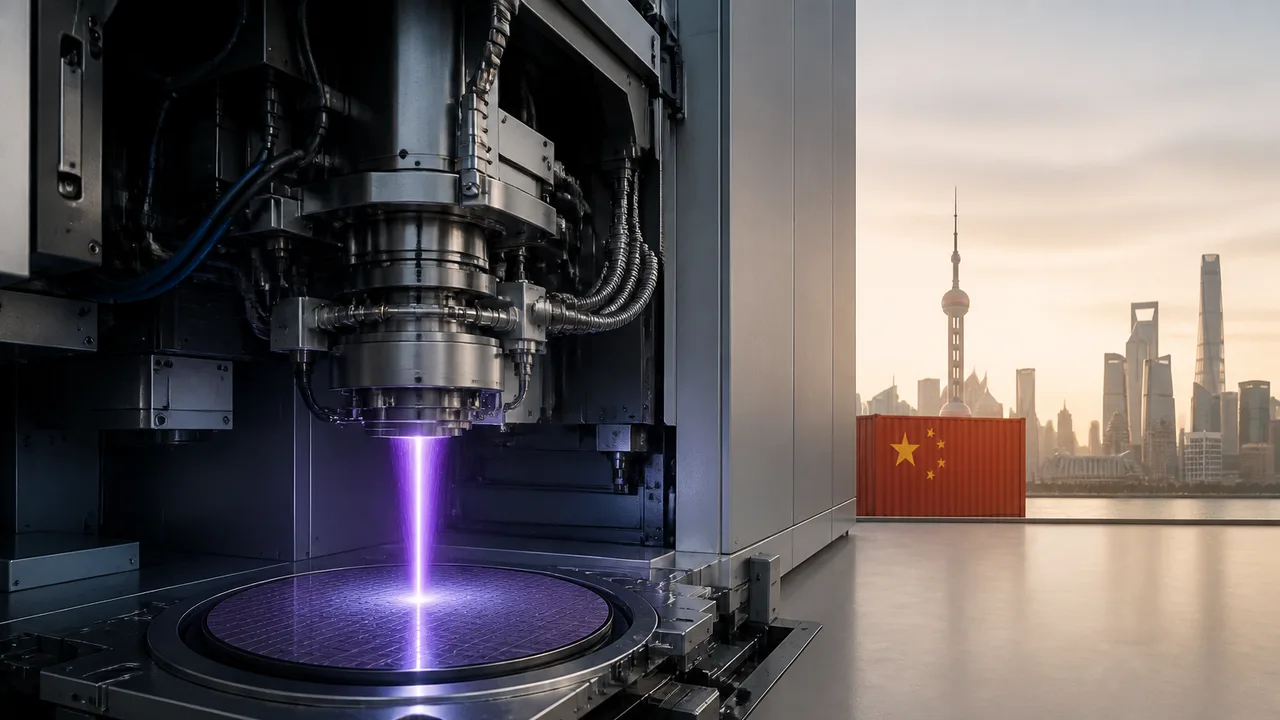
Photo: AI. Hayden Cross
A machine the size of an entire factory floor quietly powered up inside a locked lab in Shenzhen. Depending on who you ask, it either flips the whole semiconductor game on its head or it's a very expensive science project that goes nowhere.
Both takes are wrong, which is usually where the interesting story lives.
In December 2025, Chinese industry reports and state media confirmed that engineers had successfully generated a stable 13.5-nanometer extreme ultraviolet beam and pushed it through a domestic optical system. That wavelength matters because it's the one you need to print chips at 7 nanometers and below — the territory where modern AI processors live. For years, exactly one company on Earth could do this at factory scale: ASML, based in the Netherlands. The US export controls that took effect in 2022 were built on that single fact. No ASML machine, no cutting-edge chips, no path to AI parity. China's answer to that logic just powered up in Shenzhen.
Two Ways to Make Impossible Light
The part most coverage glosses over is that China didn't copy ASML's approach. It built something architecturally different.
ASML's method — laser-produced plasma, or LPP — is genuinely one of the stranger things humans have engineered. A generator fires a stream of molten tin droplets across a vacuum chamber, firing roughly 50,000 of them per second. Each droplet, mid-flight, gets hit by a carbon dioxide laser in two pulses: one to flatten it into a disc, one to vaporize it. The resulting plasma reaches temperatures hotter than the surface of the sun and emits EUV light at the moment of vaporization. Reuters reported in February 2026 that ASML is now pushing toward doubling that droplet rate — moving toward 100,000 per second — as part of a light source advance aimed at yielding 50% more chips by 2030. Every droplet hit dead center, mid-flight, timed to the nanosecond. When people say ASML's machine is among the most complex objects humans have ever built, this is what they mean.
China's prototype took a different path. The Shenzhen and Harbin teams used laser-induced discharge plasma, or LDP: tin coated onto rotating electrodes rather than fired as individual droplets. You vaporize some of that tin, hit it with a high-voltage electrical discharge, and the electron-ion collisions produce your 13.5-nanometer light. The Evolving AI breakdown describes this as "a very smart move" — you sidestep the whole engineering nightmare of hitting thousands of moving targets per second, and the architecture is mechanically simpler, smaller, cheaper to build, and draws less power.
The honest tradeoff is power output. Earlier LDP sources topped out around 30 watts — nowhere near useful for a production fab. China's prototype is reportedly running between 100 and 150 watts, which is a substantial leap for this technology. ASML's commercial machines, however, already run around 600 watts at the source, and the company recently demonstrated a pre-production system hitting 1,000 watts. Power determines throughput — how many wafers you can process per hour — and throughput is basically the entire business model of semiconductor manufacturing. China got the light. The gap between getting the light and getting enough of it to run a profitable factory is still significant.
The Mirror Problem
Once you've made EUV light, you have to aim it. This is where the engineering gets quietly brutal.
At 13.5 nanometers, light is so energetic that conventional glass lenses simply absorb it. You can't use lenses at all. Instead, you bounce the light off multilayer mirrors — stacks of alternating molybdenum and silicon layers, each only a few atoms thick, that reflect EUV through quantum interference. These mirrors have to be manufactured to a surface roughness of around 50 picometers. The Evolving AI breakdown offers a useful scale: if you enlarged one of these mirrors to the size of Germany, the largest surface imperfection would be a fraction of a millimeter.
For decades, one company has made mirrors to this standard: Zeiss in Germany, ASML's optics partner. China worked around this by developing domestic multilayer mirrors, primarily through Changchun Optics. The catch is that their mirrors don't reflect as efficiently as Zeiss's, and every mirror in the optical chain introduces losses. Stack several slightly-leaky mirrors in sequence and you bleed light fast. The engineering solution: go bigger. Use larger collectors, longer optical paths, a much larger overall machine. That's why China's prototype occupies an entire factory floor while ASML's NXE system is roughly the size of a school bus. As the Evolving AI breakdown puts it: "That giant footprint isn't a flex. It's a workaround."
Brute-forcing with scale what you can't yet match in precision is a legitimate engineering strategy. It's also a roadmap for what needs to improve next.
The Supply Chain You Can't Prototype Your Way Around
Here's a constraint that no amount of clever engineering can solve quickly: helium.
EUV fabs consume helium in large quantities — for cooling, for creating inert environments, for leak detection. There is no substitute. You cannot synthesize it, and once it escapes into the atmosphere it's gone. China historically imported more than 85% of its helium from Qatar and Russia, with domestic production covering less than 15% of demand. In 2026, both of those supply lines ran into problems simultaneously. Qatar's main helium facility was disrupted. Russia imposed its own export controls. China responded by banning helium exports entirely to protect its remaining domestic supply.
When the technology you're trying to scale depends on a resource you mostly import from countries in the middle of overlapping crises, that's a structural vulnerability, not a temporary inconvenience. And helium is just the headline. There's photoresist chemistry, pellicles, mask blanks — an entire ecosystem of consumables that ASML's supply chain spent roughly two decades refining. A prototype proves the physics work. It does not prove you've built the reliable industrial substrate underneath it. That's a different mountain entirely.
The Talent Story
According to Power Electronics News's analysis of China's EUV lithography efforts, Huawei and its partners have attracted chip industry veterans with experience at Applied Materials, Lam Research, KLA, TSMC, Intel, and ASML itself. The Evolving AI breakdown highlights one name specifically: the team working on China's LPP-based light source — a parallel effort to the LDP prototype — is reportedly led by a former head of light source technology at ASML. Someone who helped build the technology that became the bottleneck is now working on the alternative to it. That's not luck. It's the kind of deliberate, funded, coordinated industrial strategy that tends to be underestimated until it isn't.
What the Bar Actually Is
The Evolving AI breakdown does the thing most coverage avoids — holding two true statements at once: "This prototype is a real milestone. It's not a production-ready piece of equipment."
ASML took roughly 12 years to go from its early EUV prototypes to something a factory could trust to run day and night at commercial yields. Anyone suggesting China is about to flood markets with domestically-manufactured advanced chips in the near term is not being straight about the timeline. Turning a physics demonstration into reliable, high-volume manufacturing is arguably harder than the first breakthrough.
But China's strategic objective isn't to beat ASML. It's to beat what China is currently using. Right now, Chinese foundries are printing advanced nodes using older deep ultraviolet machines with a technique called multi-patterning — running the same wafer through multiple exposures to simulate finer feature sizes. It works, but yields reportedly run below 50%, meaning a lot of expensive scrapped silicon. If a homegrown EUV machine — even a slow, power-constrained, factory-floor-sized one — can push those yields meaningfully higher and reduce reliance on tools China isn't permitted to buy, that's a strategic win. It doesn't have to embarrass ASML on a spec sheet to matter.
That's a substantially lower bar than the headlines imply, and it's almost certainly the bar China is actually aiming for.
The Evolving AI breakdown lands on a framing I find hard to argue with: "This isn't the moment ASML's monopoly ends, but it might be the moment it stopped being permanent." A monopoly that is permanent and a monopoly that is temporary-but-long are very different things for how companies, governments, and supply chains plan. That distinction is where this story actually lives — not in the wattage numbers, not in the factory floor footprint, but in the shift from "impossible" to "not yet."
What happens to export control strategy when the thing being controlled is no longer exclusively controlled?
More Like This
Do You Really Need an $80 HDMI Cable? Maybe Not
Tech reviewer Adam tests a premium HDMI 2.1 cable. We examine what you're actually paying for and whether most users need it.
When Agents Generate Their Own UI: The Three Flavors Explained
CopilotKit's Tyler Slaton maps the spectrum of generative UI—from pixel-perfect control to agents writing raw HTML. Each approach makes different tradeoffs.
Can Unreal Engine 5 Run on a $500 MacBook? Sort Of.
Testing Unreal Engine 5.7 on the MacBook Neo reveals what happens when professional software meets budget hardware—and why friction matters.
AI Chip Smuggling and the US-China Tech Divide
FT's Eleanor Olcott investigates the black market for Nvidia AI chips reaching China despite US export controls — and what it reveals about the tech race.

Kimi K3 and the Open-Weight AI Shakeup
Moonshot AI's Kimi K3 tops the AI performance frontier as a fully open-weight model. What it means for US labs, compute policy, and who builds what next.
Unreal Engine 5 Still Doesn't Play Nice With Apple Silicon
While most 3D software runs smoothly on M-series Macs, Unreal Engine 5 remains frustratingly unreliable. One creator documents the disconnect.

AI Browsers Have a Guardrail Problem
A new exploit shows AI browsers can be tricked into abandoning their own rules. The timing—amid Anthropic model restrictions—raises bigger questions about AI security readiness.
AMD EPYC 8005 Sorano: A Genuine Generational Leap
AMD's EPYC 8005 Sorano upgrades SP6 with Zen 5 cores, 84-core density, and 96 PCIe Gen 5 lanes—but the ecosystem remains niche and memory costs sting.