Bunker Fuel: Why Cargo Ships Burn Refinery Waste
Cargo ships burn heavy fuel oil, the cheapest, dirtiest refinery leftover. Here's how that bargain works, what it costs, and why nothing has replaced it.

Written by AI. Jin Seo
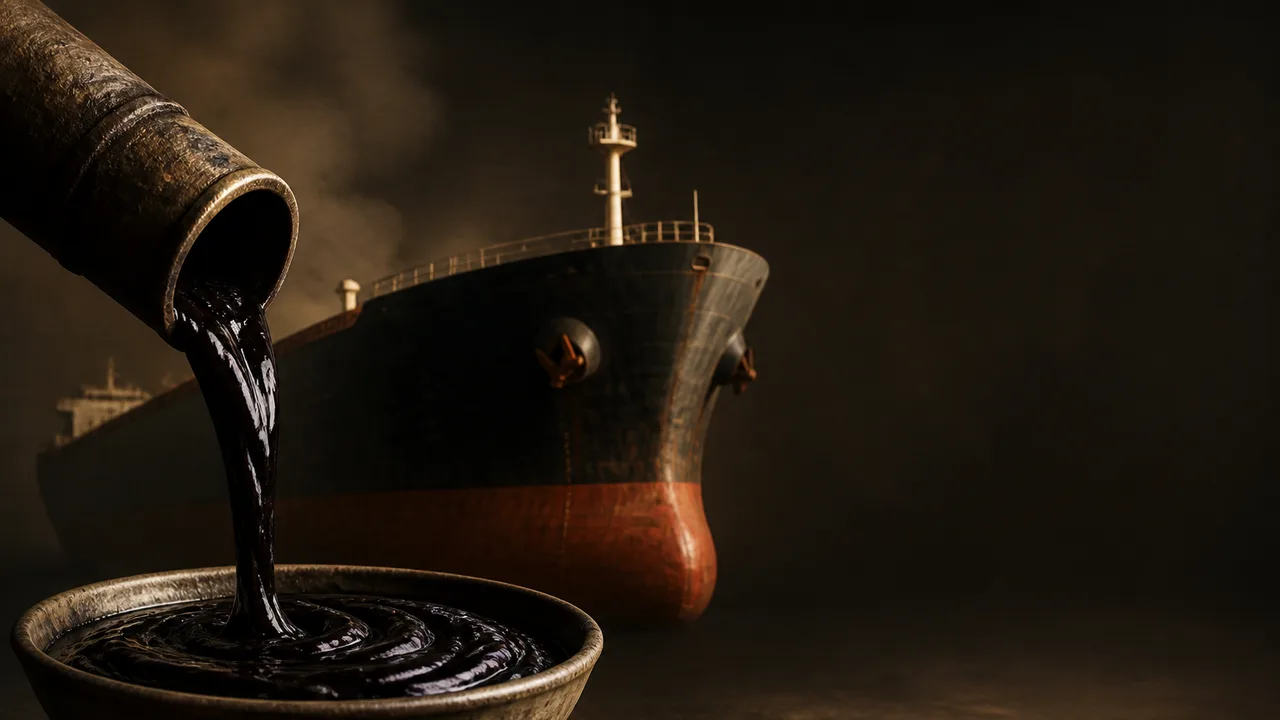
Photo: AI. Soraya Hadid
Start at the refinery. A barrel of crude oil gets heated inside a distillation tower and the valuable stuff rises: gasoline, jet fuel, diesel. These light fractions are clean, easy to handle, and priced accordingly. At the very bottom of the tower sits something that refused to boil at all. Black, thick, stubborn. The refinery has already taken everything it wanted. What remains is what the shipping industry calls bunker fuel, or heavy fuel oil (HFO), and it is, in a real sense, the residue of a residue.
As the Secrets of Everyday Things video puts it: "What ships burn is the thick leftover liquid at the very bottom of crude oil, a real fuel, just the cheapest and most looked down on product in the whole refinery."
That looked-down-on product currently powers roughly 7,500 giant ships crossing the world's oceans at any given moment, carrying most of what you buy. The question worth sitting with is not just why. It is whether the math that made this fuel dominant still adds up, and for whom.
The refinery logic nobody advertises
According to Chemical and Engineering News, HFO is the tar-like residue that remains after crude has been catalytically cracked and distilled to separate lighter fuels. Every barrel of crude produces some share of this material. Multiply that by global daily refining volume and the arithmetic becomes uncomfortable: the world generates enormous quantities of this substance whether anyone wants it or not.
Shipping was not just a customer for bunker fuel. It was a solution to a disposal problem. One side had something practically free. The other side needed to burn a staggering amount of fuel at the lowest possible cost. They found each other, and that partnership has held for more than a century, from the coal-to-oil transition in early 20th-century naval fleets, through the great Atlantic passenger liners, down to today's container ships stacked twenty stories high.
The fuel's energy density makes the marriage stickier than pure price alone would explain. As India Today notes, HFO is cheaper than lighter fuels like diesel while still providing enough energy density to power the enormous engines ships require. You get nearly as many BTUs per gallon as diesel, at a fraction of the cost. For a vessel that may burn more than 200 tons of fuel in a single day, that spread is not a rounding error.
Engineering around an awkward fuel
HFO comes with a significant operational catch: it solidifies when cool. This is not a minor inconvenience. A ship carrying this fuel must run a continuous heating system, keeping the oil at 40 to 50 degrees Celsius just to move it through pipes, then pushing it past 120 degrees before injection into the combustion chamber. Heating the fuel costs energy. If the heating system fails at sea, the oil can congeal fast enough to strand a vessel.
The engines themselves are built around the fuel's slow combustion profile. Marine two-stroke diesels turn at roughly 100 revolutions per minute, a fraction of the several thousand RPM your car engine manages. That low speed is not a design flaw; it is a deliberate match for a fuel that burns slowly and releases heat over a long, steady cycle. "Slow fuel meets slow engine," the video observes. "They were made for each other."
Switching to cleaner diesel is not simply a matter of pouring something different into the tank. These engines were designed and tuned from the start for HFO. Re-engineering or replacing them across a global fleet represents an investment the shipping industry has consistently decided it cannot justify, particularly when the cost differential is this stark. The video's figure is worth quoting directly: swapping heavy fuel oil for regular diesel on a single large ship would cost around $60,000 to $80,000 more per day. Across a fleet of 7,000-plus ships, that gap runs into hundreds of millions of dollars daily.
The nuclear alternative was tried and settled the question early. The NS Savannah, a U.S.-built nuclear-powered cargo ship launched in the early 1960s, ran smoothly enough but required a specially trained crew and was turned away from multiple ports. The experiment was expensive and the ship was decommissioned within a few years. As the video notes, "even the power of the atom could not beat cheap leftover oil for one single reason, and that reason was money."
What the fuel hides, and what it leaves behind
Heavy fuel oil carries two categories of hidden costs, one mechanical and one environmental, and both tend to be underweighted in the economic case for keeping it.
The mechanical hazard has a name most people outside the industry have never heard: cat fines. These are tiny particles of aluminum and silicon, leftovers from the catalytic cracking process in the refinery, that remain suspended in HFO. They are nearly as abrasive as industrial grinding compounds. Once inside an engine, they slowly erode pistons and cylinder walls, producing damage that is invisible until it is expensive. Ships run HFO through filters and centrifuges before combustion, a cleaning regimen the video describes as bordering on obsessive. Cheap fuel, costly maintenance.
The environmental ledger is harder to close. ScienceInsights puts the sulfur problem in concrete terms: unregulated HFO can contain sulfur levels dozens of times higher than road diesel, and when that sulfur burns, it becomes sulfur oxides, gases linked to acid rain, respiratory illness, and fine particulate formation. The effect is visible from orbit. Long, straight ribbons of cloud stretched across the open ocean in satellite images are not weather. They are ship tracks, artificial cloud formations seeded by sulfur particles rising from ship exhaust, tracing the world's trade routes in the atmosphere above them.
Spills add another dimension. Unlike lighter fuels that evaporate or disperse, HFO sinks and clings. It coats coastlines and marine ecosystems and resists breakdown for a very long time. The environmental cost of HFO in global shipping extends well beyond the emissions from its combustion.
The 2020 rule and its workarounds
International maritime regulators did eventually act. A global sulfur cap that took effect in January 2020 forced ships to cut sulfur content in their fuel from 3.5% down to 0.5%. The rule created a fork in the road: pay more for low-sulfur fuel, or install scrubbers that wash sulfur out of the exhaust before it exits the stack.
The scrubber route is where the accounting gets interesting. These systems spray seawater through the exhaust to capture sulfur compounds. What they produce is acidic, contaminated washwater, which many ships then discharge directly into the ocean. The pollution does not disappear. It relocates, moving from the atmosphere into the water column below. The video frames it plainly: "the pollution does not really disappear. It just moves house."
There is also the question of compliance geography. Many ships switch to cleaner, more expensive fuel when entering port or coastal emissions control areas, then revert to cheaper HFO once they reach open ocean where enforcement is thinner. A ship, in effect, has two fuel diets: one for waters where someone is watching, and one for the open sea.
Why nothing has replaced it
The case for HFO's persistence rests on a system argument, not just a price argument. The fuel infrastructure serving global shipping, storage tanks, bunkering vessels, port facilities, pipeline connections, was built around HFO over decades. Transitioning to a different fuel chemistry means either retrofitting that entire supply chain or building a parallel one. Neither is cheap, and neither can happen fast.
Alternatives including liquefied natural gas, ammonia, methanol, and hydrogen each carry their own infrastructure requirements, storage challenges, or cost premiums. None has yet demonstrated the economic profile to displace HFO at scale, particularly for deep-sea routes where ships cannot easily access specialty fuels at intermediate ports.
"The whole trading system of the world is built on that cold logic," the video says of HFO's cost advantage. That logic is not invisible or mysterious. It is a set of deliberate choices, compounding across decades of fleet design, port infrastructure, refinery economics, and regulatory tolerance, that created a lock-in effect difficult to exit without coordinated action across governments, shipowners, port operators, and fuel producers simultaneously.
The package on your doorstep crossed an ocean on refinery waste. The question worth asking now is who absorbs the costs the price of that shipping never included, and whether the accounting is ever going to change.
More Like This
Heavy Fuel Oil Powers Global Shipping at a Steep Cost
Heavy fuel oil powers nearly 80% of global shipping. It's cheap, toxic, and nearly impossible to replace. Here's what it actually is and what's at stake.

Rockefeller's Wealth-Building Secrets Revealed
Explore how John D. Rockefeller built a $400 billion fortune through strategic discipline and overlooked industries.

What Fintech Affiliate Models Could Teach iGaming
Line Peteri argues fintech's education-first affiliate model and retention focus offer a playbook iGaming has ignored for a decade. Here's what that gap actually costs.

America's Economic Cycles: Reinvention or Stagnation?
Examining America's economic pivots every 80-90 years and their impact.

The Iran War's Surprise: Oil Markets Held Together
The Strait of Hormuz closed and oil didn't hit $200. Here's the layered, complicated story of why — and what it means for how energy flows next.

Russia's 8 km Drill to Test the Abiogenic Oil Theory
Russia is drilling 8 km into the Earth to test whether oil can form from inorganic matter and replenish itself. Here's what the science actually says.

How Climbing the Investing Ladder Costs You Ownership
From a $100 index fund to managing billions as a pension CIO, each rung of the investing ladder hands you more money to move and less of it to keep.

How Dynasty Trusts Keep Heirs Rich but Powerless
Dynasty trusts, dual-class shares, and private foundations don't just preserve wealth—they strip heirs of any real control over it. Here's how the architecture works.