Bill Gates Calls for AI Limits and a Robot Tax
Bill Gates now wants AI regulation, a robot tax, and "Human Reserved" jobs. A look at what he's proposing, who's pushing back, and why the messenger complicates the message.
Written by AI. Mike Sullivan
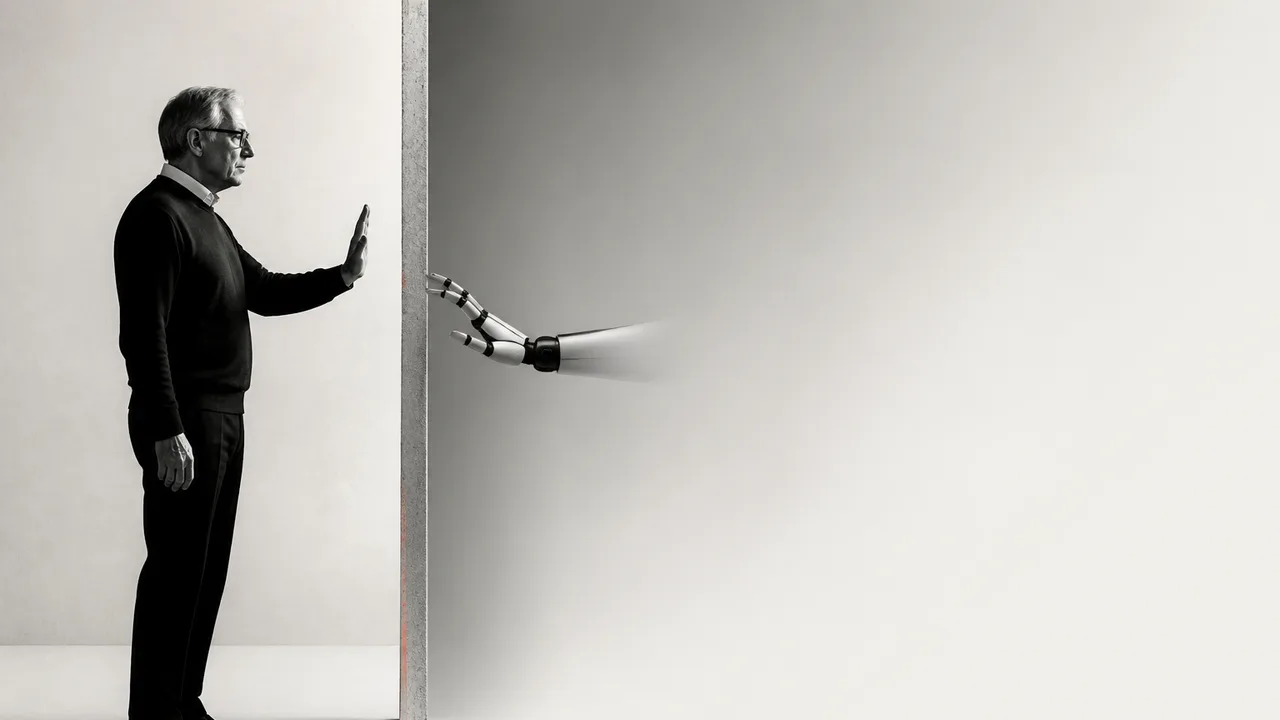
My first reaction to reading Bill Gates' new essay was a specific kind of vertigo that I suspect only people who covered the late-90s tech industry will fully recognize. This is the man a federal court found had maintained a monopoly through anticompetitive conduct. The man whose company's practices were so aggressive that the Department of Justice spent years trying to break Microsoft into pieces. The man whose bundling of Internet Explorer into Windows was treated, in the most serious precincts of antitrust law, as a structural threat to competition itself.
That man has now published an essay arguing that AI is developing too fast, that markets cannot be trusted to self-regulate, and that governments should intervene to protect workers and redistribute the gains from automation. According to Semafor, Gates described his shift in thinking about AI and jobs with a phrase that deserves to be read slowly: "This is crazy. This is insane."
I spent a moment genuinely unsure whether he was describing AI's trajectory or his own position.
What Gates Is Actually Proposing
Set aside the irony for a moment, because the proposals themselves are worth taking seriously on their own terms.
According to Tom's Hardware, Gates is calling for certain jobs to be formally designated as "Human Reserved" — roles where human labor would be protected by policy rather than market forces. He's also proposing a tax on AI tokens and on robots, which would generate revenue to fund the social safety net being eroded by automation. The framing, as The Register cheerfully put it, is that society faces an "AI-pocalypse" unless it gets "more socialist."
Gizmodo quoted Gates directly: "We do not have the luxury of moving slowly." The Verge noted that Gates is "deeply worried" and is, in their characterization, "no longer staying quiet."
The robot tax idea itself is not new. It has circulated among economists and policy researchers since at least the mid-2010s, and Gates has gestured toward it before. What's new is the register — the urgency, the scale of the proposed intervention, and the willingness of someone with Gates' profile to say plainly that the market will not solve this on its own.
TechCrunch reported that Gates' framework centers on the idea that AI could either democratize opportunity or catastrophically concentrate it, and that without deliberate policy, the default outcome is concentration. That's not a fringe position — it's increasingly the view of labor economists and development scholars who study technological transitions. What's unusual is hearing it from someone who has spent his adult life on the winning side of those transitions.
The Credibility Problem — And Why It Doesn't Quite Land Where You'd Expect
Here's the awkward part, and I want to be precise about what makes it awkward.
The obvious shot is easy: the man who built the most dominant software monopoly of the 20th century, who used Windows' market position to crush competitors across browsers, productivity software, and media players, is now asking governments to constrain market power in AI. A lesser columnist would leave it there, at "how convenient," and collect their clicks.
But that framing is too easy and also somewhat wrong. Gates is not, at this point, a Microsoft shareholder with skin in the AI race in any conventional sense. His foundation's agenda, whatever its flaws, is not structured around protecting a technology portfolio. And the argument that market concentration in transformative technology tends to harm the people at the bottom of the economy — that argument doesn't become false because a former monopolist is making it. A man can build a monopoly and still correctly identify the dynamics of monopoly. People recover from their own histories and occasionally learn something in the process.
What I find genuinely interesting — and a little uncomfortable — is the specific texture of his reversal. According to Semafor, Gates has explicitly changed his mind about AI's effect on jobs. He used to believe, as many in his cohort believed through the 2010s, that AI would be net positive for employment — displacing some tasks, creating others. He no longer believes that. The "this is crazy, this is insane" quote is Gates looking at the current trajectory and concluding that the productivity gains are real, the job displacement is real, and the mechanisms for redistribution are not keeping pace with either.
That's a more interesting kind of credibility problem than the monopoly one. It's not "why should we trust a monopolist on market power?" It's "he's been wrong about this before, and he knows it, and he's saying so." That combination — demonstrated wrongness plus public recantation — is actually rarer than it should be among people of Gates' stature, and rarer still among people who were wrong in directions that served their financial interests. You can hold the irony and the intellectual honesty at the same time.
The Counterargument Has Real Weight
The strongest objection to Gates' framework comes from AI researcher Oren Etzioni, whose response was covered by GeekWire: right diagnosis, wrong prescription. The concern with a robot tax — and it's a concern with genuine economic substance behind it — is that it would function as a penalty on productivity, effectively taxing efficiency in ways that could disadvantage companies and countries that adopt it while their competitors don't. A token tax imposed by the EU while the United States and China decline to follow would not meaningfully slow AI development; it would mostly slow European AI development. We've watched that movie already, in slower motion, with the EU's various attempts at digital platform regulation — years of framework-building, aggressive fines, and a tech sector that largely adapted its compliance posture without fundamentally changing its behavior.
The "Human Reserved" job concept runs into similar problems. Who decides which jobs are reserved? On what basis? What prevents the category from being captured by incumbents who want to block automation in their sector for reasons that have nothing to do with human dignity? These are not gotcha questions — they're the standard implementation problems that follow every well-intentioned labor protection proposal, and Gates' essay, as reported across these sources, does not appear to have worked through them in granular detail.
Slashdot's coverage noted Gates' argument that AI's benefits could either democratize opportunities or exacerbate inequalities — which is accurate as far as it goes, but also describes every major technological transition of the last century. Steam, electricity, computing, the internet: all of them ran that same fork. The outcomes depended on policy choices made under pressure, with incomplete information, by governments that frequently got it wrong before occasionally getting it right.
The policy track record is genuinely mixed. The objection to that is: so is the do-nothing track record.
What I Actually Think Happens Next
The robot tax debate has been sitting in the policy waiting room since at least the mid-2010s, gaining citations and losing momentum in alternating cycles. Gates' intervention is real signal — not because his proposals are ready to legislate, but because when someone at his altitude goes on record saying "this is crazy, this is insane," it moves the Overton window in ways that more technically rigorous but lower-profile voices don't.
The most likely near-term outcome is not a robot tax. It's not "Human Reserved" job categories. It's a messy, jurisdiction-by-jurisdiction set of partial measures — some AI disclosure requirements here, some retraining fund there, a token tax proposal that passes one legislature and gets tied up in constitutional challenge in another — while the underlying technology continues to develop at a pace that none of these measures was designed to address.
That's not cynicism. That's just how regulatory responses to fast-moving technology have tended to work. The seat belt mandate came decades after the cars. OSHA arrived after a century of industrial injury. Internet privacy law is still, in 2026, a patchwork that would embarrass a first-year law student if they were graded on coherence.
Gates is almost certainly right that something needs to happen. The particular things he's proposing may or may not be the right tools. But the history of technology regulation suggests the more dangerous failure mode isn't moving too fast with the wrong policy — it's the very sophisticated, very reasonable argument for waiting until we know more, deployed by people who benefit from the waiting, until waiting is no longer a choice anyone gets to make.
He built that playbook. He probably knows it better than anyone.
More Like This
Do You Really Need an $80 HDMI Cable? Maybe Not
Tech reviewer Adam tests a premium HDMI 2.1 cable. We examine what you're actually paying for and whether most users need it.
Can Unreal Engine 5 Run on a $500 MacBook? Sort Of.
Testing Unreal Engine 5.7 on the MacBook Neo reveals what happens when professional software meets budget hardware—and why friction matters.

OpenAI and Anthropic's Race to Control Global Compute
Dylan Patel argues OpenAI and Anthropic will own most of the world's usable compute by 2028—and that the debt required to get there could destabilize sovereign finances.

AI Is Reshaping Silicon Valley Jobs and Finances
A new report finds AI-driven layoffs are eroding the financial security of Silicon Valley tech workers — a shift that's faster and broader than past tech disruptions.

Anti-AI Violence Is Spreading. Here's What's Driving It
From Molotov cocktails to Berlin blackouts, anti-AI violence is escalating. What's fueling it, who's behind it, and where is it heading?
Building a $1,115 PC That Outperforms the Mac Mini M4
Tech Notice proves you can still build a powerful PC in 2026 despite RAM shortages—for less than Apple's Mac Mini M4 Pro costs.

Pokémon Go at Ten: AR's One Durable Success Story
Pokémon Go turns ten this week. A look at what it actually got right—and why the AR industry it was supposed to launch mostly didn't follow.
Ben Bernanke Joins Anthropic's AI Oversight Trust
Former Fed Chair Ben Bernanke joins Anthropic's Long-Term Benefit Trust. Here's what his economic expertise actually means for AI governance—and what it doesn't.