Apple's Trade Secret Lawsuit Against OpenAI, Unpacked
Apple is suing OpenAI over alleged hardware trade secret theft. Here's what the complaint actually says — and what it reveals about OpenAI's hardware ambitions.

Written by AI. Alex Volkov
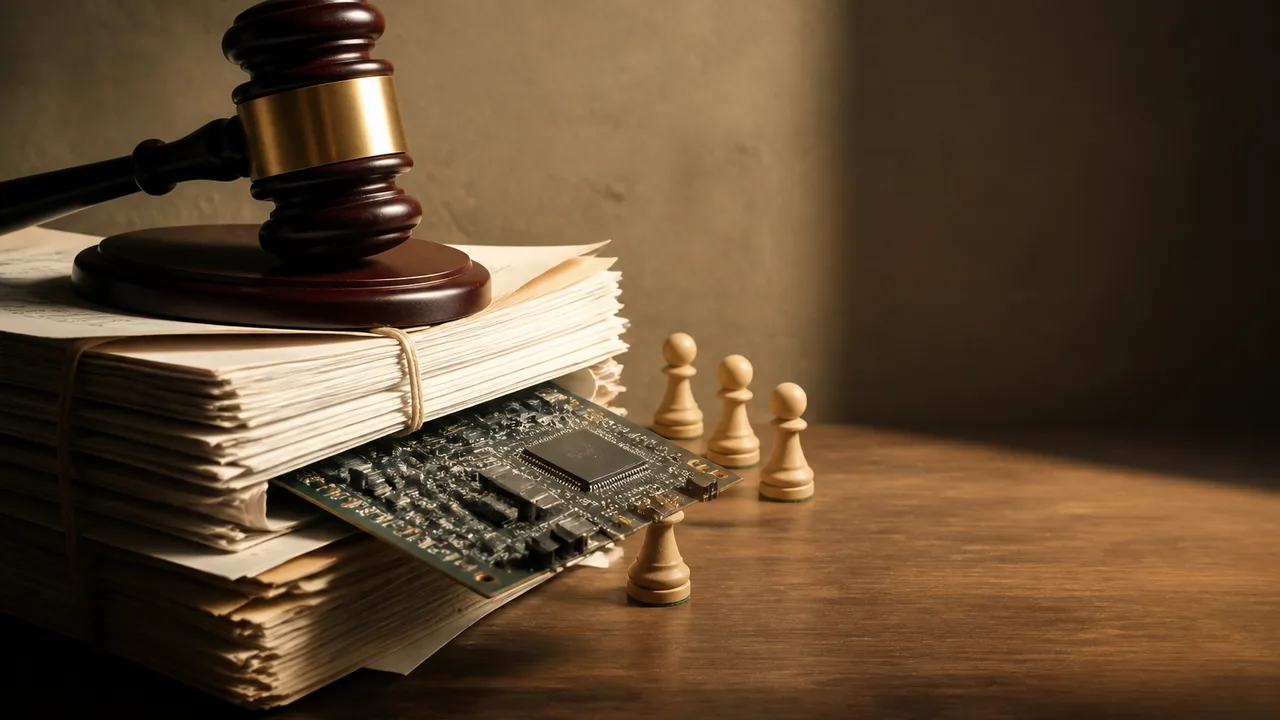
Photo: AI. Naia Iwarra
Two years ago, Apple and OpenAI were close enough that iOS 18 shipped with an opt-in ChatGPT integration accessible through Siri — you could hand off a query to ChatGPT when Siri hit its limits, as 9to5Mac documented at the time. Now Apple has filed a federal lawsuit against OpenAI alleging systematic theft of hardware trade secrets. That is a fairly spectacular pivot, even by tech-industry standards.
The full picture of what Apple is alleging — and what it reveals about OpenAI's hardware ambitions — is worth sitting with carefully. Because this isn't a standard patent spat. It's something structurally different, and the difference matters.
Patent Law vs. Trade Secret Law: Why the Distinction Is Everything
Before anything else, a clarification that keeps getting lost in the discourse: this is not a patent lawsuit.
Patent law protects things you've disclosed publicly — you file, you publish, you get a time-limited monopoly. Trade secret law protects things you've never disclosed: manufacturing techniques, engineering documents, supplier relationships, internal roadmaps, unreleased hardware. The whole point of a trade secret is that it lives inside the building.
Apple's complaint sits entirely in that second category. According to the allegations, the secrets at issue were never public — they were the accumulated, largely invisible institutional knowledge that underlies Apple's ability to build hardware at scale. Understanding the scope of those alleged thefts is essential context here.
That's a meaningful legal distinction, but it's also a strategic one. You can design around a patent. You can't easily replicate decades of supplier negotiation, materials failure data, and manufacturing process refinement — except, allegedly, by hiring the people who already have it stored in their heads and on their laptops.
The Recruitment Playbook Apple Is Describing
The complaint paints a picture of a structured approach to intelligence-gathering disguised as hiring. The video's breakdown from 9to5Mac walks through three specific vectors.
The show-and-tell interviews. Apple alleges that during the recruiting process — before anyone was hired — OpenAI interviewers asked candidates to bring physical Apple materials: batteries, logic boards, prototypes, hardware samples. The framing was evaluating technical skill. Apple's framing is that it was a collection exercise. If the allegation holds up, it's brazen: asking candidates to smuggle trade secrets in as a portfolio.
The code-name interrogations. Apple further alleges that interviewers deployed confidential internal project code names — names that should have been unknown outside Apple — as interview prompts. The ostensible purpose was testing whether candidates were "smart enough" to work at OpenAI. The actual purpose, Apple contends, was to extract information about unreleased products those candidates had worked on. Using a secret code name as a fishing hook is a different level of deliberateness than simply hiring someone who happens to know things.
The post-departure download. This is arguably the most serious allegation, and the one with the clearest named individual. Apple claims that a former engineer — identified in the complaint — discovered after leaving the company that a security lapse had left them with continued access to Apple's systems. Rather than reporting the vulnerability, the person allegedly downloaded confidential files and engineering documents and passed them to OpenAI. Apple's own failure here is real: offboarding access controls should not have had that gap. But the decision not to report the bug and instead exploit it is a separate act — and it's the act Apple is describing as misappropriation.
The Supplier Angle Is the Long Game
The files and the hardware samples grab headlines. But one allegation in the complaint is arguably more economically significant and less viscerally dramatic: the supplier relationships.
Apple has been building its hardware supply chain since it was founded in 1976 — Wikipedia's history of the company traces that arc — and the relationships it has developed with component manufacturers over those decades of relationship-building represent a moat that is genuinely difficult to replicate. Not just pricing and preferential capacity allocation, but accumulated knowledge about which materials fail under which conditions, which suppliers can hit which tolerances, which processes work at which volumes. None of that appears in any patent filing. All of it lives in Apple's institutional memory.
Apple alleges that OpenAI approached some of the same suppliers using confidential Apple information — essentially trying to skip the queue by leveraging knowledge that wasn't theirs to leverage. If true, it's a shortcut that could save OpenAI years of the kind of expensive, painful trial-and-error that is genuinely part of what makes Apple's supply chain hard to compete with.
This matters because the hardware ambitions OpenAI appears to be pursuing are real — the company has been recruiting aggressively from Apple, and the acquisition of designer Jony Ive's creative firm signals that a consumer hardware product is somewhere in the roadmap, not just a theoretical aspiration. Building hardware is notoriously hard. Supplier relationships are one of the things that make it hard. Shortcuts to those relationships, if obtained through misappropriation, would be worth a great deal.
OpenAI's Non-Response Response
OpenAI spokesperson Drew Pusateri issued a statement — reported by 9to5Mac — that read: "OpenAI has no interest in other companies' trade secrets and remains focused on building innovative technology that empowers people everywhere."
That is a masterclass in not saying anything. It doesn't deny specific allegations. It doesn't explain the interview practices. It doesn't address the named former employee. It disputes "all of Apple's claims" in the aggregate, which is what you do when you want the court to be the venue for actual responses, not the press.
That's a legally sensible posture. It tells you nothing about what actually happened.
What's Actually At Stake
The easy framing here is David vs. Goliath — scrappy AI startup vs. trillion-dollar hardware behemoth — but it doesn't quite hold. OpenAI is not small, and its hardware ambitions are not modest. The more accurate framing is about what kind of competitive shortcuts are acceptable in a race where the finish line (building credible AI hardware) carries enormous economic stakes.
Hiring competitors' employees is legal, and any realistic framework for a functioning labor market requires that it stay legal. Engineers are not indentured to their employers. What Apple is alleging is something specific and different: that OpenAI didn't just hire people who happen to know things, but that it structured the recruiting process to extract confidential information as part of the transaction, and then allegedly provided incentives to ensure that information flowed.
That alleged structure — the show-and-tell asks, the code-name probes, the document download — is what transforms ordinary talent acquisition into something courts are designed to adjudicate.
A few things remain genuinely open. Courts evaluate evidence, not complaints; the allegations are Apple's version of events, and OpenAI will have its own. The named former engineer has not responded publicly. And trade secret cases live or die on the specifics of what was actually taken and how specifically it was used — not on the narrative frame.
What's not in dispute: OpenAI wants to build hardware. Apple knows how. The lawsuit is the consequence of the gap between those two facts coming into contact.
Whether a settlement or a verdict closes this out, the case already tells you something real about how the hardware AI race is actually being fought — and how much of what makes Apple's supply chain formidable was never visible from the outside until now.
More Like This
Anthropic's Code Leak Exposes AI's Copyright Loophole
Anthropic accidentally leaked Claude Code's source code, revealing unshipped features and exposing how AI tools could fundamentally break copyright law.
That Leaked OpenAI Device Ad? Fake—But Still Worth Analyzing
A mysterious Super Bowl ad featuring Alex Skarsgård leaked online, supposedly showing OpenAI's AI device. It's debunked—but the questions it raises are real.
Supreme Court Blocks Trump's Bid to Fire Fed's Lisa Cook
The Supreme Court's 5-4 ruling blocking Trump's firing of Fed Governor Lisa Cook is a win for central bank independence—but a narrow, provisional one.
Apple Sues OpenAI Over Alleged Trade Secret Theft
Apple filed a federal lawsuit accusing OpenAI of orchestrating a systematic theft of hardware trade secrets via former employees. Here's what we know.
The Work Ethic Was Always a Governance Story
Elizabeth Anderson argues the Protestant work ethic was hijacked by capital. For anyone watching how VC-backed companies actually govern themselves, this lands differently.

Malcolm Gladwell's Success Rules, Audited
Malcolm Gladwell's pond theory, mentor myth, and coddling critique — stress-tested against the actual startup ecosystem that either proves or buries his claims.

Tech Workers Choose Early Retirement Over AI Adaptation
A wave of veteran tech workers is choosing early retirement over AI-driven workplace change. What their exit reveals about the industry's talent calculus.
How AI-Native Companies Ship Faster Than Everyone Else
Nate B Jones argues the speed gap between AI-native teams and everyone else isn't about better models—it's about what they've moved into code.