Amsterdam Data Centre Protest Exposes Two Policy Fights
At Microsoft's Amsterdam data centre site, separate actions raise questions about corporate services, local consent and how Europe decides where AI gets built.

Written by AI. Samira Barnes
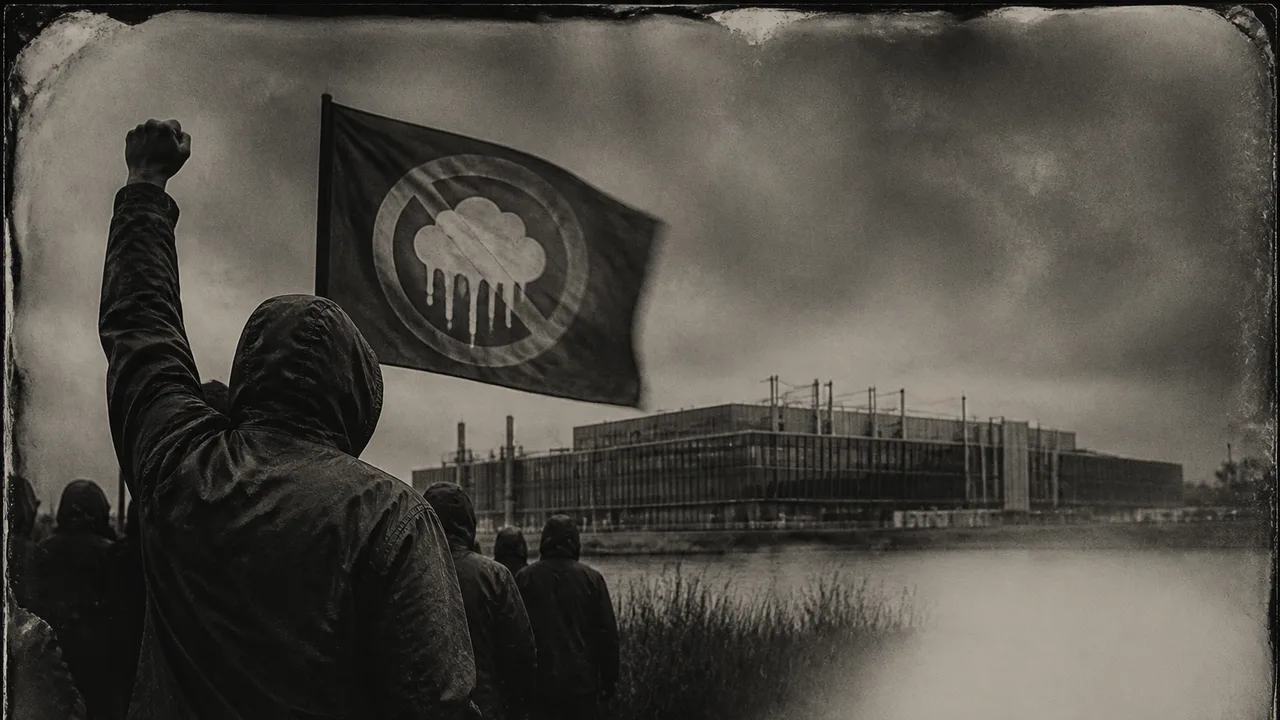
Protesters from Geef Tegengas entered a data centre construction site in Amsterdam’s Westpoort district on Friday, November 6, while members of a separate European campaign demonstrated outside its fence. Both actions targeted the same planned Microsoft facility. They raised different questions about it.
The Dutch direct-action group objected to Microsoft’s services to the Israeli military and US Immigration and Customs Enforcement. The Stop Dirty Data Centres coalition, whose affiliates stayed outside, wants governments to pause large data centre construction while the public has a greater say in what gets built. The coalition said it neither coordinated nor promoted the site occupation. Treating everyone at Westpoort as one organisation would assign the breach to people who say they did not organise it, and blur two demands that would require different responses.
Geef Tegengas protesters climbed a crane and displayed banners during the occupation. Police told Dutch broadcaster NOS that officers used force while trying to prevent it and that an officer was slightly injured. Protesters from both groups said police used force and teargas against activists trying to enter. Those accounts describe a confrontation at a live building site; they do not settle the arguments about what the completed facility should do.
One Site, Two Routes to a Decision
Pure Data Centres Group is developing the facility, which has a planned capacity of 78 megawatts and Microsoft as its intended sole tenant. Capacity describes the scale planned for the project, not how much electricity it is using now or will use at every hour once operating. Nor does a building’s planned capacity establish how much water it will consume. Roos Molenaar of Geef Tegengas alleged that the project was taking drinking water; that project-specific claim would require water-use figures to assess.
The sole-tenant arrangement helps explain why Microsoft, rather than only the developer, appears on the protesters’ banners. Geef Tegengas is challenging a company’s relationships and uses of computing power. A decision about the site’s physical footprint would not, by itself, answer that objection. Conversely, changing Microsoft’s policies concerning its customers would not answer residents who want a say over the land, power and water demands of a large facility. The groups can oppose the same construction project without sharing a theory of how to fix what they oppose.
Stop Dirty Data Centres has asked elected leaders for moratoria at local, national and European levels until people can decide what conditions should govern AI and data centre development. Its concerns include energy bills, water shortages, climate impacts and the use of AI in warfare. Owen Espley, a campaign coordinator, argued that many European projects proceed with limited transparency and that communities are shut out of decisions. That is the coalition’s broader criticism, rather than an established account of Westpoort’s permitting or consultation history.
A pause has a stronger policy rationale than a slogan might suggest: once construction is under way, the scope for choosing another site or setting conditions before building narrows. Westpoort is already a construction site, so campaigners are confronting a decision at a later stage than a proposal on a map. Whether its actual approval process excluded residents remains an open question. The useful test for this project is concrete: what decisions were open to public input, when was that input invited, and could it change the outcome?
Pure Data Centres said it respected peaceful protest, called entry into the live site unlawful and dangerous, and invited those on site to leave safely and discuss their concerns. Microsoft said it respected peaceful expression but opposed actions that were unlawful or put people at risk. Their safety objection has force in a construction area, where workers and protesters can be hurt. An invitation to dialogue can address immediate concerns; whether it offers a way to revisit a development decision depends on what remains open to change.
Why the Fence Became a European Policy Question
The dispute arrives after European governments have supported AI data centre development in pursuit of tax revenue and more computing capacity, including in a race with the US and China. That policy backdrop helps explain the coalition’s choice of target. Governments that encourage construction also help determine when communities can scrutinise it. A promise of future economic benefit and a request to examine local costs are competing claims on the same decision process; neither supplies a project-specific accounting of those benefits or costs.
The coalition organised demonstrations for November 6 and 7, while the Amsterdam occupation took place on the first day. Smaller protests occurred in central Bristol, at a Berlin data centre, outside the Polish parliament in Warsaw and in Zagreb’s main square. Those settings put different decision-makers in view. A protest at a building site addresses an immediate project and the organisations behind it; one outside a parliament asks lawmakers to set rules that could apply across projects. The shared campaign demand does not make each location’s infrastructure pressures identical, or turn the separate Geef Tegengas action into a coalition tactic.
The coalition said groups had announced actions in 16 countries. That is a count of announced actions, not a measure of public opinion. The same account says the coalition seeks a halt to major new construction while governments establish clearer rules, rather than closure of existing facilities. A moratorium framed that way would create time for decisions about future projects; it would not resolve objections to services already offered by a technology company.
That leaves two practical questions at Westpoort. One concerns whether the rules and opportunities for public participation were adequate before construction began. The other concerns what responsibility Microsoft bears for the services Geef Tegengas opposes. Police, the developer and Microsoft have addressed safety at the site; the coalition has proposed a pause in new building. Each response meets a different part of Friday’s protest. The fence made those arguments visible together, but it cannot make one answer stand in for the other.
More Like This

OpenAI Drops Data Center NDAs After Voter Backlash
OpenAI says it will stop using NDAs with public officials on future data center sites after election backlash. What changes for communities weighing AI projects?

Chinese Bots Targeted AI Data Centers. Real People Did Too.
X found 200 Chinese bot accounts targeting AI data center debates. OpenAI and Republicans ran with it. Wired and others say the outrage was already real.

Amazon Says It Has Stopped Using NDAs in Data Center Talks
Amazon says it has dropped NDAs in data center outreach. Residents still need early answers on power, water, incentives and who pays when project plans change.

Judge Lets NAACP Clean Air Act Suit Against xAI Proceed
A judge has let the NAACP's Clean Air Act suit over xAI's data center move ahead. The case puts on-site power, local air rules and AI expansion under scrutiny.

Tesla Opens Dallas Cybercab Rides, Testing Wider Rollout
Tesla has opened Cybercab rides in Dallas, its second U.S. market after Austin. Fleet size, operating limits and safety data will shape the rollout's meaning.

Anthropic's Compute Deals Fix Rate Limits—For Now
Anthropic's SpaceX deal doubles Claude Code rate limits and kills peak-hour throttling. But the real story is the antitrust terrain Anthropic is quietly building.

Grok 4.6, Cursor, and xAI's Accountability Gaps
Grok 4.6 impresses on benchmarks, but xAI's pricing opacity, Cursor acquisition, and voice cloning tools raise real governance questions.
AI Data Centers Hit a U.S. Regulatory Wall
GPU deployments are moving to Mexico and Australia. Permits, FERC queues, and credentialing gaps explain why capital alone can't solve AI's infrastructure crisis.