Amazonian Wildlife in Bangkok Raises Trade Route Questions
Amazonian wildlife in Bangkok's pet trade raises questions about origins and welfare. DNA may identify a species, but tracing its route takes records too.

Written by AI. Mei Zhang
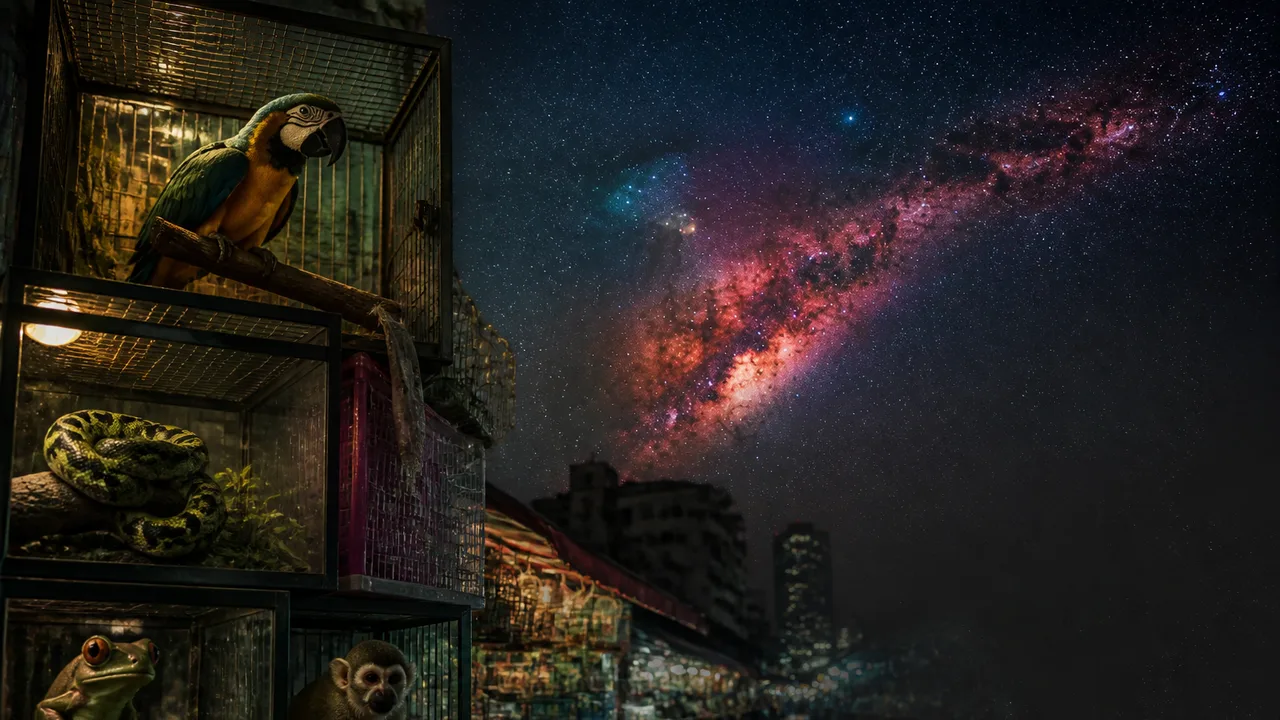
Amazonian wildlife is appearing in Bangkok’s exotic-pet market, and a counter-trafficking specialist has observed more Latin American species there over the past two years, Mongabay reported. That is a reason to investigate a possible long-distance supply route. It is not, on the information available, a count of animals entering Thailand or evidence that any animal described in the report was traded illegally.
Now put yourself in front of an online wildlife listing. A photo and a species name can make an animal feel knowable: you can search its habitat, watch clips of its behavior, maybe even find a DNA sequence in a public database. But the listing may tell you almost nothing about the questions that govern the animal’s life and the buyer’s decision. Was it bred in captivity? Where? Did it come from the wild? Which people handled it before it reached the seller? A species ID gives the animal a name. A documented trade route gives that name a history.
A Name is Not a Passport Stamp
Genetics offers a tempting shortcut here. In wildlife identification, a lab can compare a short stretch of DNA from a sample with reference sequences to help determine which species an animal belongs to. Think of the reference library as a cookbook index: a close match can point you toward a recipe, provided the index contains the relevant entry and the sample was collected and handled properly. For species that look alike, or animals whose appearance changes with age, that can be more informative than a seller’s label or a blurry photo.
The limits arrive fast. Closely related species may be difficult to separate with one short genetic marker. An incomplete reference library can produce an uncertain match. A sample from one animal cannot automatically authenticate every other animal in the same shipment or listing. And even a confident identification usually says nothing about whether that individual was born in a breeding facility, taken from a forest or moved through several countries. A DNA match is closer to a map dot than a passport stamp.
Researchers can sometimes investigate geographic origin using broader genetic data and well-sampled reference populations. That takes suitable samples from the animal and from potential source populations, plus an analysis that accounts for overlap among those populations. A claim about origin would need its own evidence; species-level identification alone cannot supply it. No genetic testing or population comparison is documented in the information available about the Bangkok sightings.
For someone scrolling listings, this gap has a practical consequence. A seller could correctly name a species while leaving its origin unsupported. The opposite problem is possible too: a mistaken name could obscure which rules apply to its trade. A persuasive photo, a scientific name and a confident claim of captive breeding still leave the buyer dependent on records that connect this animal to that claim. Genetics can help check the label. It cannot reconstruct a missing chain of custody from a screenshot.
Follow the Animal, Then Follow the Paperwork
The Bangkok observation raises several questions that sound similar but require different evidence. How many Latin American animals are being offered? Which species are they? Were they bred or collected in the wild? How did they travel? Which sales comply with the rules that apply to those animals and movements? A two-year observation by a specialist can flag a change worth checking. Repeated surveys, with consistent methods and reliable identifications, would be needed to measure whether the market itself has grown.
Those surveys would also need to avoid counting the same animal twice. An animal offered by one seller, moved to another and photographed again could look like multiple arrivals. A seller might use several listings for one animal, or several animals might appear under one listing. Monitoring that records dates, locations, identifiers where appropriate and the level of confidence in each species ID would help separate fresh supply from repeated appearances. None of that requires pretending that every sighting is a trafficking case.
Tracing movement adds another layer. When animals pass through brokers and jurisdictions, a final point of sale reveals little about earlier transfers. Transport and breeding records, permits where required, and documentation that can be checked against the individual animal would let authorities test an origin claim. The legal answer depends on the species, where it came from, how it was obtained and which rules governed each movement. An animal’s presence in an exotic-pet market does not settle that answer.
If a claimed captive-bred animal has no verifiable link to a breeding record, a species name cannot close the gap. If officials have strong documentation but an uncertain ID, they may need to check which species the paperwork actually covers. Identification and provenance work best as cross-checks, with neither doing the other’s job.
What a Better Signal Could Change
Wildlife monitoring often has to work with uneven evidence: a market visit here, a listing there, a specialist noticing a pattern. The first improvement is consistency. Repeated checks using comparable methods could show whether Latin American species appear more often over time, while careful identification could show whether a few frequently seen animals are driving the impression of change. Records about origin and transfers could then help distinguish isolated sales from a sustained supply network.
That sequence matters for conservation. If animals come from wild populations, demand could add pressure where they are collected. If animals come from documented breeding operations, the conservation questions shift, though welfare and oversight still matter. Transport and captivity can pose welfare and disease risks regardless of whether a sale breaks a trade rule. Better evidence helps direct inspections and cooperation across borders toward the routes and practices that need scrutiny, rather than treating every Latin American animal in Bangkok as proof of the same story.
There is also an ethical trap in asking buyers to do the work of investigators. A person encountering a listing can ask for a clear species ID and verifiable origin documents, and can recognize when a claim has little support. They cannot audit a multinational chain of brokers from a phone screen. Platforms, sellers, conservation monitors and enforcement agencies hold different pieces of that puzzle. Measures to reduce demand have a role, but they work best when people understand why an appealing species label cannot answer the question of how an animal got there.
The reported sightings leave Bangkok at the map-dot stage: a place where Amazonian wildlife has appeared and a specialist has noticed more Latin American species. The next passport stamps have to come from repeatable observations and records tied to individual animals. Until then, even an accurate DNA-based species name would identify the passenger, not the journey.
More Like This
Unraveling the Golden Ratio's Mathematical Magic
Explore how the golden ratio's unique irrationality connects math, nature, and fractals.
How Maxwell Unified Electricity and Magnetism
A compass needle twitched in 1820 and set off a chain of discoveries that now powers every wireless signal in your life. Here's the physics behind it.

August's 96% Blood Moon Lunar Eclipse Explained
A 96% partial lunar eclipse turns the moon deep red on Aug. 27-28. Here's when to watch, why it happens, and what's threatening our view of it.

SpaceX Rocket Team Wins First Neil Armstrong Prize
SpaceX's Falcon 9 landing team won the first Neil Armstrong Space Prize, spotlighting reusable rocket engineering, costs, climate and access to orbit.

Black Holes, Colliding Galaxies, and the Chaotic Universe
Astrophysicist Mordecai-Mark Mac Low joins StarTalk to unpack galaxy collisions, planets orbiting black holes, dark matter, and why the universe is messier than we thought.

Ten Discoveries That Rewired How We See Everything
From CRISPR to dark energy, ten scientific breakthroughs that didn't just change their fields — they changed what questions we're allowed to ask.