Alibaba’s Zhenwu V900 Claims Still Need More Evidence
Alibaba says its Zhenwu V900 triples prior performance. Disclosed specs, Huawei comparisons and cloud plans show what can and cannot yet be verified.

Written by AI. Rachel "Rach" Kovacs
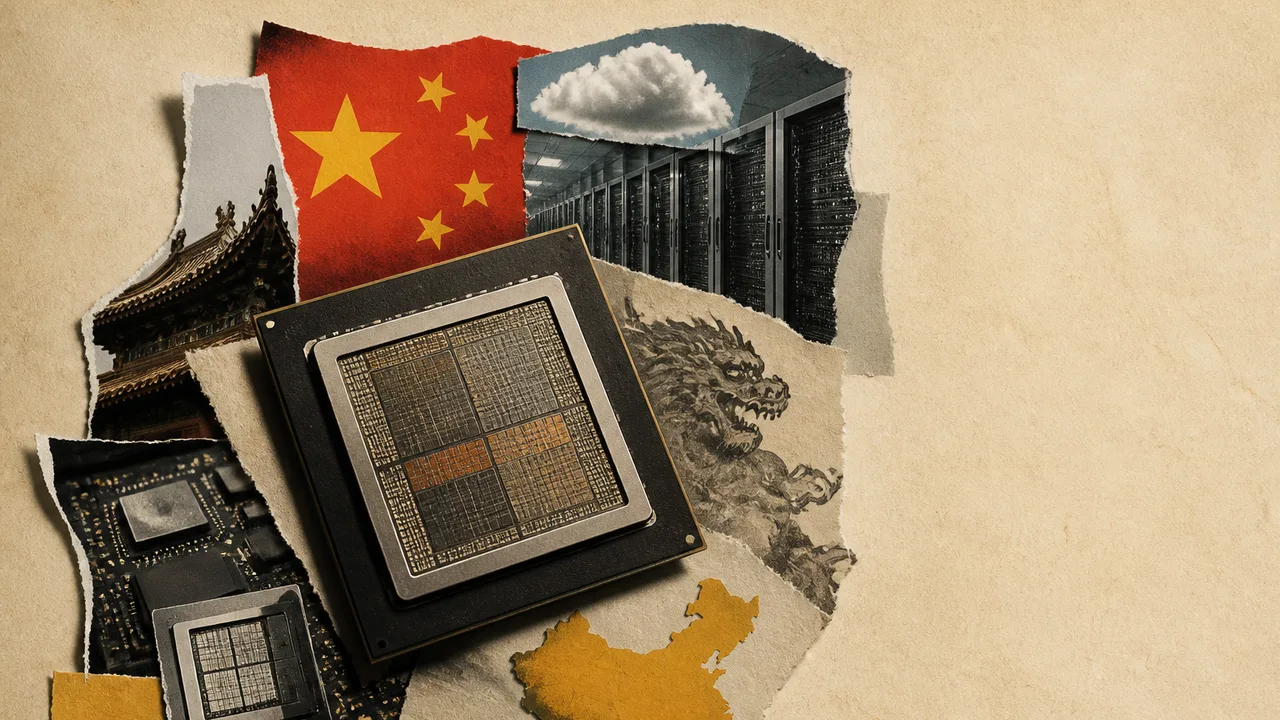
Alibaba shares rose about 3% in Hong Kong after the company unveiled the Zhenwu V900 AI accelerator and a plan for more than 20 gigawatts of global data center capacity by 2032. The stock moved as investors received a whole AI supply chain in one presentation: chips, cloud infrastructure and future Qwen models.
The chip claim needs a narrower reading. Alibaba says the V900 delivers three times the performance of the M890, its previous-generation accelerator released in May. That comparison does not establish how either chip performs against Nvidia, Huawei or another competitor, and Alibaba has not released enough information for outsiders to reproduce it.
This leaves two conclusions that can coexist. Alibaba has an established accelerator business, a faster release schedule and hundreds of customers. Its claim to have produced the “most powerful AI chip in China” remains unverified pending independent benchmarks, power figures, pricing and software details.
The Disclosed Numbers Cannot Reconstruct “Three Times”
The V900 is designed for AI training and inference, with 216 GB of memory and 1,200 GB/s of inter-chip bandwidth. Alibaba also says the processor supports FP8 and FP4 numerical formats and can scale into systems containing large numbers of cards.
The previous M890 had 144 GB of memory and 800 GB/s of inter-chip bandwidth, according to technical details reported by Tom’s Hardware. That means the disclosed memory capacity increased by 50%, while the stated inter-chip bandwidth also increased by 50%.
Neither calculation produces a threefold increase. That does not disprove Alibaba’s claim, because performance can improve through compute architecture, lower-precision operations, networking, storage and software optimization. It does show that readers cannot derive the claimed result from the published specifications.
Alibaba did not disclose absolute compute performance in FLOPS, the manufacturing process, foundry or power consumption. It also did not identify, in the available reporting, the workloads, batch sizes or software settings behind the three-times figure. A benchmark without a test description is a little like a restaurant review that only says “faster.” Faster at what, under which conditions, and for how much money?
The strongest interpretation of Alibaba’s claim is that the company measured the complete V900 platform against its own M890 platform under internal workloads. That would fit its emphasis on Alibaba-developed networking and storage components. The limitation is straightforward: customers cannot yet determine whether those gains transfer to their models or compare them with competing systems.
A Roadmap Accelerated by Export Restrictions
The V900 follows an unusually compressed public schedule. Alibaba released the M890 in May, when its roadmap placed the V900 in the third quarter of 2027. The company now expects mass production and commercial availability in the first quarter of 2027.
Alibaba’s chip unit, T-Head, had shipped more than 560,000 Zhenwu processors to over 400 external customers as of May. Alibaba now says its existing processors serve more than 650 customers across automotive, finance, energy and manufacturing. Those figures concern the broader Zhenwu line, rather than V900 deployments, but they give the roadmap more weight than a first-generation concept chip would carry.
The history also explains why a domestic alternative has commercial value before it wins a benchmark crown. Chinese technology companies have been expanding domestic semiconductor capabilities while the United States restricts exports of some advanced Nvidia AI processors to China, as International Business Times reported. Availability, support and integration can make an accelerator useful even when public evidence does not show category-leading raw performance.
Alibaba is pairing that silicon schedule with larger models. Qwen 4 is in training, while planned Qwen 4.5 and Qwen 5 models could contain between 5 trillion and 10 trillion parameters, compared with 2.4 trillion for Qwen3.8-Max. Parameter count alone does not establish quality, speed or operating cost. Alibaba also has not confirmed that the future models will run on V900 hardware. The combined roadmap nevertheless shows the company preparing chips, models and data centers around the same expectation: future AI workloads will demand far more compute.
Huawei Offers a Comparison, with Caveats Attached
Huawei’s planned Ascend 960PR provides the closest disclosed Chinese comparison. Due in the third quarter of 2027, it is slated to offer 192 GB of memory, 2.4 TB/s of memory bandwidth and a 2.2 TB/s scale-up interconnect.
Those figures do not settle which chip is faster. Alibaba’s 1,200 GB/s figure describes inter-chip bandwidth, while Huawei’s 2.4 TB/s figure describes memory bandwidth, so placing them in a two-column table would produce attractive nonsense. Neither company has delivered independently reproduced application benchmarks for these future products in the reporting available so far.
The comparison still exposes the limits of Alibaba’s superlative. “Most powerful” requires a shared workload, comparable software, power measurements and an agreed performance metric. Memory capacity by itself cannot supply that verdict.
Alibaba also says its architecture can scale to clusters of up to 500,000 accelerator cards. TechRepublic’s examination of the announcement found that the company has not said it currently operates such a cluster. At that size, accelerator count is only the opening headache. Networking, cooling, electricity and component supply determine how much of the theoretical system becomes usable compute.
The 20-Gigawatt Plan is the Larger Bet
Alibaba aims to operate more than 20 gigawatts of global data center capacity by 2032. For scale, Nvidia has outlined work with Australian partners supporting up to 2 gigawatts of AI infrastructure by 2027. Meta’s planned Alberta data center is a 1-gigawatt facility expected to cost about $9 billion, according to CNBC’s comparison.
These are useful scale markers, not apples-to-apples projects. Alibaba’s figure covers global capacity six years from now, Nvidia’s covers a national partnership with an earlier deadline, and Meta’s describes one facility. Electricity capacity also says nothing by itself about accelerator performance or utilization. It does reveal how much infrastructure Alibaba expects its AI business to require.
That international dimension sharpens the company’s positioning. Alibaba Cloud has announced planned regions in Türkiye, Finland and the Netherlands, alongside added capacity in Malaysia, Germany, the United Arab Emirates, France and Hong Kong. If V900-backed services reach those regions, Alibaba could distribute its accelerator through cloud access rather than asking customers to buy and install the hardware directly. Pricing, regional availability and software compatibility remain undisclosed, so this is a plausible route rather than a confirmed deployment plan.
The announcement also arrived shortly before the scheduled meeting between Chinese President Xi Jinping and US President Donald Trump, with AI among the subjects surrounding the talks. The timing made Alibaba’s full-stack roadmap useful as a demonstration of Chinese computing ambition. No disclosed evidence shows that Alibaba timed its conference to influence the summit, so the connection should stay in the category marked “context,” not “cause.”
What Customers Should Look for Next
A procurement team evaluating the V900 will need more than a multiplier. Four disclosures would turn the announcement into a product comparison:
- Independent benchmarks using named training and inference workloads.
- Power consumption and total system cost, including networking and cooling.
- Pricing, cloud instance types, availability and support terms.
- Evidence that Nvidia-oriented libraries, containers and orchestration tools can migrate without expensive rewrites.
Commercial availability is scheduled for the first quarter of 2027, giving Alibaba a concrete deadline. Evidence of V900-backed cloud instances, customer deployments and reproducible benchmarks would support the company’s performance claims. Delays, limited software support or benchmarks confined to internal workloads would narrow them.
For now, Alibaba has supplied dates, memory, interconnect and scale targets. The missing benchmark table will decide whether “three times” describes customer performance or conference-stage potential.
More Like This
Inside an AI Factory: What 144 GPUs in One Rack Actually Means
Supermicro's NVIDIA B300 systems pack unprecedented GPU density. But the networking, cooling, and power infrastructure reveals the real engineering challenge.

AI Data Center Expansion Confronts Political Backlash
A new poll finds 61% of likely voters oppose AI data centers, exposing political risks around power, water, permits, tax breaks and local community trust.

PyTorch Conference China 2026: The Open AI Stack Grows Up
PyTorch Conference China ran in Shanghai alongside KubeCon and OpenInfra, placing AI frameworks beside the infrastructure layers models need to ship.

China's AI Firms Take Platinum Seats in PyTorch Governance
Alibaba Cloud and Cambricon join the PyTorch Foundation as Platinum members. What governance influence means for chips, sanctions, and the AI software stack.

Nscale IPO Tests the Economics of the Neocloud Boom
Nscale's IPO filing pairs 1,252% revenue growth with a $1.02 billion loss. CoreWeave shows why demand, debt and dilution matter for investors.

ChatGPT, Claude, Grok and Gemini All Failed at Once
ChatGPT, Claude, Grok, and Gemini failed in the same window on September 3. What each company said, and didn't say, reveals how AI designs failure communication.

A Four-Step Framework for Automating Work With Claude
A YouTube creator's four-step Claude automation framework is drawing attention. Here's what works, what needs scrutiny, and what it means for your actual workweek.

Claude Fable 5 Return, OpenAI Jalapeño Chip, and AI Espionage
Claude Fable 5 signals a return, Anthropic accuses Alibaba of mass model distillation, OpenAI unveils its Jalapeño chip, and Gemini 3.5 Pro disappoints.