Alfred Nobel: Dynamite, Death, and a Legacy Rewritten
Alfred Nobel invented dynamite, amassed a fortune, then read his own obituary. What he did next reshaped how the world defines human achievement.

Written by AI. Harold "Harry" Goodman
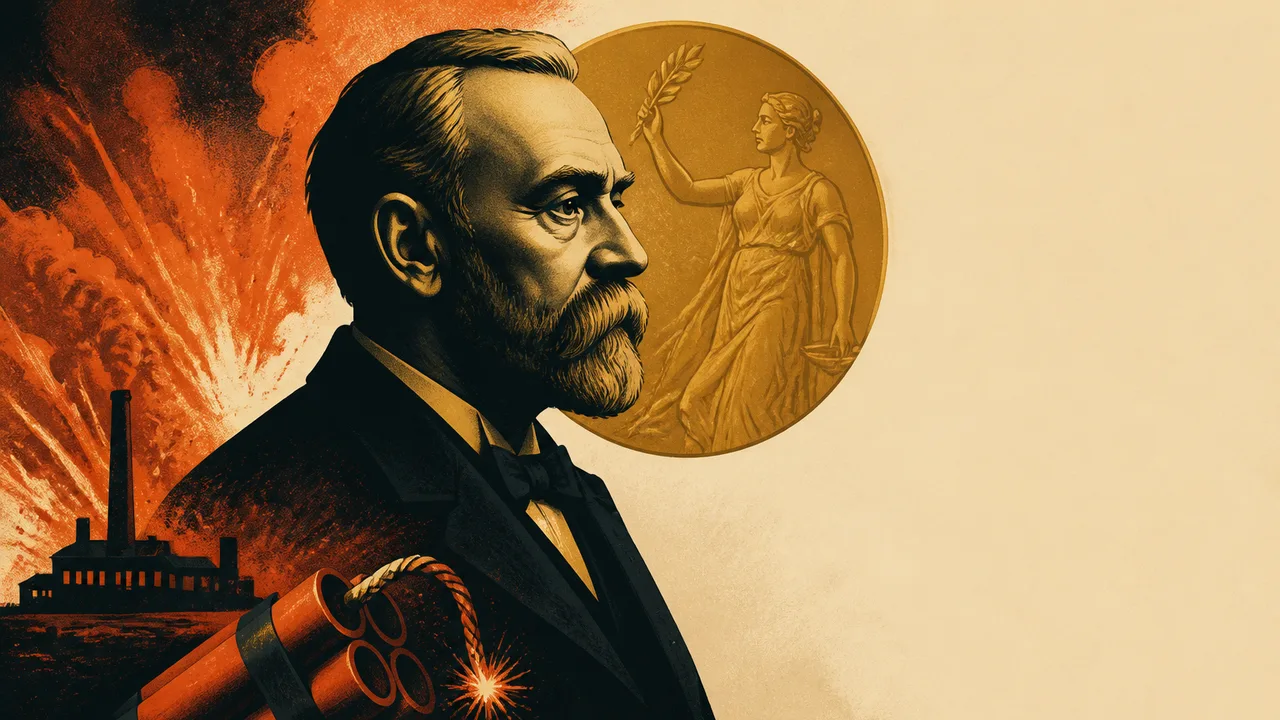
Photo: AI. Mika Sørensen
There is a particular species of reckoning available only to the very famous and the very fortunate: reading your own obituary while still alive to argue with it. Alfred Nobel experienced this in 1888, when his brother Ludvig died and at least one French newspaper, apparently eager to bury the more consequential Nobel, ran the headline "Le marchand de la mort est mort" — "The merchant of death is dead." According to a 2018 account in Thrive Global, Nobel was devastated by what he read — not grief, exactly, but something closer to the horror of accurate self-recognition. The papers had him right, and he knew it.
What Nobel did with that knowledge is the more interesting story.
The Education of an Explosives Man
Alfred Bernhard Nobel was born on August 21, 1833, in Stockholm, into a family that had already learned the geography of failure. His father Emmanuel was an inventor by temperament and a bankrupt by circumstance — the business had collapsed three months before Alfred's birth, and creditors were a persistent feature of the household. When fire took the family home, the Nobel children sold matches in the streets.
Alfred was the bookish one. Sickly, introverted, prone to epileptic convulsions and gastric complaints that kept him indoors while his brothers ran outside, he educated himself through sheer appetite. By the time he was a teenager he could speak five languages, and his reading of Percy Shelley had given him, by the Biographics account, "a deep desire to stand up to injustice" — a sentiment that would spend the next several decades in complicated negotiation with his livelihood.
Emmanuel's fortunes eventually revived in Russia, where a meeting with Tsar Nicholas I secured government contracts for submerged explosive mines. By 1842 the family had reunited in St. Petersburg, living in conditions that stood in pointed contrast to the match-selling years. Alfred thrived academically, spent his free hours in his father's factory absorbing chemistry by proximity, and in 1850 was sent to Paris to pursue it formally.
In Paris he met Ascanio Sobrero, the chemist who had synthesized nitroglycerin a few years earlier and had already arrived at regret about it. Sobrero would later say: "When I think of all the victims killed during nitroglycerin explosions, and the terrible havoc that it wreaked, which in all probability will continue to occur in the future, I am almost ashamed to admit to being its discoverer." Nobel, nineteen and fascinated, drew precisely the opposite lesson from the same substance: not that nitroglycerin was too dangerous to use, but that it was too useful to leave untamed.
The Cost of Taming It
The taming took years and extracted a brutal price. Nobel spent up to eighteen hours a day in a small factory trying to make nitroglycerin commercially viable. In September 1864, a vat of overheated nitroglycerin exploded at the Swedish Nobel company factory. Five people were killed. One of them was Alfred's younger brother Emil. Alfred was in the adjacent building and survived with minor injuries.
A man of different temperament might have stepped back. Nobel accelerated. He built a factory in Hamburg, then — in what proved to be the decisive accident of his scientific career — established operations at Krümmel, near Hamburg. According to NobelPrize.org, it was at Krümmel that Nobel discovered kieselguhr, a diatomaceous earth whose siliceous, porous structure absorbed liquid nitroglycerin and rendered it stable enough to handle, shape, and transport safely. The resulting compound — nitroglycerin, kieselguhr, and a blasting cap using mercury fulminate — Nobel called dynamite. He patented it in 1867.
Engineers worldwide wanted it immediately. Tunnels, mines, railways, harbors — dynamite collapsed the distance between ambition and excavation. Nobel became, in his own accounting, rich beyond his wildest dreams. He expanded into gelignite, a more powerful and more manageable successor, then into ballistite, a smokeless propellant that the Italian government licensed for military use. He built factories across Europe and into the United States. He was a one-man industrial complex.
He was also, by his own admission, uncomfortable with where all of this was leading.
Nobel's public justification for dynamite was remarkable for its faith in deterrence as a mechanism of peace. He argued that "my dynamite will sooner lead to peace than a thousand world conventions — as soon as men will find that in one instant whole armies can be utterly destroyed, they will surely abide in golden peace." The logic was not entirely absurd — it anticipates, in crude form, arguments that would later surround nuclear deterrence theory — but as the Biographics video observes, history treated his faith in mankind as, to put it plainly, misplaced.
The Obituary Problem
Nobel was a complicated private figure as well. He never married. His most sustained relationship — eighteen years with a woman named Sophie Hess — ended in the early 1890s when she became pregnant by another man and married him. Nobel continued paying her an annual allowance regardless. Earlier, he had briefly employed Bertha Kinsky as his secretary; she rebuffed his evident attraction and left his employ, but the two maintained a correspondence until his death. In 1905, Bertha von Suttner — as she had become — received the Nobel Peace Prize, a symmetry that Nobel could not have planned but might have appreciated.
Through all of this Nobel presented himself as a hermit, a loner, someone who kept his emotional life behind multiple locked doors. His immense wealth went largely unspent on personal luxury — no extravagant wardrobes or carriages. He invested in estates and laboratories. He worked. The Biographics account notes he could go twenty hours without stopping.
So when the French obituaries arrived in 1888, misattributed but functionally accurate, the shock was specific. Not that the world found him guilty — he had lived with that suspicion — but that this was the verdict. The merchant of death. That was to be the sentence.
He spent the next several years revising it.
The Will as Argument
On November 27, 1895, Nobel signed a document at the Swedish-Norwegian Club in Paris that redirected 94 percent of his total estate toward the annual recognition of individuals who, in the preceding year, had "conferred the greatest benefit on mankind." Five prize categories: physics, chemistry, medicine, literature, and peace. The economics prize came later, added at the century's end.
The Peace Prize's language in the original will is worth sitting with. It was to go to whoever had done "the most or best work for fraternity between the nations and abolition or reduction of standing armies and the formation and spreading of peace congresses." Not a vague nod toward good feeling — a specific, almost impatient set of criteria from a man who had spent his career supplying armies with more efficient means of destroying each other.
Nobel died on December 10, 1896, following a stroke. He was 63. The prizes bearing his name began to be awarded five years later, and have not stopped.
The question the obituary incident raises is not whether Nobel's philanthropic conversion was genuine or strategic — the honest answer is almost certainly both, in proportions that can't be recovered from this distance. The more durable question is what it means that the prize for peace was endowed by the man who made modern explosives commercially viable. Every October, when the announcements come, that tension is quietly present in the institution itself: the idea that the same intelligence which produces devastation can, if it chooses and if it is sufficiently rattled by the mirror, also produce something else entirely.
Nobel read his obituary and did not like the man he found there. Whether the prizes change that verdict is a question each recipient's work answers differently, year by year.
More Like This
Roman Empire History With Anthony Kaldellis
Anthony Kaldellis joins Lex Fridman to argue the Byzantine Empire never existed—it was Rome all along. A historian makes the case across 2,200 years.

Common History Myths That Schools Still Teach
From Napoleon's height to Viking helmets, a new video maps the historical myths that textbooks kept alive—and asks why bad history is so hard to dislodge.

Nash Equilibrium Explained: The Logic of Locked-In Choices
MIT's Ian Ball breaks down Nash equilibrium—why being "rational" isn't enough, and what it really means when no one can gain by going it alone.

Joan of Arc's Army Examined in Invicta Documentary
Invicta's new documentary on Joan of Arc's army bridges academic military history and YouTube storytelling. Harry Goodman examines what that translation costs and earns.

The Fermi Paradox: Why Silence From Space Makes Sense
Brian Keating and Shawn Ryan unpack the Fermi Paradox — from cosmic scale to civilization lifespans — and why silence might be the expected answer.

Hedy Lamarr, Inventor of Frequency-Hopping Technology
Hedy Lamarr wasn't just Hollywood's biggest star — she co-invented frequency-hopping, the technology underpinning Wi-Fi, Bluetooth, and GPS. Her story is overdue.

How a Programmer Tried to Crack the Rubik's Cube
Sebastian Lague's coding adventure to solve the Rubik's Cube reveals why 43 quintillion permutations humbles even clever algorithms. A craft-focused breakdown.

Martin Road Series Retro D12E: A Modern Acoustic Classic
Explore why the Martin Road Series Retro D12E is a hit with musicians, blending vintage aesthetics with modern features.