235 East 42nd Street and NYC's Office Conversion Reckoning
Steel columns buckled at a Midtown Manhattan office-to-apartment conversion in July 2026. Here's what the failure reveals about NYC's housing ambitions.

Written by AI. Jin Seo
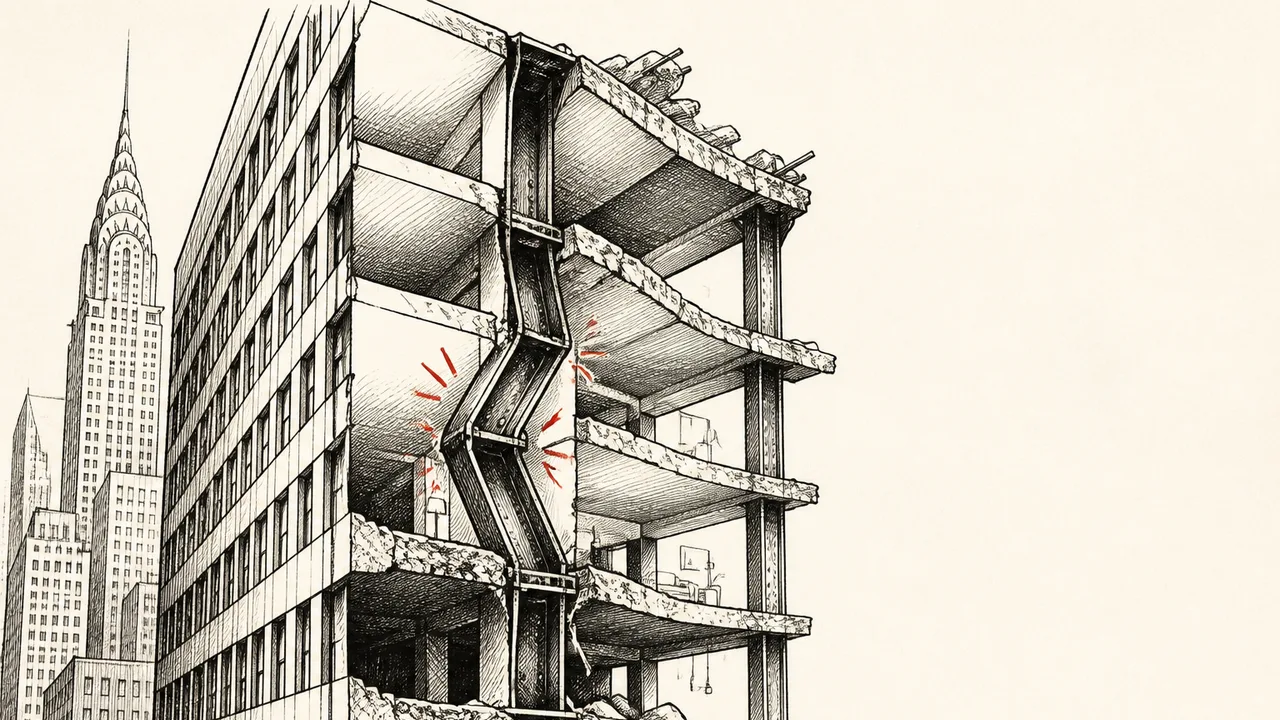
Photo: AI. Eira Pendragon
The radio call came in early on the morning of July 7, 2026: "We're operating at 235 East 42. We have columns partially down on 21 and 22 and we have floor sagging between 21 and 26."
That is not the language of a routine construction hiccup. Nine nearby buildings were evacuated, including a school. A frozen zone went up around a stretch of Midtown Manhattan a few blocks from Grand Central Terminal. The developer, Nathan Burman, would later characterize it as a typical construction mishap. The fire department, watching a compromised column continue to move after they arrived on scene, seemed to disagree.
What happened at 235 East 42nd Street matters beyond one building and one bad morning. It landed at the precise intersection of two of New York City's most pressing problems — a glut of empty office space and a shortage of places to live — and it arrived just as the city had committed, politically and financially, to solving the second problem by filling up the first.
The Policy Bet That Got Physical
In 2024, the city passed what it called the "City of Yes for Housing Opportunity," a regulatory liberalization explicitly designed to make office-to-residential conversions easier to execute. The logic was straightforward: vacancy rates in Manhattan offices shot up after the pandemic, housing supply remains brutally constrained, and there are a lot of buildings sitting between those two problems.
235 East 42nd Street — originally the Pfizer headquarters, opened in 1961 — became the largest conversion of its kind in New York City history, according to The B1M's reporting on the incident. Once complete, it was projected to offer more than 1,600 apartments. The ambition was real.
So was the complexity.
The project isn't just converting a single building. It's merging two of them: 235 itself, a 33-story steel structure from 1961, and its neighbor, 219 East 42nd Street, a 10-story building from the early 20th century built with terra cotta and cast iron. The plan called for 219 to be extended to nearly 30 stories, and for 235 to gain four additional floors, taking it to 37. Two structures built roughly half a century apart, with entirely different material profiles, were being stitched together into a single development and simultaneously pushed upward.
Chris O'Reagan, a chartered structural engineer and head of structural safety at Frankham Consultancy Group — who was not involved in the project but spoke about it publicly after the incident — laid out the fundamental challenge: "The first thing you'll do is find out what the structural performance is — almost reverse engineer the structure entirely. Determine what it can actually support. Then if there is any need for strengthening works, you design them, apply them, and develop them and work them through."
The question the July 7 incident raises is whether that sequence was followed with sufficient rigor.
What the Engineering Record Suggests
The early picture that has emerged from reporting is not flattering to the execution, even if the full investigation is still ongoing.
GACE, the firm that created the engineering plan for the project, told the Gothamist that the probable cause was a lack of reinforcement between the 19th and 21st floors. The same reporting noted that GACE's own approved plans called for reinforcement along the two columns that eventually buckled. Burman, in an interview on the day of the incident, acknowledged the buckling columns may not have been reinforced properly — while the city's Department of Buildings stated the steel columns would need reinforcement.
The NYC Department of Buildings initially posted a complaint note stating that "the failure to provide steel reinforcements as per approved plans led to the cause of the incident." That note was then deleted. The department's press secretary later told the Gothamist the note was posted by a staff member in error and corrected the same day. That the department felt the need to delete and walk back the note is its own data point — though what it means exactly is unclear pending the investigation.
O'Reagan's structural explanation of how this kind of failure occurs is worth holding onto: "Simply put, they were overloaded. They buckled in on themselves. That's how steel columns — and indeed reinforced concrete, any column really — fails typically."
He also flagged something specific about the geometry at 235: the buckled columns were located where the structure cantilevers over, which would have concentrated load on those specific columns more than on others nearby. That, he suggested, is likely why those two buckled while the rest of the structure remained standing.
The $64,000 question — O'Reagan's phrase was "a very loaded question" — is where the load went after those columns failed. The building is still standing. That load redistributed somewhere. The investigation needs to find where.
The Wider Stakes
One incident at one building could be isolated. What followed it is harder to dismiss.
Smart Cities Dive reported that the failure triggered a citywide inspection campaign, with three buildings across five boroughs facing stop-work orders or partial work pauses — covering issues ranging from cracking beams to missing paperwork. The New Yorker asked directly whether the crisis at the Pfizer building could set back office-to-residential conversions more broadly. Morning Brew noted that lenders and investors are now reassessing their exposure to similar projects.
Fortune reported industry voices arguing that construction failures do happen and typically get caught before they get worse — which is technically true and also cold comfort for the school that got evacuated on a Tuesday morning in July.
235 had already racked up 44 prior complaints before the columns buckled, covering everything from falling debris to safety complaints. The project's scale — 1,600 apartments, two buildings of wildly different vintages being merged and extended simultaneously — always meant the margin for error was thin.
For context on what disciplined execution looks like: the 2023 conversion of 1 Wall Street, which added six floors to a historic building, used lighter voided slabs for the new levels while reinforcing existing structural elements throughout, and designed transfer structures specifically to route new loads into the older frame without concentrating stress at vulnerable points. Apartments run lighter than offices, which gave that project some structural headroom. The process worked. It also required, by all accounts, exhaustive pre-construction analysis.
That's the baseline. The B1M cites a 2023 Moody Analytics review of over a thousand offices in New York City that found only 3% were genuinely viable for residential conversion. The policy bet New York made in 2024 was that removing regulatory friction would unlock housing supply. The engineering reality is that regulatory ease doesn't change what the buildings can structurally support.
What Comes Next
Burman has suggested the incident will cost the project only a few extra weeks. Cranes had previously reported that lease signings were targeted for 2026 and move-ins for 2027. Those timelines look optimistic from here — but a developer with investors and pre-sales commitments has strong incentive to project confidence, and strong incentive to move fast.
The compromised section will need to be rebuilt. Depending on what the investigation determines about load redistribution, the structural system itself may require redesign. A criminal investigation is underway, which creates its own dynamic around what parties will say publicly and when.
The buildings are still there. The cordon is gone. Life on 42nd Street looks normal again. The investigation, though, has barely started — and the housing policy that bet heavily on this kind of project is watching closely to see what the findings say about whether the bet was sound, or whether the math only worked on paper.
More Like This

How Times Square Became a Billboard for Itself
Times Square's wall-to-wall advertising wasn't inevitable. It was built by specific people, specific decisions, and one very consequential zoning law.

Rockefeller's Wealth-Building Secrets Revealed
Explore how John D. Rockefeller built a $400 billion fortune through strategic discipline and overlooked industries.

What Fintech Affiliate Models Could Teach iGaming
Line Peteri argues fintech's education-first affiliate model and retention focus offer a playbook iGaming has ignored for a decade. Here's what that gap actually costs.
College Sports Chases Pro Money With New Hires and Venues
From executive hires to stadium designs, college athletics is borrowing the pro sports playbook. Here's what the latest moves tell us about where the money flows.

Toronto's Ontario Line: $27B Gamble on Transit's Future
Toronto's Ontario Line has ballooned from $10.9B to $27B with no opening date in sight. Here's what's at stake—and why the city's skepticism is entirely earned.

Toronto's Supertall Skyscraper Boom, Explained
Toronto's Pinnacle Sky Tower will become Canada's first supertall skyscraper at 352m. Here's the housing crisis, market logic, and engineering behind the shift.

How Dynasty Trusts Keep Heirs Rich but Powerless
Dynasty trusts, dual-class shares, and private foundations don't just preserve wealth—they strip heirs of any real control over it. Here's how the architecture works.
June Jobs Report: 57K Jobs Added, Well Below Forecasts
The U.S. added just 57,000 jobs in June—roughly half what economists expected. Here's what the slowdown means for the Fed, markets, and hiring.