BuzzRAG Daily Digest — 2026-11-17

Curated by AI. Callum Pierce
Today’s trends move between spectacular views of Earth and space and less visible forces shaping research and technology. Alongside cosmic mysteries, readers are weighing the energy costs of computing, workplace urgency and the safeguards built into everyday software.
Lightning’s Spectacle, Seen from Orbit
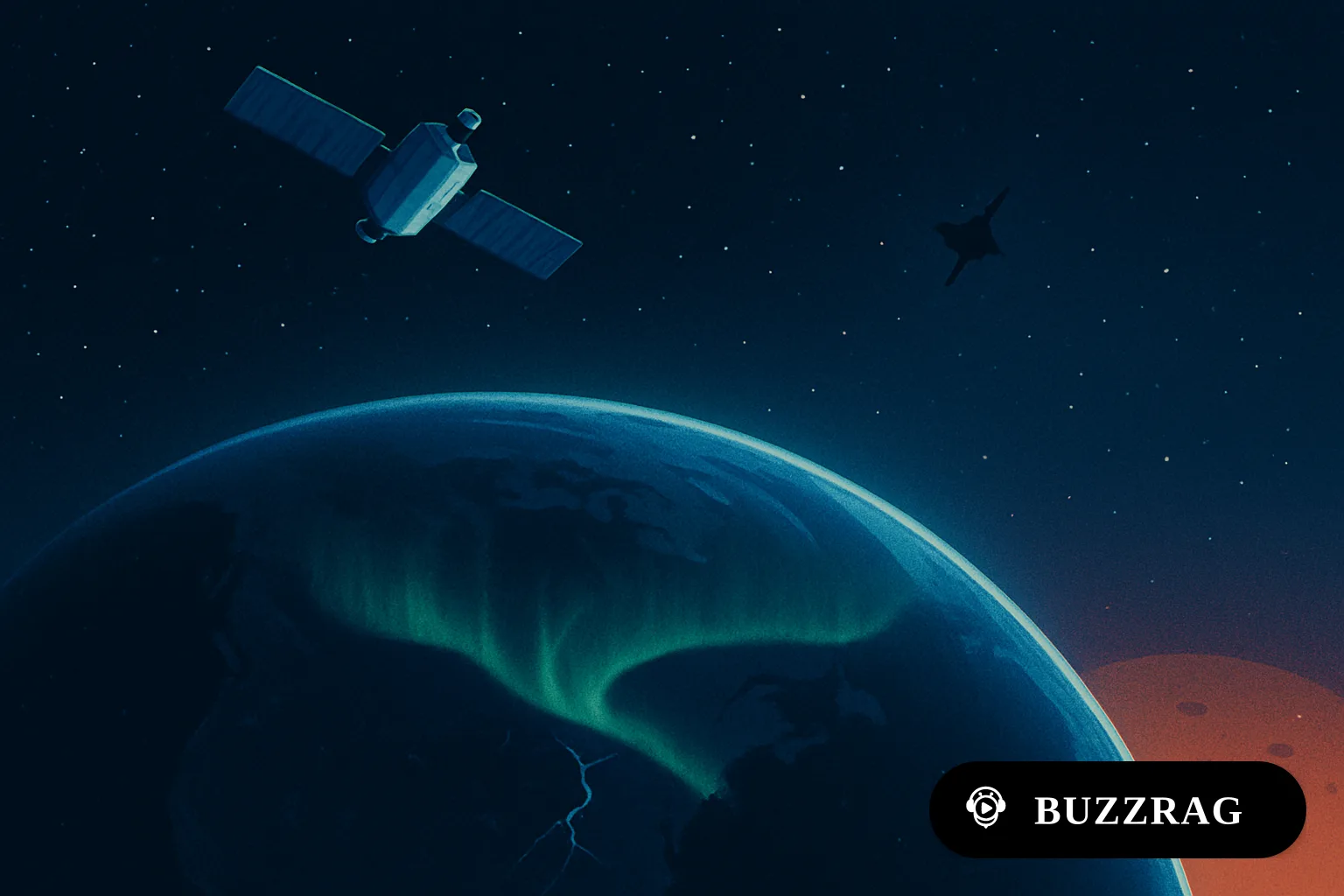
Lightning is familiar from the ground, but from orbit its flashes become part of a vast view of Earth’s weather systems. An account drawing on astronauts’ perspectives highlights how striking storms can appear from the International Space Station, where the planet’s curved horizon and broad cloud fields give familiar flashes a different scale.
The view is more than a dramatic spectacle: observations from orbit help researchers study electrical activity in storms and the atmosphere above them. Lightning can be difficult to capture from any one vantage point, while an orbital platform offers repeated passes over different regions. The item’s title likens the flashes to fireworks moving between clouds, a vivid way to describe a phenomenon that links local storms to the planet-wide systems visible from space. The appeal is both visual and scientific: a reminder that an everyday weather event can look entirely different when seen from hundreds of kilometres above Earth.
Iceboy Violet’s Invitation to Glitch Beneath the Surface
The Quietus has put “How to Glitch Under The Map,” by Iceboy Violet, among today’s most-read culture stories. The title suggests an interest in slipping past familiar boundaries, but the available listing offers no description of the piece’s musical details or its critical verdict. What is clear is that the work is being discussed in a context where glitch, digital texture and the idea of hidden layers have become familiar ways to describe contemporary experimentation.
Rather than assume a particular sound or production approach, the headline itself offers a useful point of entry: the map is a guide to the visible world, and a glitch hints at something that interrupts its rules. That tension can shape how listeners approach music that resists straightforward categories. The story’s reach signals appetite for writing that treats music not only as something to hear, but as a way to explore altered perspective and the edges of a system.
A Celestial Contrast: Milky Way and Aurora
The Astronomy Picture of the Day for November 17 sets the Milky Way against an aurora, bringing two sky phenomena into one frame. The daily feature pairs an astronomical image with an explanation from a professional astronomer; its subject here is a meeting of distant galactic structure and light produced much closer to Earth.
The contrast gives the image its pull. The Milky Way’s star-filled band traces our place within a galaxy, while auroral light unfolds in Earth’s upper atmosphere, shaped by activity from the Sun and our planet’s magnetic environment. They occupy radically different scales, yet both become visible to the naked eye under dark skies. The juxtaposition also points to the conditions behind such images: location, timing and a clear view of the night sky can bring phenomena together that are usually considered separately. The picture’s title invites viewers to compare, not simply choose between, two kinds of cosmic spectacle.
Hiring Fast Without Losing a Company’s Culture
A Sifted interview with Legora’s revenue chief focuses on a familiar scaling challenge: how to hire quickly while preserving the habits and culture of a growing organisation. The headline also foregrounds a call for “extreme urgency,” framing speed as an operating principle rather than merely a matter of filling open roles.
Rapid hiring can help a company seize opportunities, but every new cohort changes how decisions are made and how teams communicate. Culture, in that setting, is not just a set of stated values; it is shaped by the people brought in, the expectations they encounter and the routines leaders reinforce. The tension is especially sharp when managers are asked to move quickly without allowing standards or coordination to slip. The interview’s themes offer a window into how a revenue leader thinks about growth and internal cohesion. The practical test is whether urgency can be sustained while new employees still understand what the organisation expects of them.
Could Stars and Planets Help Reveal Dark Matter?
Dark matter remains undetected directly, leaving researchers to look for indirect signs of its presence. The research described here considers whether slow-moving dark-matter particles might be captured by massive objects—including the Sun, Earth, Jupiter and white dwarfs—and build up inside them over time.
That possibility turns familiar celestial bodies into potential detection environments. If accumulated particles produce measurable effects, existing instruments might be able to look for traces that conventional detectors could miss because the signals are too faint. The idea is theoretical, not a report of a confirmed detection, and its value depends on whether the predicted effects can be distinguished from ordinary astrophysical processes. Comparing different bodies could help researchers identify where a signal would be strongest and what observations would be needed. With dark matter still an open question, exploring indirect evidence broadens the search beyond experiments designed to catch particles arriving at a detector.
The Year’s Standout Images, Stripped to Black and White
A selection of the world’s most striking black-and-white photographs of 2026 is drawing attention to images that rely on light, shadow, texture and composition rather than colour. The listing points to a collection spanning at least architectural photography, though the supplied excerpt does not identify the full range of subjects or the photographers represented.
Monochrome can make a photograph’s structure more immediate: a bright edge, a deep shadow or a repeated pattern can carry the viewer’s eye without competing hues. That restraint does not make the images simple; it places greater weight on timing and on the photographer’s choices about contrast and framing. A year-end selection also offers a snapshot of what visual storytellers have found compelling across different settings. The particular images will matter most, but the broader appeal is the chance to see how varied subjects can be reinterpreted through a shared visual language.
Hyperscale Data Centers’ Electricity Use Rivals a State’s
A Harvard study published in Nature Sustainability estimates that 400 hyperscale data centers connected in the United States used as much electricity in a year as Michigan. The reported comparison makes the scale of the facilities’ power demand tangible at a moment when computing infrastructure is expanding and its resource needs are attracting greater scrutiny.
The study also finds that most of the electricity in its accounting came from fossil fuels, and that data-center emissions are three times higher than an earlier level cited in the report. The available summary does not specify that baseline, so the precise comparison needs the full study for context. Still, the findings put the energy source alongside total consumption: efficiency gains alone may not resolve the climate impact if facilities continue to rely heavily on carbon-intensive power. As operators and policymakers plan for more computing capacity, the questions are how demand is measured, where the electricity comes from and whether new infrastructure can be matched with cleaner supply.
What Makes a Bargaining Chip So Costly?
The essay “The most expensive bargaining chip in history” arrives with a title built around a striking question: what price can be attached to leverage when it is used in a negotiation? The listing does not identify the specific historical episode or asset at its centre, so it would be premature to draw conclusions about the case the author examines.
The phrase nevertheless captures a recurring problem in diplomacy, business and politics. A bargaining chip can appear valuable because it changes what the other side is willing to accept, but exercising that leverage may carry costs of its own. The harder question is whether the concession gained outweighs what is surrendered, and whether a short-term advantage leaves lasting consequences. Readers will need the essay itself to assess its historical argument; the headline’s provocation is a reminder that negotiations are measured not only by what is won, but by the price paid to secure it.
When Software Requests Broad Access to Your Mac
A support article addresses what to do if an app asks for Full Disk Access or asks a user to override system and app protections. These are consequential requests: broad permissions can allow software to reach data or perform actions that ordinary app access would not permit, while system safeguards are intended to reduce exposure to untrusted software.
A permission prompt is not, by itself, proof that an app is malicious; some legitimate tools need elevated access to perform specific tasks. But users should understand why the request appears and whether the app and its source are trustworthy before granting it or changing a protection setting. The distinction between a necessary permission and an unnecessary override can be difficult to judge, which is why clear platform guidance matters. As more work and personal information lives on computers, cautious permission decisions are part of basic security hygiene, not just a concern for technical specialists.
The day’s stories point toward questions that will keep sharpening: how to observe the unseen, how to grow without losing coherence, and how to meet rising computing demand responsibly. Watch for new measurements and clearer evidence to turn those questions into decisions.