BuzzRAG Daily Digest — 2026-09-30

Curated by AI. Callum Pierce
Today’s stories move between remote frontiers and familiar systems under strain: scientists explore life in the deep Pacific as storms batter the ocean above, while AI unsettles hiring and public identity. Books, music and materials research offer other ways to reconsider how we understand the world.
A whimsical expedition to the threatened deep Pacific
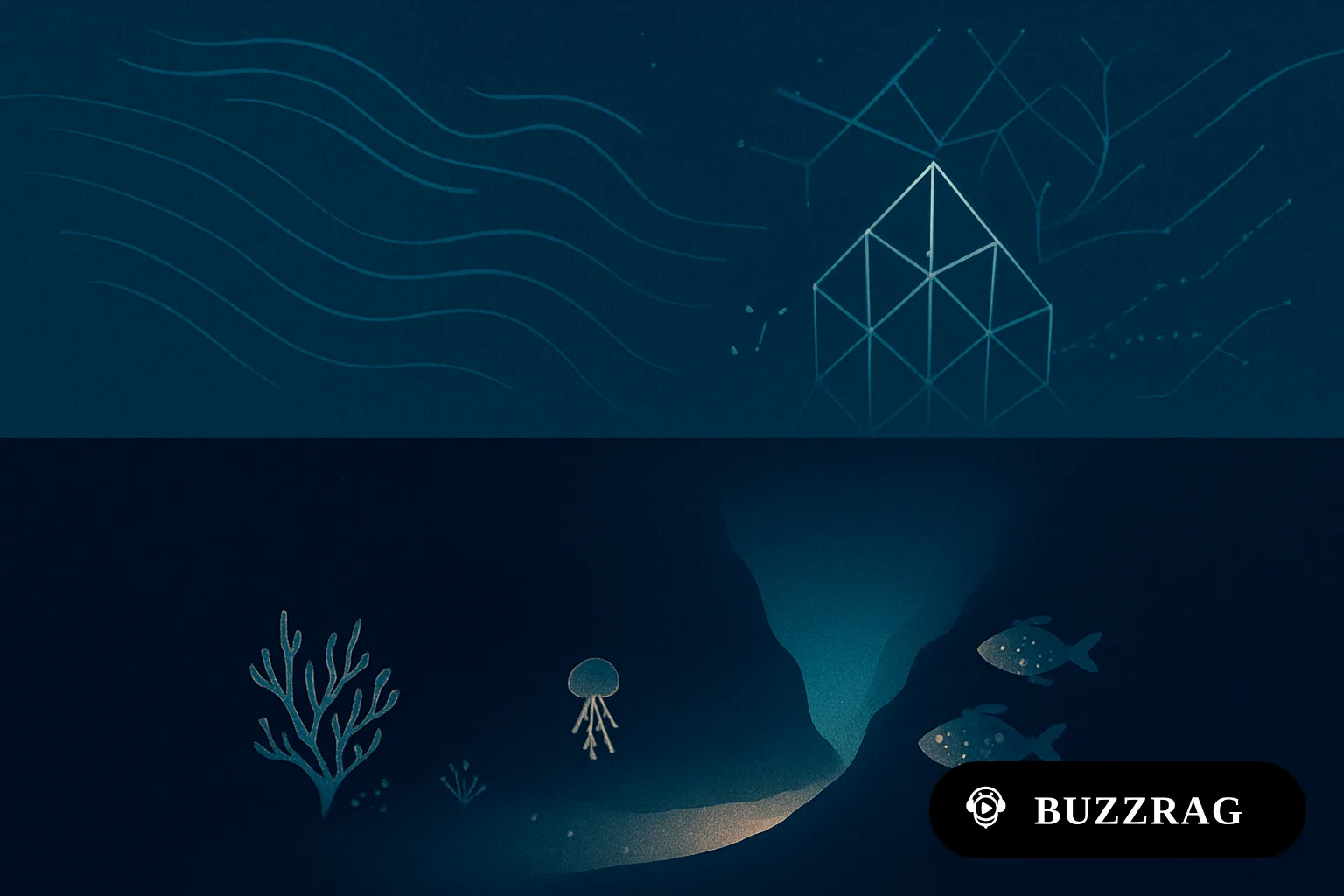
Eleanor Mortimer’s eco-documentary descends with marine biologists to the deep Pacific, where unfamiliar creatures thrive in cold, dark water thousands of metres below the surface. The review finds wonder in the expedition’s close attention to these animals, including their observation and classification in the lab, and in the striking forms that have earned one creature the nickname “Psychedelic Elvis Worm.”
That sense of discovery sits alongside a warning: the habitat is exposed to the prospect of seabed mining. The film’s central tension is between the scientific urge to learn what lives in a little-known environment and the risk that industrial activity could damage it before it is properly understood. Its playful approach makes the strange life on screen accessible without losing sight of how fragile this frontier may be. The broader question is whether curiosity and research can help shape protections before exploitation outpaces knowledge.
Carlo Rovelli’s wide-ranging guide to reality and human life
In “On the Equality of All Things,” physicist Carlo Rovelli ranges well beyond the boundaries of a conventional science book. The review describes a work that brings physics into conversation with philosophy and questions about how people understand themselves. Its unusually eclectic index—spanning Francis Bacon, bats, behaviourism, Henri Bergson and the big bang—signals the breadth of the project.
Rovelli’s approach is presented as near-mystical at times, with the confidence of a scientist who believes our understanding may be approaching a major shift. That ambition offers readers connections across disciplines, though it also asks them to follow an argument that is more expansive than a strictly technical account of physics. The book’s appeal lies in treating scientific knowledge not as a sealed-off body of facts but as part of a larger inquiry into existence. The review invites readers to consider how far such a synthesis can illuminate both the universe and everyday human experience.
Juicebox enters London with a rival in its sights
Sequoia-backed Juicebox is expanding into London, according to a report that frames the move as a challenge to Jack & Jill. The headline makes the company’s arrival and its competitive target the key development, but the supplied listing gives no further detail about its offering, launch plans or the specific market it intends to contest.
The expansion nevertheless points to a familiar test for a growing company: whether backing and momentum can translate into a foothold in a crowded new market. Establishing a London presence may bring Juicebox closer to customers and competitors, but a stated challenge is not the same as demonstrated traction. The important details to watch are what the company is bringing to the city, how it differentiates itself from established alternatives, and whether the rivalry produces a meaningful shift for users. For now, the report marks an entry and an ambition, rather than a verdict on the contest.
AI-written applications force employers to rethink hiring
Generative AI has made it easy for candidates to produce large volumes of polished résumés and cover letters, weakening the usefulness of application materials as a signal of individual fit. The story asks what can replace a process that employers may no longer be able to trust at face value, as automated tools help applicants tailor or multiply submissions.
The challenge is not simply detecting AI use. If employers respond with screening systems of their own, they risk creating an arms race in which candidates and recruiters both automate more of the exchange, while human judgment gets pushed further from the first decision. Businesses may need to put greater weight on evidence that is harder to mass-produce: structured assessments, work samples, conversations and clearly defined skills. Each alternative brings its own questions about fairness, accessibility and time. The next phase of hiring will depend on whether companies can assess people more directly without building a new set of opaque barriers.
Gilla Band’s “Pugnello” draws attention
A new Quietus listing spotlights “Pugnello” by Gilla Band, placing the track among the day’s music stories. The item supplied here contains an image link but no accompanying review text, so it offers little basis for describing the song’s sound, its place in the group’s catalogue or the writer’s assessment.
That lack of detail makes the safest takeaway a modest one: the release has attracted attention from a music publication, while the available listing leaves the critical case unexplained. For listeners, the title and artist provide a starting point for seeking out the track, but not a substitute for hearing it or reading the full coverage. In a fast-moving stream of music discovery, even a brief listing can direct attention; the more useful question is what the complete review says about the work itself and how it fits into the band’s evolving output.
The performance game taking over professional profiles
“LinkedIn Larpmaxxing” turns a pointed phrase toward the performance of professional identity online. The linked essay’s title suggests a look at people adopting exaggerated or carefully staged workplace personas on a platform built around careers, credentials and networking. The available listing provides no summary of the author’s argument, so the precise examples and conclusions are not clear from the information supplied.
The subject speaks to a wider tension in professional social media: users are expected to present themselves as both authentic and relentlessly accomplished, even as the platform rewards attention-grabbing stories and polished personal brands. That pressure can blur the line between sharing useful experience and acting out an idealised version of work life. The discussion is worth following not as a verdict on any one user, but as a question about the incentives that shape online career culture. What counts as genuine professional self-presentation when visibility itself is part of the job?
An active Pacific storm season keeps threats in focus
Hurricanes Polo and Nolo have sent destructive effects ashore as activity continues across the northeastern and central Pacific. The report underscores that the season remains active, with storms affecting communities as well as drawing attention to changing conditions across a wide stretch of ocean. The brief supplied account does not specify locations or provide details of damage.
Storm impacts depend on more than a system’s position at sea: forecast tracks, rainfall, coastal exposure and the readiness of local services all shape the risks people face. In an active season, developments can move quickly, making reliable updates and preparedness important for communities in the path of severe weather. The naming of two systems in the report is a reminder that Pacific hazards can arise across separate regions and require close monitoring. The coming days will bring further focus to storm movement and local impacts, as forecasters and residents assess what conditions may mean onshore.
Crystal spacing offers a clue to magnetic states in complex alloys
Researchers studying complex intermetallic alloys report that crystal spacing can predict magnetic ground states more effectively than electron count. The finding addresses a longstanding materials-chemistry challenge: identifying a useful parameter that can organise magnetic behaviour across compounds whose properties vary with composition. Electron-per-atom ratio has often served as a guide, but the research points to the arrangement of atoms in the crystal lattice as a stronger predictor in the systems examined.
A reliable structural clue could help researchers compare materials and narrow the search for compounds with particular magnetic properties. It does not make the chemistry simple: complex alloys can respond to several interacting factors, and a relationship observed in one set of materials needs careful testing before it becomes a general rule. Still, shifting attention from electron count to crystal geometry offers a potentially practical way to think about how structure shapes behaviour. Follow-up work will determine how broadly the result applies and whether it can guide the design of new magnetic materials.
The stories leave a shared question hanging: how do we make sound decisions when the systems around us—oceans, workplaces and scientific models—are changing faster than our habits? New evidence and closer observation may help answer it, but the choices made next will matter just as much.