BuzzRAG Daily Digest — 2026-09-29

Curated by AI. Callum Pierce
A striking atmospheric event and fresh looks at the night sky share the agenda with questions about AI's costs, capabilities and risks. Music criticism adds both an anniversary retrospective and a snapshot of current French releases.
A fleeting cap cloud crowns a Montana wildfire plume
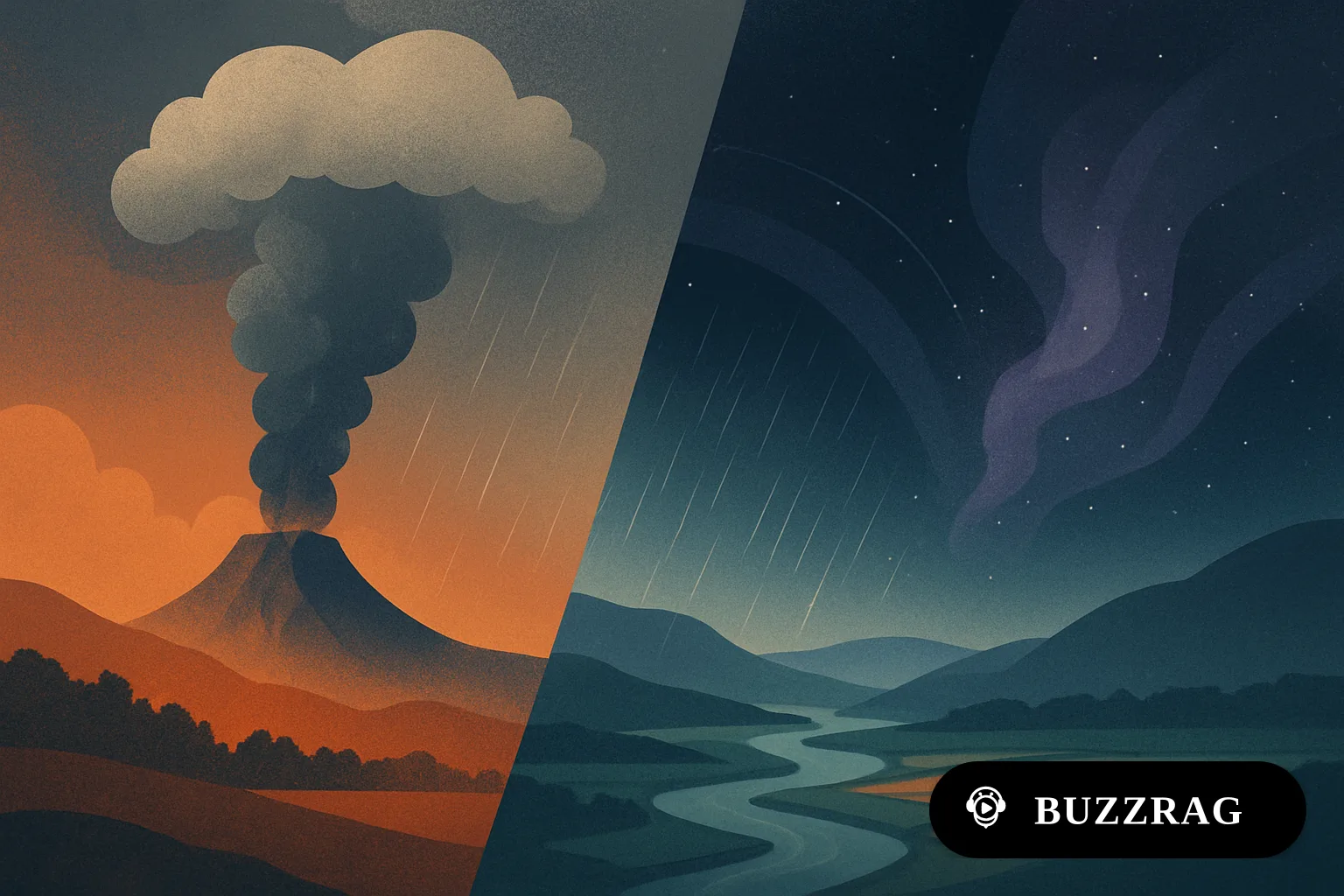
Scientists have recorded a rare pileus cloud forming above a smoke-laden cloud rising from a Montana wildfire. The smooth, cap-like feature is ephemeral: it can appear when rapidly rising air pushes into a layer of moisture, briefly lifting and cooling it enough for a cloud to form. Here, the fire’s plume supplied the dramatic upward motion, creating a layered scene that is unusual to catch in observations.
The sight is more than a striking image. Wildfire plumes can loft smoke and other material high into the atmosphere, while the clouds that form around them offer clues to the heat and moisture moving through the column. A single observation cannot establish how often these events occur or what their wider atmospheric effects may be, but it gives researchers a valuable moment to study. The next questions are how frequently similar caps develop over fires, and what sustained monitoring can reveal about their structure and behavior.
Iggy Pop’s ‘Blah Blah Blah’ turns 40
Four decades after its release, Iggy Pop’s *Blah Blah Blah* is back in view through a retrospective marking the album’s 40th anniversary. The title’s provocation still suits an artist whose public image has long been tied to restless reinvention; revisiting a record at this distance invites listeners to consider not only its place in a career, but also how its reception changes with time.
Anniversary criticism can do more than trade on nostalgia. It can revisit the sounds and choices that once seemed immediate, then ask what stands out to listeners encountering the work in a different musical landscape. The supplied listing does not detail the review’s particular arguments, so the central draw is the return to the album itself and the chance to reassess its legacy. The anniversary offers a useful prompt: which parts of a record remain vivid, and which are reshaped by the decades around it?
A September listening guide to French music
The monthly *Rockfort!* column turns its attention to French music released or in circulation this September, with David McKenna reviewing the selection. A roundup like this gives readers a compact route into a scene that can be difficult to follow from outside its usual language and press networks. Its value lies in gathering several listening points under one editorial lens rather than treating each release as an isolated discovery.
The listing does not identify the artists or describe the records, so it would be premature to claim a particular sound or trend defines this month’s selection. Still, regular reviews can help map how varied a national music landscape is, and can point readers toward work they might otherwise miss. The most revealing question is whether the chosen releases share any concerns or approaches, or whether the month’s story is precisely its range. For listeners, the column is an invitation to explore beyond familiar names and genres.
Anthropic filing puts AI growth beside staggering losses
Anthropic’s prospectus reportedly presents a sharp contrast: rapid growth alongside losses measured in tens of billions of dollars a year, and a warning that its AI systems could pose an existential threat to humanity. The combination puts two difficult questions in the same investor-facing document: how a company can sustain the costs of building advanced AI, and how seriously it treats the risks its technology may create.
The figures and warnings deserve careful reading in their full context. A prospectus is meant to explain a company’s business and risks, but headlines can flatten complex disclosures into a single alarming number or phrase. The company’s financial trajectory will matter to investors and to the wider debate over the capital required to compete in AI. Its safety language also invites scrutiny: what safeguards, evaluations and governance commitments sit behind the warning? Independent assessment of both the financial claims and the risk controls will be essential as the company grows.
Oren Ambarchi’s ‘Cooked’ under review
Oren Ambarchi’s *Cooked* is the subject of a new review, bringing the experimental musician’s latest work to the attention of readers who follow adventurous releases. The listing offers no description of the album’s sound or the critic’s verdict, but the review itself signals a chance to engage with the record beyond its title and cover: what kind of listening does it demand, and what ideas does it leave with an audience?
For music that sits outside conventional pop formats, criticism can provide useful bearings without reducing an album to a simple recommendation. A close reading may clarify how its choices fit within an artist’s broader practice, while leaving room for listeners to form their own response. The key details to look for are the reviewer’s account of the work’s structure, textures and pacing, none of which are specified in the available listing. For now, the item marks a fresh point of entry into Ambarchi’s current catalogue.
The Shrimp Nebula takes the astronomy spotlight
The September 29 Astronomy Picture of the Day features Sh2-188, commonly known as the Shrimp Nebula. The daily feature pairs an astronomical image with an explanation from a professional astronomer, turning a single object into an accessible starting point for learning about the cosmos. Its distinctive nickname offers an easy hook, but the deeper interest is in what careful observation can reveal about the structure and evolution of objects far beyond our solar system.
A nebula is a broad term for a cloud of gas and dust in space, and objects in this category can take many forms and have different origins. The supplied listing does not include the image explanation, so details of this particular nebula’s formation and features should be checked against the full astronomy entry. Even without those particulars, the daily format connects a visual encounter to scientific context—and reminds readers how much interpretation lies behind an evocative image. The accompanying explanation is the next stop for anyone wanting to understand what makes Sh2-188 distinctive.
An unpublished sunspot sketch resurfaces from 1870
A newly announced research paper reports the discovery of a sunspot drawing attributed to astronomer Richard Christopher Carrington and dated December 23, 1870. Carrington is known for extensive sunspot observations from 1853 to 1861, making a later, unpublished sketch a potentially intriguing addition to the documentary record of his work. The researchers say they found it by consulting original manuscripts, rather than relying only on the material that had already been published.
The drawing’s date and provenance are central to the claim: researchers must establish that the manuscript is authentic and correctly attributed before it can reshape the historical account. If the identification holds, the sketch could extend the known record of Carrington’s observations and offer historians another primary source to examine. It may also provide a view of how nineteenth-century observers recorded solar activity before modern imaging. The paper’s methods and the original document will be important for understanding how the dating was reached and what, if anything, the drawing adds to the science.
Could AI agents run entirely on your phone?
A conversation with Div Garg, chief executive of AGI Inc., explores the idea of running AI agents directly on mobile devices. The discussion covers adapting models to the chips inside phones and building safeguards for agents that can interact with apps on a user’s behalf. It points toward a shift in how people may encounter AI: not only through remote services, but through software operating locally on a device they already carry.
Local processing could change response times, connectivity requirements and how personal data is handled, though the practical trade-offs depend on the models and tasks involved. Autonomous app interactions raise a different challenge: an agent needs clear limits, reliable permission checks and ways for people to understand or interrupt its actions. The interview’s focus on safety is therefore as important as its engineering ambitions. The prospect of capable assistants on phones will hinge on whether they can perform useful tasks without making consequential decisions opaque or difficult to reverse.
The day’s stories leave two especially open questions: how researchers will interpret rare observations, and how AI developers will balance ambition with accountability. Watch for evidence that turns striking claims—whether in the sky, the archive or a company filing—into durable conclusions.