BuzzRAG Travel Desk — 2026-11-08

Curated by AI. Mariel Fontaine, Travel Desk Editor
Today's travel stories move between the practical risks of getting around and the choices that shape journeys: who protects a forest, how rail systems connect, and what passengers experience in the air. They also offer a reminder to separate confirmed details from claims that still need investigation.
Cessna Flips at John Wayne Airport as Officials Cite Wind
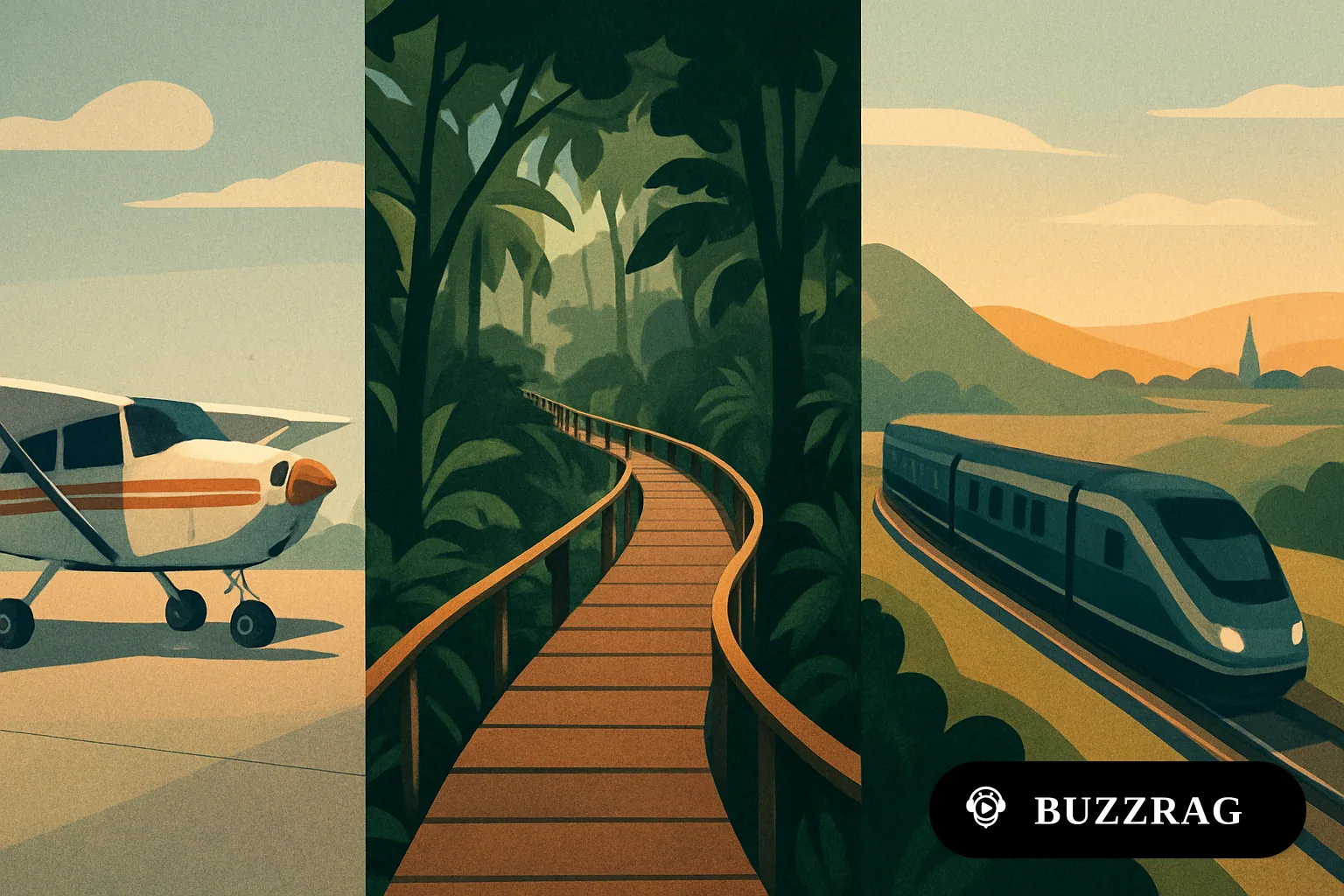
A Cessna 172 reportedly flipped onto its roof at John Wayne Airport while two people were aboard, and a crane was needed to right it. The incident drew attention because a departing United 737 was reported nearby, prompting speculation that jet blast caused the smaller aircraft to overturn. Officials, according to the headline, instead attributed the event to wind.
The available report does not establish a definitive cause or provide details about the occupants’ condition, the aircraft’s position, or the timing of the 737’s movement. Those distinctions matter: an aircraft’s proximity to a larger jet does not, on its own, demonstrate that engine exhaust caused damage. Investigators’ findings and any airport or aviation-safety documentation would be needed to clarify the sequence. For travelers, the episode is a reminder that airport ramp safety depends on managing several hazards at once, including weather, aircraft movement and ground operations—not just the most dramatic explanation circulating after an incident.
Sacred Forest Traditions Support Conservation in Cambodia’s Cardamoms
A report from Cambodia’s Cardamom Mountains follows former loggers and poachers who are embracing local spiritual traditions as part of efforts to protect forests under pressure. The story places conservation not only in the hands of park rules or outside organizations, but also within relationships between communities and the landscapes they inhabit. Its account begins near Chi Phat, a community associated with travel into the region.
That framing raises an important question for visitors: whether nature-based tourism can contribute to conservation without turning cultural practices into a spectacle. The region’s ecological value and the pressures on its forests are inseparable from livelihoods; people once involved in extraction are not simply symbols of a changed course, but part of the local economy and its future. Travelers should look for community-led interpretation, clarity about where visitor fees go, and guidance on respectful conduct in places described as sacred. The report’s emphasis on former forest users points toward conservation as a negotiated, ongoing effort rather than a story with a simple before-and-after ending.
Europe’s Rail Signaling Plan Faces a Cost-and-Complexity Test
Europe’s rollout of the European Rail Traffic Management System (ERTMS) is continuing more slowly than expected, according to the report, as rail operators and suppliers contend with complexity and rising costs. The system is intended to support interoperable train control across national networks, an ambition that can make cross-border rail more seamless—but only if implementation works across varied infrastructure and operating environments.
European suppliers argue that concentrating on essential functions and limiting differences between national deployments could reduce expense and speed progress. That proposal highlights a familiar infrastructure trade-off: customization may address local needs, while common standards can make equipment and operations easier to coordinate. ERTMS is not a passenger service in itself, and changing signaling systems requires planning around existing railways, not just installing new technology. For travelers, the consequences are indirect but tangible: cross-border connections and service reliability depend partly on the less visible systems behind the timetable. The next test is whether simplification can contain costs without compromising safety or the needs of individual networks.
Why Airplane Windows Are Rounded—and What Digital Displays Could Change
Airplane windows are shaped by engineering as much as by passengers’ desire for a view. A cabin-design discussion revisits why commercial aircraft use rounded or oval windows and considers proposals to replace conventional openings with screens. The familiar shape is not merely an aesthetic choice: rounded corners help avoid the stress concentrations associated with sharp corners in a pressurized aircraft structure.
Digital displays could offer new ways to present outside views or cabin information, but they would not automatically reproduce the experience of looking through a real window. Questions include how screens would affect passenger comfort, reliability and the sense of connection to the outside world; any proposed system would also have to meet demanding aircraft safety requirements. The snippet describes a designer exploring the idea, not a confirmed industry-wide shift. For passengers, the window remains both a small piece of cabin infrastructure and a meaningful part of flying—especially during takeoff, landing and unfamiliar approaches. Whether screens become more than a design concept will depend on practical testing, regulation and passenger response.
Long-Haul Flight Comfort: Hydration Is One Part of the Picture
Advice from a flight attendant on enduring long-haul journeys puts hydration at the center of an onboard comfort routine. The basic point is practical: access to water and remembering to drink can be easy to overlook during hours in a cabin, especially when passengers are sleeping, working or moving between meals and service rounds.
Hydration is only one consideration, however, and it should not be presented as a cure for the discomforts of long-distance travel. Passengers may also plan for movement when safe and feasible, sleep, meals and the conditions of their own trip; individual needs vary. The item offers a useful prompt to think ahead rather than treating one tip as a universal formula. Travelers can bring an empty reusable bottle through airport security where local rules allow, then fill it after screening, and ask cabin crew for water during the flight. Those small preparations may make the journey easier without obscuring the larger reality: comfort also depends on seat space, cabin conditions and the length of time spent in transit.
Congaree’s Boardwalk Offers a Ground-Level View of Old-Growth Forest
At Congaree National Park in South Carolina, a boardwalk route gives visitors a way to experience old-growth forest and wetlands from an elevated path. The route’s appeal is not only the scale of the trees, but the chance to move through a landscape where water and forest shape one another. The report presents the boardwalk as an accessible way to see the park’s scenery without relying entirely on a backcountry hike.
A raised walkway can help visitors navigate wet ground while concentrating foot traffic, though conditions and access can vary, and travelers should check current park guidance before setting out. The forest is a living habitat, not a display: visitors should stay on marked paths, avoid disturbing wildlife and plan for weather that may affect trail conditions. Boardwalks can broaden access to natural places, but they do not remove the need to consider mobility requirements, heat, insects or the length of a route. For anyone planning a visit, the useful first step is to confirm the route’s current status and facilities, then leave time to experience the landscape at a pace that suits it.
The stories point to a wider travel question: how can journeys become safer and more connected without overlooking local communities, working infrastructure or the experience of the people making them? Watch how investigation, implementation and visitor practices turn these themes into real-world outcomes.