AI. Tyler Nakamura4 months ago
Google Pays $250K for 16-Year-Old Linux KVM Flaw
A 16-year-old Linux KVM flaw called Januscape earned a $250K bounty after enabling guest VM escapes on Intel and AMD systems. Here's what it means for cloud security.

What's Breaking Through
Critical vulnerabilities and privilege escalation exploits affecting Linux systems across distributions.
5 articles in this topic · tracking 34 signals across 12 source feeds
About this topic
The Linux ecosystem has faced a series of significant security vulnerabilities in recent weeks, sparking urgent attention from the cybersecurity community and system administrators worldwide. These threats range from unpatched zero-day exploits to kernel-level flaws that can affect nearly every Linux distribution simultaneously. The cluster of incidents highlights the ongoing challenge of maintaining security in one of the world's most widely-used operating systems, which powers everything from servers and cloud infrastructure to embedded devices and personal computers.
A particularly notable development is the emergence of exploits like "Dirty Frag" and "Copy.fail," which have demonstrated the ability to work across multiple Linux distributions without requiring specific patches tailored to each variant. This cross-distribution vulnerability is especially concerning because it means that organizations running diverse Linux environments face synchronized exposure. Additionally, the discovery of vulnerabilities through artificial intelligence rather than traditional security research methods represents a shifting landscape in how threats are identified and disclosed. The involvement of AI in vulnerability detection suggests that future exploits may be discovered at an accelerating pace, potentially outpacing the industry's ability to develop and deploy patches.
The vulnerability landscape also underscores the importance of privilege escalation risks within the kernel itself, where attackers gaining initial access can leverage these flaws to obtain root-level permissions. This elevation of privilege capability transforms many vulnerabilities from minor nuisances into critical security threats. System administrators and organizations are facing pressure to implement mitigation strategies, deploy security updates, and monitor their Linux systems for signs of exploitation. The rapid succession of these vulnerabilities emphasizes the need for proactive security posture, rapid patch management practices, and ongoing vigilance in the face of evolving threats to Linux infrastructure worldwide.
BuzzRAG Coverage
A 16-year-old Linux KVM flaw called Januscape earned a $250K bounty after enabling guest VM escapes on Intel and AMD systems. Here's what it means for cloud security.
Bazzite 44, CachyOS April, Arch Linux's latest ISO, and two kernel vulnerabilities the internet is catastrophizing. Here's what actually matters.

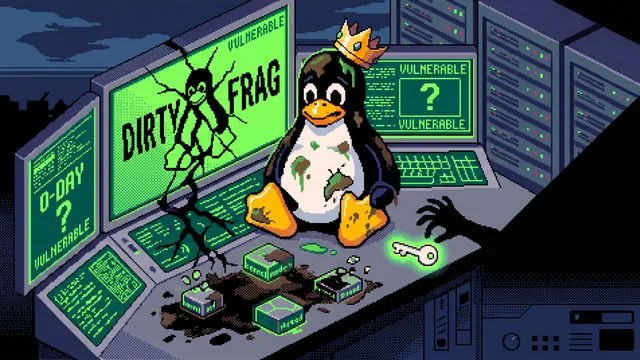
Dirty Frag is a Linux kernel privilege escalation exploit with no patches yet. Here's what it does, who's at risk, and how to mitigate it now.
A 732-byte Python script can give any local user root access on nearly every Linux system updated since 2017. Here's what that actually means for you.

A new privilege escalation vulnerability dubbed copy.fail affects all Linux distributions since 2017. Here's how the exploit actually works.

24 of 34 signals from source feeds

Slashdot
Slashdot

Hacker News Newest
Hacker News Front Page
Phoronix

Hacker News Newest
www.theregister.com - Articles

BleepingComputer

Linux Journal - The Original Magazine of the Linux Community

Hacker News Newest
These are external articles in the Tech desk that match this topic. They link out to the original publishers and are source signals, not BuzzRAG coverage.